Maximize fleet efficiency with wheel loader attachment versatility – Explore the benefits!
Heavy equipment operators have been primarily using wheel loaders as workhorses for loading, hauling, and unloading of loose materials. But the current trend of asset optimization along with the requirements to minimize operating costs is partnering the traditional views and operations. Today, it is common to find that relying on a machine to perform just one task can lead to serious operational bottlenecks and higher capital costs. Hence, introducing the wheel loader attachment versatility which brings efficiency in projects.
The things that make an earth moving machine powerful are not the engine power or the tipping load alone but the ability to carry out a variety of tasks. Using attachments for your equipment is a way to stay productive and efficient all through the seasons.
Why Wheel Loader Attachment Versatility Matters for Modern Wheel Loader Fleets
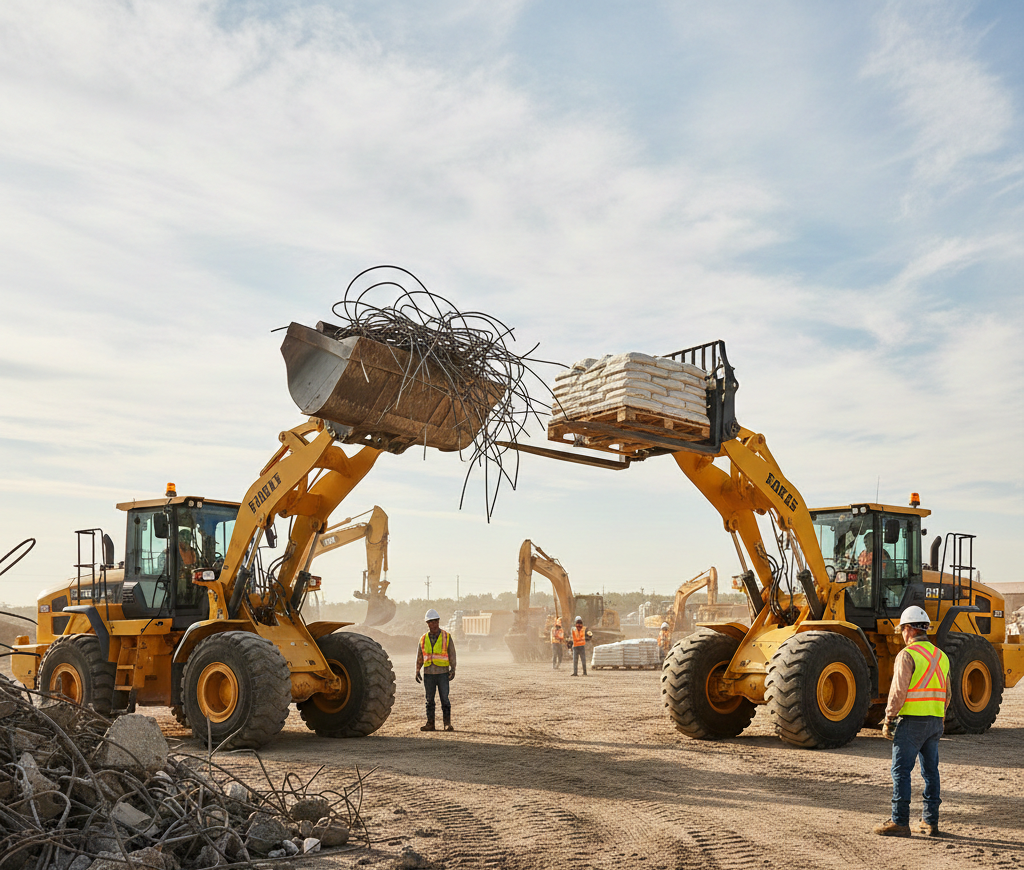
In this capacity, a regular wheel loader can be turned into a multi-purpose machine capable of handling material, cleaning the site, preparing structures, etc. Infrastructure development teams through site managers who leverage the value of wheel loader attachment versatility can shorten the project time drastically while maintaining profits.
Maximizing Machine Uptime and Lowering Total Cost of Ownership
Efficient fleet management is a combination of maximization of machine uptime and minimization of the total cost of ownership. When you buy an isolated, single-purpose machine, there is a great possibility that it will spend more time in the equipment yard waiting for specific project phases thus your capital stays locked in one place.
Developing a highly adaptable tool carrier system gives fleet managers the ability to carry out consistent rotation five schedules of their existing assets all day long.
Current wheel loaders capable of changing from earth-moving to fine material handling will do away with the necessity for large fleets of multiple machines. This will not only reduce the initial capital acquisition costs but also limit the storage space and transport expenses.
- Minimizing Idle Asset Risks: This strategy frees you from the financial constraints incurred when you own and operate niche machinery that remains operational only for certain phases of the construction project.
- Optimizing Upfront Machinery Costs: Fleet owners can concentrate their financial resources in a limited number of high-quality and highly reliable machines rather than buying many low-quality, single-purpose units.
- Cutting Transport Logistics Friction: No more moving and unloading multiple specialized machines to one job site, a great reduction in trailer needs, and in the use of fuel.
Improving Onsite Workflow and Eliminating Delays
In fact, deadlines are so tight in modern civil engineering that mechanical breakdowns of even a few hours and complicated swaps of equipment can result in huge penalties. Having advanced hydraulic system interfaces and quick-attach coupler designs allows the ground personnel to change the equipment in just a few minutes.
This kind of flexibility means that the operator, after finishing a bulk earth excavation, can immediately do a structural support task without waiting for the arrival of the secondary equipment.
Besides, the smart mechanical setups offer the option to exactly match hydraulic power curves to the tool requirements. It is these load-sensing hydraulic systems which monitor the resistance to distribute the correct flow of fluid to avoid overheating and system stress. Such a wheel loader booster ensures continuous run at optimal mechanical and thermal conditions with the result of faster cycle times.
| THE WHEEL LOADER ATTACHMENT VERSATILITY PRODUCTION LOOP |
| Excavation —-> Quick-Coupler Swap —-> Site Cleanup |
| Continuous Uptime |
| Fuel Savings <— Load-Sensing Hydraulics <– Material Arm |
- Rapid Hydraulic Quick-Coupling: Gives operators the power to complete tool changeouts in just a few minutes and directly from the safety of the reinforced cabin.
- Precision Load-Sensing Distribution: Cuts out unnecessary fuel consumption and mechanical fatigue by providing only the hydraulic pressure required by the tool.
- Enhanced Multi-Task Cycle Speeds: Greatly decreases intermediate project delays resulting in productive and steadily moving ground crews.
Cross-Industry Adaptability: From Earthmoving to Compaction
If you ask us, wheel loader attachment versatility is the perfect scenario when one machine is adept at working across the boundaries of various industrial sectors. For example, construction machines could use grading blades or high-capacity buckets for initial site clearing and aggregate distribution.
After the placement of base materials, the loader switches to compaction activities by using material handling arms for heavy component placement or by utilizing tool setups that go along with dedicated roller compactors.
While compaction should always be done by purpose-built machinery such as smooth drum rollers or padfoot rollers (your top choice for these kinds of machines is rollercompactor.net), a well-equipped wheel loader acts as a perfect logistic partner.
In addition, the loader can handle loose material layers, transport critical equipment spare parts over tough terrains, and clear away over-compacted debris, thereby ensuring continued smooth operation of the primary rolling equipment.
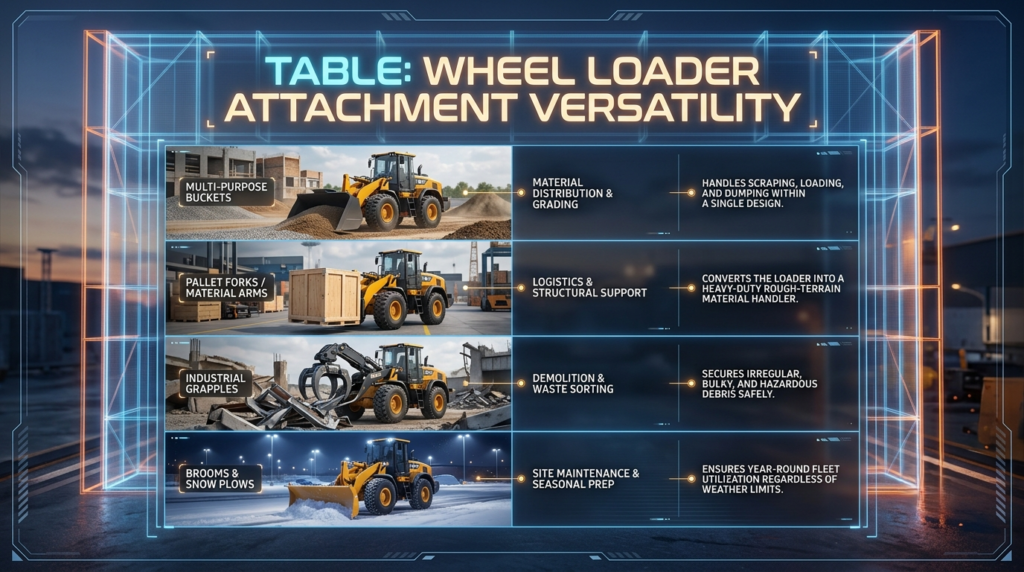
Table: Wheel Loader Attachment Versatility
| Attachment Category | Primary Field Application | Key Asset Benefit |
| Multi-Purpose Buckets | Material Distribution & Grading | Handles scraping, loading, and dumping within a single design. |
| Pallet Forks / Material Arms | Logistics & Structural Support | Converts the loader into a heavy-duty rough-terrain material handler. |
| Industrial Grapples | Demolition & Waste Sorting | Secures irregular, bulky, and hazardous debris safely. |
| Brooms & Snow Plows | Site Maintenance & Seasonal Prep | Ensures year-round fleet utilization regardless of weather limits. |
- Persistent Material Pre-Grading: Enables the loader to set up material lifts perfectly before soil compactors do density passes.
- Complete Year-Round Fleet Rotation: Makes the transition from warm-weather earthwork to cold-weather snow removal, thus preventing machine hibernation by seasons.
- Exceptional Site Logistics Flexibility: Offers immediate support to underground engineering, utility placements, and site remediation without altering the core machine.
Promoting Jobsite Safety and Operator Comfort with Wheel Loader Attachment Versatility
Among the construction project values at the top of the list is safety. Heavy machinery operations come with the risk that different parties try to control systematically in various ways.
One of the ways to control the risk is to use tools with specific weight ratings to avoid the dangerous term of the machine’s tipping and overextension of components. Also, an operator with the right tool for the job (like industrial grapple for structural debris, heavy component pallet fork) will considerably reduce the chances of material slippage.
Besides that, the latest wheel loaders are integrated with electronic control recognition of attachments wherein upon attachment connection internal safety parameters and load charts get adjusted automatically among wheel loader attachment versatility.
This technical relationship helps reduce operator exhaustion by simplifying complicated movements; which means that the ground crew or operators can carry out repetitive handling cycles accurately with minimum fatigue.
- Fleet Alert: Usage of disallowed or poorly matched attachment configurations can lead to severe damage to the loader’s forward linkage arm, burst hydraulic seals, and catastrophic stability risks for the operator. Always cross-check lifting capacities and coupler compatibility before proceeding with the operation.
- Smart Load-Chart Calibration: It will modify onboard stability sensors to fit the weight distribution of the active attachment effortlessly.
- Reduced Manual Labor Risks: Changes hazardous rigging procedures on the ground to safe cab-controlled mechanical engagement systems.
- Improved Operator Forward Visibility: Frame designs grant unobstructed views of the engagement tips, thus decreasing the likelihood of collisions with site obstacles.
Improving Long Term ROI and Resale Value of Your Machines
Construction businesses financial health depends a lot on the residual value of their key equipment fleets. A wheel loader used as a multi-purpose tool carrier during its whole operational life is usually sold at a higher price in the secondary market.
Buyers go after units that are equipped with auxiliary hydraulic lines and standardized quick-coupler brackets because they know the machine can fit in their operations without causing disruptions.
Moreover, grouping various tasks on a single, well-maintained machine reduces the number of engines, drivetrains, and cooling systems that your team has to service. Rather than handling the maintenance of oil changes, filter replacements, and track repairs of three machines, your technicians will be concentrating on one premier wheel loader and its auxiliary attachments.
- Imagine the service cost dropping drastically from fewer operating diesel engines and complex drivetrains to be actively maintained.
- After liquidation phases, you will be able to get better prices due to your machines being equipped with auxiliary hydraulics and quick-coupler systems.
- Performing different workloads will not only save specialized single-task components from being worn out but also can give a longer lifespan to the entire stage machine.
Frequently Asked Questions – Wheel Loader Attachment Versatility
What wheel loader attachments are often used in construction?
You will find general-purpose and multi-purpose buckets commonly used in the earthmoving processes, pallet forks to handle logistical materials efficiently, and industrial grapples to secure demolition debris. Apart from these, most of the time material handling arms, sweeping brooms, and high-capacity snow plows get employed in maintaining year-round machine productivity.
Is it possible for any wheel loader to use a quick-attach coupler system?
A good number of modern wheel loaders have quick-couplers either factory-installed or can be retrofitted with aftermarket brackets. However, the compatibility comes down to the size class of the machine, linkage design (like Z-bar or parallel lift), and the capacity of the auxiliary hydraulic system to support coupler locking mechanisms.
What is the role of auxiliary hydraulics in wheel loader attachment versatility?
Auxiliary hydraulics are responsible for delivering the pressurized fluid flow needed to power attachments like rotating brooms, high-performance grapples, and hydraulic cold planers. Without these secondary hydraulic lines (third or fourth function valves), a wheel loader is limited strictly to mechanical tools such as buckets and manual forks.
How can I tell a standard wheel loader from a tool carrier?
Generally, a standard wheel loader will have a Z-bar linkage for maximum dig force. However, this results in poor visibility when lifting in a parallel fashion. A tool carrier setup, on the other hand, uses a parallel lift linkage and is equipped with a quick-coupler, giving better visibility and ease during handling of a wider range of attachments.
What factors to consider when selecting an attachment size for wheel loader fleet?
When determining the right size, you must compare the operating capacity (tipping load limits) of the loader and the hydraulic flow rate (GPM/PSI) with the attachment’s requirements. An oversized attachment can lead to overloading of the machine’s hydraulic pumps; it may lead to structural failure of the lift arms and seriously impact vehicle stability.
Is it possible that a wheel loader replaces a roller compactor at a project site?
No! There is no way that a wheel loader can perform the job of a roller compactor. A roller compactor generates the centrifugal force required, has the heavy steel drums needed and level of vibratory frequency/ to achieve soil density structurally. On the other hand, a versatile loader as a perfect support asset through the grading of loose materials and moving supplies can make the roller compactor work at its best efficiency.
What are the effects of using multiple attachments on the maintenance schedules of wheel loaders?
Using multiple attachments reduces the schedule of servicing separate vehicles; however, it significantly increases the attention required for the maintenance of auxiliary hydraulic connections. After every switch of attachment, operators have to clean the quick-disconnect couplers to avoid dirt entry into the hydraulic fluid reservoir. Similarly, technicians must check the pins, bushings, and wear plates more frequently for signs of uneven stress.