Are Excavator-Mounted Compactors Better Than Standalone Machines?
Anybody who has spent time on a job site knows the absolute headache of a settling foundation or a collapsed trench. If you don’t pack that dirt down right the first time, you are essentially guaranteeing structural failures, underground water pooling, and some very angry phone calls from clients down the road. Thus, let’s learn the multitudinous ways of using Excavator-Mounted Compactors.
Proper compaction squeezes out the air pockets and gives the soil the load-bearing muscle it needs to hold up roads, pipes, and buildings. But when you are out there staring at a massive pile of backfill, a major debate always pops up among contractors: Are Excavator-Mounted Compactors vs Standalone Machines the way to go?
A lot of old-school guys swear by walk-behind units because they grew up using them, while the newer crews want everything hooked up to a hydraulic boom. Choosing the right piece of iron isn’t just about what you like; it’s about getting the job done fast without burning out your crew or blowing your budget. Here at rollercompactor.net, we look at the reality of site conditions every single day, and we know that making the right call means digging deep into what these machines can actually pull off when the pressure is on.
Understanding Excavator-Mounted Compactors
If you want to talk about raw, earth-moving muscle, you have to look at excavator-mounted compactors. These aren’t just heavy plates you drag around; they are heavy-duty hydraulic attachments that pin right onto the stick of an excavator or a backhoe. Instead of a guy sweating it out on the ground fighting a vibrating machine, the operator sits in a climate-controlled cab and lets the heavy equipment do the heavy lifting.
The attachment uses a built-in hydraulic motor to create high-frequency vibrations. When you combine that intense vibration with the thousands of pounds of downward pressure from the excavator’s boom, you get a level of compaction that a standalone machine simply can’t touch.
You see these units shining on sites with deep utility trenches, angled embankments, and heavy clay soils where pushing a hand-operated machine would be a total nightmare. Honestly, strapping one of these onto your carrier machine completely changes the way you look at a job site because it turns your digging equipment into an all-in-one prep tool.
- Keeping the Crew Safe: You never have to send a worker down into a deep, unsupported trench just to run a compactor. The operator stays up top in the cab, completely removing the risk of trench cave-ins and severe injuries.
- Crazy Reach and Angles: Because it is attached to a hydraulic arm, you can pack down dirt on steep highway embankments, reach over retaining walls, and hit angles that would flip a walk-behind unit upside down.
- Getting More Out of Your Iron: If you already have an excavator on site digging the hole, you don’t have to wait for a separate compaction crew to show up. You just swap the bucket for the compactor attachment and keep the workflow moving without skipping a beat.
The Role of Standalone Compaction Machines
Even with all that hydraulic power available on the market, standalone compaction machines are definitely not going out of style anytime soon. We are talking about your classic walk-behind vibratory plate compactors, jumping jack trench rammers, and those small walk-behind rollers.
These machines run completely on their own power—usually a small gas engine or sometimes a battery pack—and they rely heavily on their own physical weight mixed with rapid vibration to shake the air out of the soil. They are the bread and butter for landscaping crews, hardscape installers, and guys doing driveway repairs.
You don’t need a CDL, a massive flatbed trailer, or a certified heavy equipment operator to get these things running. You basically pull the cord, hold on tight, and walk it across the sand or gravel. For shallow lifts and tight residential jobs where bringing in an excavator would tear up the customer’s lawn or crack their driveway, a standalone machine is exactly what the doctor ordered.
- Dirt Cheap to Get Started: Buying or renting a walk-behind plate compactor is a fraction of the cost of buying a hydraulic attachment, let alone the six-figure carrier machine you need to run it.
- Throw It in the Truck: These machines are built to be relatively light and completely mobile. Two guys can easily lift a small plate compactor into the back of a standard pickup truck and hit three different job sites before lunch.
- Doesn’t Tie Up Big Machinery: When you use a standalone unit for a quick walkway prep, your expensive excavators and skid steers are free to keep doing the heavy digging elsewhere on the site.
Key Differences: Excavator-Mounted vs Standalone
When you put Excavator-Mounted Compactors vs Standalone Machines head-to-head, the biggest differences boil down to brute force and agility. A hydraulic plate compactor attachment doesn’t just vibrate; it literally gets pushed into the dirt by the weight of a ten-ton or twenty-ton machine.
That means you can compact much thicker layers of soil (deeper lifts) in a single pass. A standalone machine, however, only has gravity on its side. It bounces up and down to settle the dirt, which works great for three to six inches of gravel, but it won’t do much for a three-foot trench backfill.
The other massive difference is the physical toll it takes on the human body. Running a walk-behind compactor all day will shake your arms to the bone and leave you exhausted, whereas running an attachment is basically like playing a video game with joysticks. But you can’t ignore the agility of a standalone unit; if you need to compact dirt right up against a fragile glass storefront or a freshly poured decorative curb, an excavator is just too bulky and risky to use.
- How They Hit the Dirt: Attachments force the plate down using heavy hydraulic boom pressure, while standalone units rely purely on their own vibrating static weight to settle the material.
- Wear and Tear on Your Guys: Hand-operated units expose workers to constant hand-arm vibration and physical exhaustion. Operating an attachment keeps the worker sitting comfortably in a seat, reducing fatigue and turnover.
- Where They Actually Work Best: Walk-behind rollers are strictly meant for flat, easy-to-walk ground. Boom-mounted compactors don’t care about the terrain; they can pack dirt sideways on a hill if you need them to.
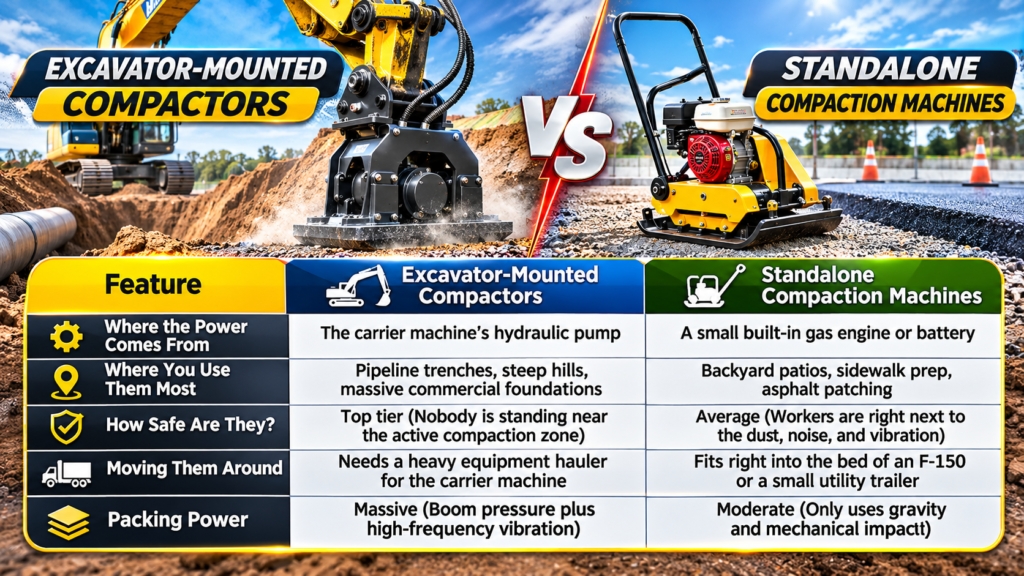
Table: Excavator-Mounted Compactors Vs Standalone Compaction Machines
| Feature | Excavator-Mounted Compactors | Standalone Compaction Machines |
| Where the Power Comes From | The carrier machine’s hydraulic pump | A small built-in gas engine or battery |
| Where You Use Them Most | Pipeline trenches, steep hills, massive commercial foundations | Backyard patios, sidewalk prep, asphalt patching |
| How Safe Are They? | Top tier (Nobody is standing near the active compaction zone) | Average (Workers are right next to the dust, noise, and vibration) |
| Moving Them Around | Needs a heavy equipment hauler for the carrier machine | Fits right into the bed of an F-150 or a small utility trailer |
| Packing Power | Massive (Boom pressure plus high-frequency vibration) | Moderate (Only uses gravity and mechanical impact) |
Cost Efficiency and Job Site Versatility
Let’s talk about the money, because at the end of the day, that is what keeps a construction business running. Figuring out which machine makes the most financial sense means looking past the price tag and looking at your daily payroll.
If you do a lot of pipeline work and already have a mini-excavator sitting on the dirt, buying a hydraulic attachment is a massive money-saver. Why pay a laborer hourly to slowly walk a trench rammer back and forth when your excavator operator can do the exact same job in a quarter of the time? Plus, every minute that a large piece of heavy equipment sits idle, you are bleeding money.
By swapping attachments from buckets to breakers to compactors, you keep that machine earning its keep all day long. But flip the scenario: if you run a small crew doing paver patios, spending thousands on a hydraulic attachment and renting an excavator just to compact some base gravel is a terrible business move. For smaller outfits, the standalone machine keeps overhead low and profit margins high. It really comes down to knowing your niche and optimizing the tools you bring to the fight.
- Cutting Down the Payroll: When one guy in a cab can handle the trenching, the pipe laying, the backfilling, and the final compaction, you don’t need a four-man crew standing around watching him.
- Fewer Engines to Fix: Standalone machines have carburetors, spark plugs, and filters that get clogged with construction dust constantly. A hydraulic attachment has very few moving parts, meaning way less maintenance hassle.
- One Truck Delivery: Sending one heavy machine to a site that can handle every phase of the dirt work saves you from coordinating a bunch of separate tool deliveries and pickups throughout the week.
Which Compactor is Right For Your Project?
So, who wins the battle? It entirely depends on the dirt you are standing on today. If you are staring down a massive commercial utility project, putting in deep sewer lines, or trying to stabilize a severely sloped embankment, the excavator-mounted compactor is the obvious winner.
It gives you the heavy downward force required to pass strict density tests and keeps your crew out of the danger zone. But if your schedule for the month is filled with residential driveways, tight backyard hardscaping, or quick asphalt pothole repairs, leave the heavy iron at the yard. A solid, reliable standalone machine will get the job done beautifully without destroying the client’s property or blowing up your fuel budget.
We always tell our readers to take a hard look at the kind of work they book the most. Buy the equipment that fits 80% of your daily jobs, and just rent for the weird outliers. If you need more advice on matching the exact tool to your dirt, check out the resources over at rollercompactor.net.
- Check the Dirt Type: Sticky, wet clay needs the heavy kneading action and pressure of an excavator attachment. Loose, dry gravel and sand settle just fine with a standalone vibratory plate.
- Look at Your Current Yard: If you own three excavators already, buy the attachment. If you only own pickup trucks and wheelbarrows, stick to the walk-behind units.
- Measure Your Workspace: Boom attachments need plenty of overhead clearance to swing around. If you are working under tree canopies or low power lines, you might be forced to use a low-profile standalone machine.
FAQs – Excavator-Mounted Compactors
What is the real difference between an excavator plate compactor and a standalone machine?
It is all about the power source. An excavator plate runs off a massive machine’s hydraulics and uses boom pressure to crush dirt. A standalone machine has its own little gas engine and just uses its own weight to bounce up and down on the soil.
Can I run a vibratory plate compactor on a mini excavator?
You absolutely can, as long as you match the specs. You have to check the hydraulic flow (gallons per minute) of your mini-ex and make sure it matches what the attachment needs so you don’t blow out your pumps.
Why do people say excavator attachments are better for trench backfill?
Because they keep people alive. Trenches can cave in without warning. Using an attachment lets the operator reach down into the hole from safely up top, rather than forcing a guy to stand at the bottom with a jumping jack.
What are the biggest perks of buying a hydraulic plate compactor attachment?
You get insane compaction force, you can safely pack dirt on steep hills, you need fewer guys on the payroll, and it keeps your expensive carrier machines busy and making money instead of sitting parked.
Do standalone walk-behind compactors still have a place on modern job sites?
100%. You can’t bring a 15-ton excavator into a nice suburban backyard just to lay a small brick walkway. Walk-behinds are perfect for tight, flat, finish-level work where you need a light touch.
How big of an excavator do I actually need for a hydraulic plate compactor?
They make them for almost everything now. You can find small attachments that fit 4-ton mini excavators, all the way up to massive units built for 30-ton monsters. Just match the pin size and the hydraulic flow.
Why is soil compaction such a big deal before pouring concrete?
If you pour concrete over loose dirt, the ground will eventually settle over time or wash out from rain. When the dirt drops, the concrete loses its support and snaps in half. Compaction prevents all that expensive cracking.
Conclusion – Excavator-Mounted Compactors
Figuring out the winner between Excavator-Mounted Compactors vs Standalone Machines isn’t about picking a favorite brand; it’s about picking the right tool for the mud you are standing in. Both of these setups are incredibly important to have in the modern dirt-work industry.
When you are fighting deep trenches, bad weather, and tight deadlines, the massive power and reach of an excavator attachment will save your life and your wallet. But when it comes to finesse, getting into tight backyards, and keeping equipment costs low, nothing beats firing up a standalone walk-behind unit.
Take a hard look at the dirt you move every week, the trucks you already own, and the size of your crew. If you do that, you will know exactly which route to take. And if you are still on the fence, head over to rollercompactor.net so we can help you spec out the perfect setup for your next big dig.