Choosing Compatible Roller Compactor Attachments for Maximum Efficiency
In the construction and ground preparation world, a project’s success or failure to the point of re-doing the work can be mainly dependent on how precisely the used equipment can be operated. A roller is a very powerful machine by itself already, but its capacity can be greatly raised by using roller compactor attachments strategically.
Purchasing suitable roller compactor attachments for maximum efficiency does not just imply increasing the number of tools at your disposal, it involves changing a single machine to a multi-functional tool that is able to cope with different soil types, asphalt surfaces, and even working in very limited spaces.
Choosing Compatible Roller Compactor Attachments
Contractors who realize how various attachments work with different materials can not only reduce the number of passes substantially but also save on the fuel and have a structurally sound finish that meets the highest industry standards.
With the current fast developments in the construction industry, it is highly unlikely that an entire project will be done consistently with just one type of roller, for instance. If you are carrying out a large highway project or even just a small ornamental walk, being able to change your machine according to the varying features of the terrain is very important.
Take a smooth drum roller for example, it might work great on asphalt, but without a padfoot shell kit, it is very unlikely that it will be able to compact dense clay soils effectively. The effectiveness of compaction depends on the surface uniformity as well as the time taken to reach it.
That is why selecting the proper attachment is a calculated decision that requires a deep understanding of the material properties, the desired compaction depth, and the mechanical compatibility of the attachment with your existing main machine.
Understanding Primary Roller Compactor Attachments
It is highly recommended that before you start the selection process, you first familiarize yourself with the most common attachments that can enhance productivity drastically. The concept of operators being able to convert a smooth drum to a padded surface within a few hours has significantly evolved the industry.
That kind of flexibility means that one investment is able to cover multiple stages of construction, from initial sub-base preparation to final surface sealing.
- Vibration Plate Attachments: These provide significantly increased compaction force and make it possible to reach work areas that are difficult or impossible for big drum rollers such as trenches, curbs, and sidewalk edges.
- Padfoot (Sheepsfoot) Shell Kits: Best for cohesive soils, these bolt-on shells convert smooth drums into “kneading” tools that physically tear down clay clusters for far greater, deeper compaction stability.
- Edge Cutter Attachments: This specialized tool is for use in asphalt work and makes it possible to achieve clean joints and prevent the minor surface cracks that can lead to premature road failure.
Evaluating Material Compatibility for Maximum Efficiency
A tool must be matched to the material to achieve the best compaction. Sand and gravel (granular materials) behave quite differently from silts and clays (cohesive materials) when subjected to pressure.
Efficiency is compromised when an operator employs a “one-size-fits-all” approach, resulting in either over-compaction—where aggregates are crushed—or under-compaction, which leaves air pockets and leads to settlement in the future.
- Granular Soils – These types of soils normally respond well to high-frequency vibrations; hence, smooth drum vibratory attachments are the default option for compacting these soil particles into a dense matrix.
- Cohesive Soils – Since clay, on the one hand, requires a kneading motion to get rid of air and moisture, a padfoot attachment is used to provide the highly concentrated pressure necessary for both of these components to be expelled from the soil.
- Mixed Materials – For sites that have varying soil compositions, the best compromise of force and frequency are provided by adjustable vibration settings on plate compactors or multi-purpose drum rollers.
Table: Roller Compactor Attachments
| Material Type | Recommended Attachment | Primary Benefit |
| Sand / Fine Gravel | Smooth Drum Vibratory | High-speed leveling and surface density |
| Heavy Clay / Silt | Padfoot Shell Kit | Deep kneading to remove air/moisture |
| Asphalt Edges | Edge Cutter | Precision joints and professional finish |
| Trench Backfill | Vibratory Plate | High maneuverability in confined spaces |
Mechanical Compatibility and Machine Integration
Selecting compatible roller compactor attachments for highest performance, mechanical compatibility is an equally critical factor as well as the particular job. A heavy attachment will put too much pressure on the base machine’s hydraulic system, and a very light one at the same time will not produce the required compaction force.
It is absolutely essential to measure the hydraulic flow requirements (LPM) and the pressure ratings (Bar) of both the machine and the attachment to assure that they are perfectly synchronized.
- Hydraulic Flow Matching – Confirm that your loader or excavator gives the correct Liters Per Minute (LPM) to run vibratory motors without overheating the system.
- Weight Distribution – The weight of the attachment ought to be in line with the machine’s lifting and operation capacity capabilities so that the balance is not compromised, particularly when you are working on slopes.
- Mounting Systems – The use of standardized quick-couplers or universal hitches for single machines is advantageous since they reduce downtime for attachment changes, thus allowing for a smooth transition between tasks.
Optimizing Site Performance and Depth
The amount of compaction depth, also often called “lift thickness,” is the measure of how much force your equipment needs. Although a standard roller can generally handle a 4-inch lift, supplementing it with an appropriate vibratory attachment will allow it to carry out compaction work on 8 or 12 inches, thereby doing twice the amount of work with a single pass. Efficiency is not just about moving fast; it’s about moving less to achieve more.
- Shallow Lifts (2–4 inches): Small vibratory plates or lightweight tandem rollers are sufficient for pathways and finishing layers.
- Medium Lifts (4–8 inches): 5–10 ton rollers equipped with smooth drums are very common for road sub-bases.
- Deep Lifts (8+ inches): Base stability from the bottom up demands either heavy-duty padfoot attachments or high-amplitude vibratory rollers.
Maintenance and Safety for Long-Term Efficiency
Maintenance is a critical component of efficiency which is often overlooked by most operators. The construction environments are extremely abrasive, and attachments such as drum shells and plate compactors are, in fact, at the very forefront of wear and tear.
A stringent maintenance program will not only keep breakdowns to a minimum but will also maintain the performing capacity of the machines at their peak levels over the entire period of the contract.
- Daily Inspections: Look for hydraulic leakage, loose bolting on shell kits, and the status of rubber isolation mounts which help in minimizing machine damage through vibrations.
- Cleaning Protocols: Uneven compaction is often caused by soil and asphalt build-up on drums and can be avoided by working with water spray bars, manual scrapers, or cutting-edge self-cleaning drum surfaces.
- Operator Training: Give training and guidance to the crew on the various settings for each type of attachment such as changing the vibration frequency to correspond to the moisture content of the soil.
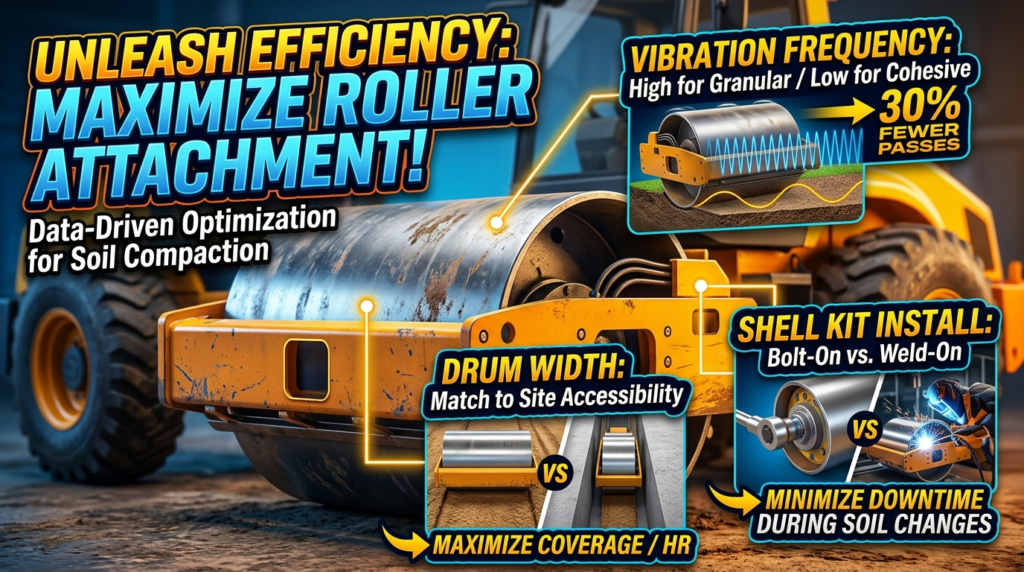
| Feature | Attachment Optimization | Impact on Efficiency |
| Vibration Frequency | High for granular, Low for cohesive | Reduces number of passes by 30% |
| Drum Width | Match to site accessibility | Maximizes coverage per hour |
| Shell Kit Install | Bolt-on vs. Weld-on | Minimizes downtime during soil changes |
The Role of Technology in Modern Compaction
In the construction industry, “smart” attachments, endowed with sensing capabilities, are already the present and the near future of the industry. Vibratory rollers with embedded sensors can now give continuous real-time information on soil compaction levels so that the operator is immediately made aware of achieving the target compaction level.
This will result in reduced “over-rolling” time which not only reduces fuel consumption but also protects the equipment from untimely wear and tear.
- Density Sensors – Operators are given real-time feedback so that they can stop exactly at the point when the soil is deemed ready, thus eliminating guesswork.
- Automated Speed Control – Several high-end attachments can be synchronized to the machine’s GPS, so that they maintain a constant speed that assures the uniformity of compaction throughout the entire site.
- Environmental Controls – Today’s modern water spray attachments are more efficient in that they use less water for suppressing dust and cooling asphalt, which in turn prolongs the machine’s working time.
FAQs – roller compactor attachments
How do I choose the right size of roller compactor for my project?
The right size depends on the nature of the material and the total area to be compacted. Small-scale landscaping or trench work will benefit from using 1–3 ton rollers, while large-scale road construction will require 10– 20 ton rollers with high-amplitude vibratory attachments in order to achieve deep compaction and speed.
What is the difference between a smooth drum and a padfoot roller attachment?
Smooth drums are best suited to work with granular materials and asphalt to provide a flat finish. Padfoot (or sheepsfoot) type attachments are equipped with lugs having a tapered shape that “knead” cohesive soils such as clay giving better moisture evaporation and thus allowing deeper density.
Can I use a vibratory plate attachment on any excavator?
You need to make sure that the hydraulic flow and pressure are compatible. The auxiliary hydraulic output of the excavator and the requirements of the attachment must be matched exactly. A mismatched attachment will not only be capable of damaging the hydraulic pump but will also result in poor vibratory performance.
When should I use a water spray system on a roller?
The use of water spray systems during the compaction of asphalt is to avoid the sticking of warm material to drums. On the other hand, when compacting soil, water spray is also used to reduce dust as well as to keep the soil at the “Optimum Moisture Content” level for maximum density.
Are bolt-on padfoot shells as effective as dedicated padfoot rollers?
Absolutely, the bolt-on and modern shell kits are very effective, especially when carried between different types of soil. They are a very economic way of enjoying the benefits of a padfoot roller without the hassle of having to transport two separate heavy machines to the site.
What are the benefits of using a vibratory attachment over a static one?
The rapid impacts that vibratory attachments make to the material are aimed at rearranging the particles and getting rid of air gaps, which means they are, in most cases, much more efficient for soil and gravel. Static rollers are those that rely solely on weight and they are normally used only for final finishing touches on asphalt.
How often should I maintain my roller compactor attachments?
You should carry out daily visual checks of the attachments for leaks and signs of wear. You need to lubricate moving parts and hydraulic connections regularly, and you should stick tightly to the manufacturer’s schedule for hydraulic fluid and filter changes in order to keep the efficiency level at its peak for a long time to come.
Final Thoughts on roller compactor attachments Selection
Purchasing compatible roller compactor attachments for maximum efficiency does not only indicate an increase of the number of tools at your disposal; it can bring about the change of a single machine to a multi-functional tool that is able to cope with different soil types, asphalt surfaces, and the working in very limited spaces.
Roller compactor attachments come in various forms, each lending its own unique strength and features to the roller it is mounted on. Aerating the soil, demolishing rocks, adhering to tricky soil and shallow substrate, or smoothing and sealing the final pavement are just a few of the work-ready functions available when you install the right attachment onto your primary roller.
Being a step ahead by knowing what to look for and how to make an informed call on the best fit will put you in a position to reap all the benefits that come with optimized compaction production, better comfort, and ultimately a whole lot less downtime.