Going a Step Further than Loading: Unconventional Uses of wheel loader compaction support!
In heavy civil engineering and site development, equipment utilization is the single greatest factor that drives the profitability of projects. When team leads evaluate a jobsite, they generally consider the wheel loader as a single-purpose workhorse mainly designed to material handling, stockpiling, and loading buckets of haul trucks for the wheel loader compaction support to enhance the efficiency and productivity of the business.
However, with the change in project requirements coupled with strict density automation the idea of only using wheel loaders for the traditional activities appears outdated, and haulers have started creating new ways to utilize their wheel loaders.
Currently, wheel loaders are being used in alternative roles in the capacity of direct wheel loader compaction support tools. Leveraging operating principles of these heavy-duty earthmovers along with fancy quick-coupling attachments, wheel loaders are not only able to fill critical equipment shortages but also allow soil flows to be maintained at all times and get the maximum density result at difficult sites.
Also, the use of a wheel loader as wheel loader compaction support allows contractors to get the best out of the equipment at their disposal without hiring the extra single-purpose machinery.
Top wheel loader compaction support Features
1. The Heavy Front-End Frame Becomes a Potent Compaction Force
The inherent design of a wheel loader frame plays a major role in the wheel loader compaction support prospects thereof. A mid-to-large wheel loader, unlike smaller walk-behind units or small utility rollers, has a very high static weight supported by two very strong axles.
When added the advanced hydraulic systems, this weight can be directed at the front frame making the ordinary front-loader become a major component of your heavy compaction support equipment stock.
| WHEEL LOADER COMPACTION SUPPORT |
| Static Mass Leverage —> Transferred through Front Lift Arms |
| Auxiliary Hydraulics —> Powers High-Frequency Vibratory Plates |
| Articulated Steering —> Navigates Narrow, Confined Trench Corridors |
| RESULT: Elimination of voids, continuous workflow, high-density base |
Key Operational Benefits
- Static Weight Manipulation: Heavy crates of stones or damp soil are loaded in the front bucket to quickly modify the balance and weight of the whole machine. This focused down-force significantly boosts the contact pressure between the wheels and the ground, thus not only enhancing the versatility of heavy equipment on the jobsite but also making it possible to achieve excellent, deep-lift compaction results.
- High-Flow Auxiliary Hydraulics: Latest generation wheel loaders are equipped with cutting-edge, high-performance auxiliary hydraulic circuits that deliver a steady, non-fluctuating supply of fluid power. Such constant energy flow is ideal for operating a heavy hydraulic vibratory roller attachment or high-frequency vibratory plates without overloading the main engine.
- Exceptional Articulated Mobility: Thanks to the center-point articulated steering, wheel loaders can be maneuvered easily into tight footing tracks, narrow embankments, and complex utility easements. This capability to move ensures reaching consistent soil density enhancements along sharp concrete edges and structures where road rollers with rigid frames may not be able to operate.
2. Use of Specialized Compaction Attachments Makes Mythical the switch Of Wheel Loader
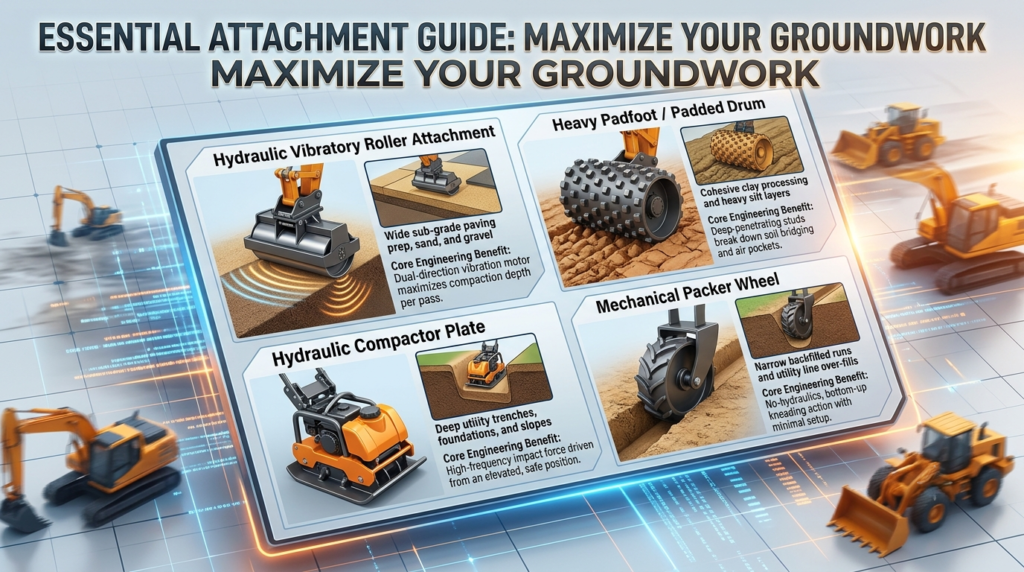
A major change of activity for a wheel loader is at the quick-coupler end. By changing standard material buckets into heavy-engineered compaction attachments, fleet controllers can immediately convert their machinery from mass excavation to targeted cohesive soil stabilization.
This fast changeover not only gets rid of losing time to call single-purpose rollers for site but also highlights the machine’s role in all-round wheel loader compaction support.
| Attachment Type | Primary Groundwork Application | Core Engineering Benefit |
| Hydraulic Vibratory Roller Attachment | Wide sub-grade paving prep, sand, and gravel | Dual-direction vibration motor maximizes compaction depth per pass |
| Heavy Padfoot / Padded Drum | Cohesive clay processing and heavy silt layers | Deep-penetrating studs break down soil bridging and air pockets |
| Hydraulic Compactor Plate | Deep utility trenches, foundations, and slopes | High-frequency impact force driven from an elevated, safe position |
| Mechanical Packer Wheel | Narrow backfilled runs and utility line over-fills | No-hydraulics, bottom-up kneading action with minimal setup |
3. Better Cohesive Soil Management and Trench Backfilling Operations
Clay type materials are one of the most challenging to compact mainly because cohesive soils trap moisture and air inside their matrix. Flat smooth surface finish rollers will just bridge over these without the load being distributed to the deeper subsurface layers thus leaving defects.
Wheel loaders targeted for wheel loader compaction support go a great length in packing these kinds of soils through proper weight distribution and use of high-pressure surface penetration.
Important Civil Engineering Concept:
Soil Density Optimization basically depends on equipping machinery with the right mechanical equipment suited for packing operations of particular soil types. For example, cohesive clay needs high pressure kneading action coupled with aeration of the moisture, whereas granular soils rely on quick high-frequency vibratory impacts to get the particles re-oriented and packed tightly.
Cohesive Stabilization Protocols
- Controlled Lift Thickness Management: The front edge of a compaction attachment is a great tool for operators to easily scoop and spread loose backfill soil in uniform lifts that fall between eight to twelve inches. This way the compaction energy is able to spread evenly throughout the soil matrix leading to enhanced cohesive soil stabilization.
- Mechanical Kneading of Soil at High Pressure: The contact pressure of heavily loaded rubber tires or the padfoot wheels exerted on damp clay-rich backfill is super-localized and of high intensity. This very physical action leads to the sliding of clay particles against each other, the expulsion of the trapped moisture, and the maximization of the heavy compaction support equipment performance.
- Effective Balancing of Moisture Content: In case the sub-grade materials are discovered to be excessively wet or beyond their Optimum Moisture Content (OMC), then the loader can come in handy to implement the soil front-mounted scarification for rapid turning and aeration. After the material has dried to the perfect engineering spec, the machine switches walkers to being a trench backfill compactor with high output.
4. Enhancing Sub-Base and Paving Preparations
Before the structural concrete slab can be poured or the asphalt highway lift can be rolled out, the underlying granular sub-base has to be absolutely uniform, rock-hard, and totally devoid of any deflection.
A unit that is geared towards wheel loader compaction support can deliver the heavy proof-rolling passes that electro-mechanically tip the scale to highlight soft spots hidden in the sub-base away from the final grading stage.
Sub-Base Production Enhancements
- Rigid Proof-Rolling of Structural Soil: One of the most potent ways to uncover subsoil failures is to operate a large, fully weighted wheel loader on a sub-base that has just been graded. The moments where the heavy wheel loaders are put to use exposing any place where the sub-grade is giving way are immediate and effective, thereby illustrating the great potential of jobsite heavy machinery versatility to safeguard the longevity of infrastructure.
- Curbs and Gutters with Sharp Radii are Treated: The discrepancy in the standard full-size road rollers is their inability to be handled well when it comes to tight cul-de-sacs, catch basins, and sharp concrete curb lines. A wheel loader that has been articulated and is carrying a hydraulic vibratory roller attachment offset can perfect the hugging of these complex radiuses while compacting the stone base tightly against the concrete forms without causing any structural damage.
- Uninterrupted Spreading and Sealing of Aggregates: While single-drum compactors have to wait until separate graders for the spreading of stone, a wheel loader that is fitted with a multi-purpose compaction bucket can, in a single continuous operation, dump the aggregate, smoothly spread it across the grade, and track-compact it.
5. Improving Structural Integrity and Jobsite Safety In Confined Areas
Jobs involving trench shoring of deep utilities and excavations of steep foundations are very dangerous. Some risks in sending laborers down into narrow pits with hand-guided walk-behind ramming equipment include severe cave-ins and hand-arm vibration syndrome.
When a wheel loader is used for wheel loader compaction support as a remote operation, the personnel are kept safe while the structural outcomes are significantly improved.
Safety and Structural Preservation Measures
- No-Personnel Trench Access: The mounting of a heavy-duty hydraulic compactor plate or a robust packer wheel to the boom of a wheel loader that is extended allows for the compaction of backfill to be carried out from a very safe position. The personnel remain completely on the surface, which eliminates the necessity of having a worker placed in a noxious area, while the loader performs the function of a remote trench backfill compactor.
- Vibration Isolation Design: Couplers for modern wheel loader attachments are engineered to incorporate heavy-duty rubber isolation mounts. These vibration-dampening pads absorb the roughness and high-frequency feedback that is produced by a hydraulic vibratory roller attachment, which in turn protects the internal workings of the machine such as pins, hydraulic lines, and the operator in the cab against .5 fatigue.
- Shock Absorption Boundary at Precision: When the work is to be carried out along the foundations of historical buildings, fragile utility conduits, or freshly-poured retaining walls, operators are able to carefully regulate the flow of the loader’s auxiliary hydraulics. This control allows the fine-tuning of the vibration frequencies, and hence they can effectively stabilize the cohesive soil and increase soil density while not causing any damage to nearby structures.
FAQs – Wheel Loader Compaction Support Innovative Ways!
What are the main types of compaction equipment used in construction?
Primary types of machines include single or double-drum vibratory road rollers that are normally used for bulk earthwork, pneumatic-tired rollers to knead the sub-base, and padfoot rollers for clay. Compact options such as walk-behind plates, trench rollers, and rammers are usually used when the space is very limited.
Can you use a wheel loader as an effective soil compactor?
Definitely, when a wheel loader is matched with quick-attach, specialized components such as hydraulic vibratory drum or packer wheel, it can leverage its high static weight and hydraulic power to create quite satisfactory soil density in trenches and foundations.
How do you select the right compaction attachment for a wheel loader?
Match the tool to the soil type: opt for high-frequency hydraulic vibratory rollers or plates if the site clients are granular sand and gravel, or use the padfoot drums and packer wheels to knead the cohesive clays.
What is the difference between static and vibratory compaction?
Static compaction purely relies on the sheer weight of the machine to press soil down, whereas vibratory compaction adds high-frequency mechanical strikes to alter particle friction thereby allowing deeper density results.
Why is proper soil compaction critical for structural foundations?
Compaction works to maximize the shear strength of soil and eliminates air voids underground. This step in the construction process helps in preventing future structural movements, water ponding, foundation cracks, and premature failures of pavement.
How does moisture content affect soil compaction results?
Soil goes through an Optimum Moisture Content (OMC) stage where water acts as a particle lubricant allowing them to be packed tightly; very dry soil not only will resist compaction but also excess water will push these particles apart.
What safety measures should be followed during trench compaction?
Keep workers out of dangerous trench lines by deploying loader boom extensions for side/backfill compacting remotely from the top side while operational with the use of backup cameras and through constant monitoring of proximity to buried utilities.
Wheel Loader Compaction Support