Mastering Soil Compaction: When to Choose a Sheepsfoot Roller
Soil compaction is an essential phase in the construction process without which the structural elements like foundations, roads or embankments would not be able to support the intended loads after a certain period. Sheepsfoot rollers also known as padfoot or tamping rollers are among the most secret weapon of construction machinery.
While smooth drum rollers only exert surface pressure, a sheepsfoot roller is designed to disturb the soil at a deeper level. Its bodies are fitted with rectangular or club-shaped protrusions that enable it to work the soil at the molecular level.
For those working in construction and engineering, choosing a sheepsfoot roller based on the project requirements and soil type rather than merely by preference is crucial. Generally, traditional rollers are not suitable for difficult terrains but a sheepsfoot roller can make a difference owing to its points of contact having very high pressure, which it uses to expel air and moisture, leaving behind a very hard base. We will discuss the technical aspects, advantages, and examples where a sheepsfoot roller is the best fit for your work.
Understanding the Unique Design of the Sheepsfoot Roller
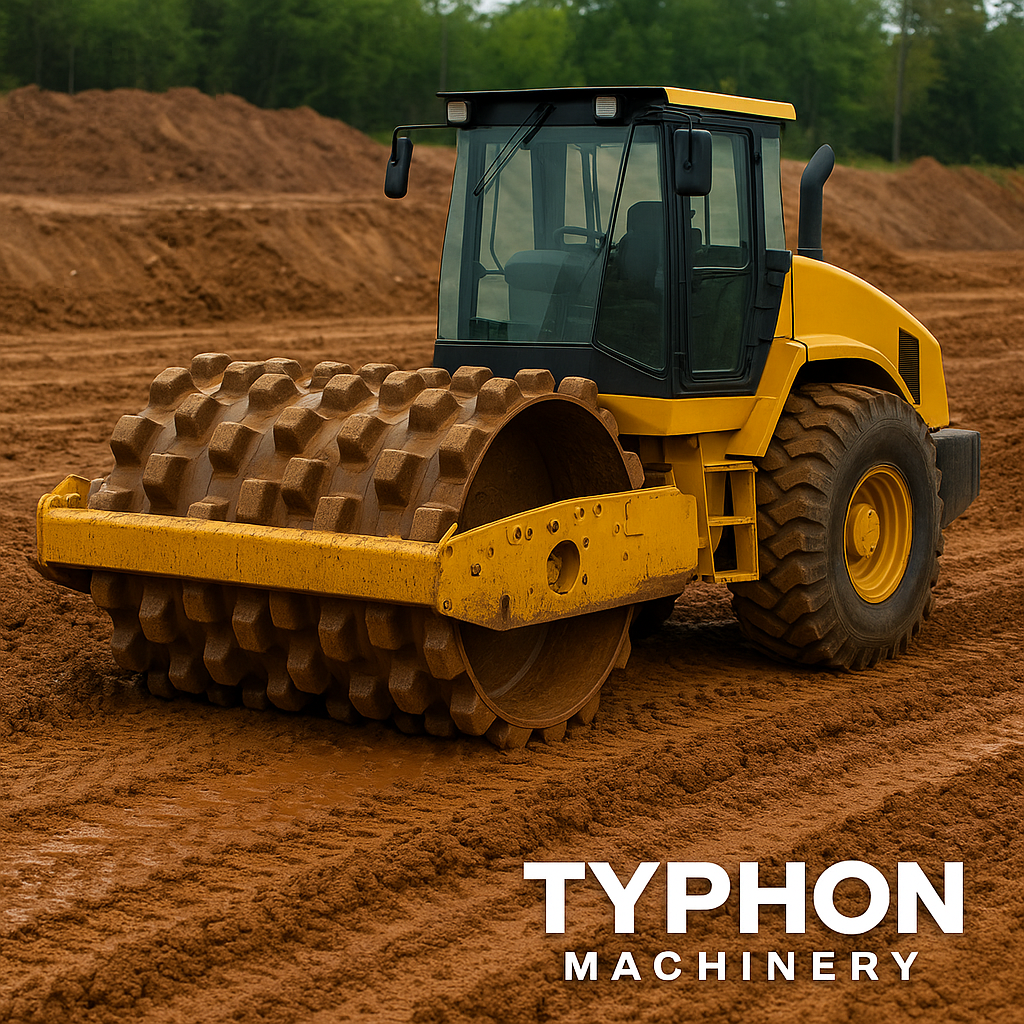
The sheepsfoot roller is a heavy construction machine, characterized by a large cylindrical steel drum equipped with numerous raised “feet” or lugs. The foot-like shapes on the surface are deliberately designed to simulate the high-pressure impact of the hoof of a sheep.
This principle was derived from the practice of using sheep to compact earthen paths. It is this feature that makes the tool capable of extracting and breaking very tough soil.
Its main features include:
- Kneading, which disturbs cohesive soil bonding;
- The direction of compaction is from bottom to top of the lift;
- The extent of pressure is capable of producing 14-70 kg/cm² at each contact area from the tiny feet.
The Role of Cohesive Soils in Compaction Selection
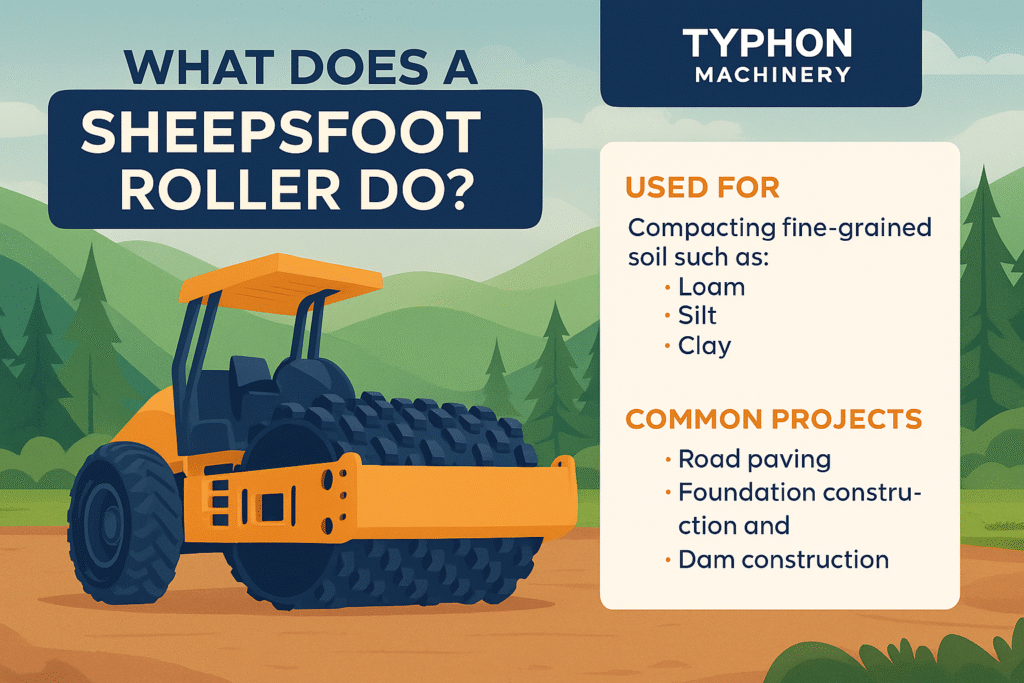
Without doubt, the most significant factor in deciding when to choose a sheepsfoot roller is the state of the soil you are working on. This equipment has been manufactured mainly for cohesive soil types such as clay or silt.
These soils are usually fine-grained and quite sticky, therefore, air pockets and moisture get trapped, which may result in settlement or sponginess in the future if not handled properly.
- Clay is the favorite mate of a sheepsfoot roller as it can break down the elastic air pockets present in that material.
- Silty soils, which are primarily fine without gravel, are enhanced by the deep kneading that makes the particles arrange in a dense structure.
- Moisture content is well controlled by these rollers aerating wet soil which dries naturally while getting compacted.
Comparative Analysis: Sheepsfoot vs. Smooth Drum Roller
Understanding the differences between various types of machinery is a must if you want to excel in soil compaction. Although these two pieces of equipment serve the same purpose of densification, in terms of soil physics and final finish requirements their applications lie at opposites.
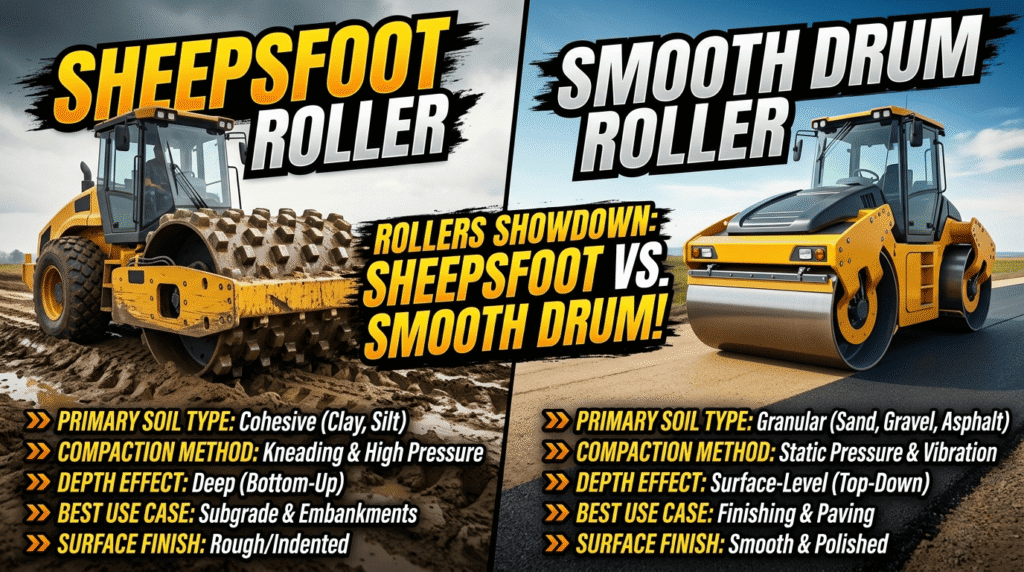
Table: Sheepsfoot Roller Features
| Feature | Sheepsfoot Roller | Smooth Drum Roller |
| Primary Soil Type | Cohesive (Clay, Silt) | Granular (Sand, Gravel, Asphalt) |
| Compaction Method | Kneading & High Pressure | Static Pressure & Vibration |
| Depth Effect | Deep (Bottom-Up) | Surface-Level (Top-Down) |
| Best Use Case | Subgrade & Embankments | Finishing & Paving |
| Surface Finish | Rough/Indented | Smooth & Polished |
- Surface Area: In terms of load effect distribution, a smooth drum is much broader and helps with finishing, but it does not reach deep clay levels.
- Vibratory or static: Both may be vibratory; however, a sheepsfoot roller utilizes vibration as a way to penetrate deeper with its feet into sticky layers.
- Layer thickness: Sheepsfoot rollers handle layers of 6 to 10 inches quite well ensuring every inch is solid.
When to Choose a Sheepsfoot Roller: Key Scenarios
The selection of a sheepsfoot roller in some projects is a matter of survival. It is the one and only piece of equipment on which the stability of the whole structure depends whether you are constructing a hydroelectric power station or a sub-base for a highway. Selecting this piece of equipment at the right time can save you from huge remedial works and structural failures in the long run.
- Dam and Levee Construction: Since there is a very high need for water impermeability, the use of a sheepsfoot roller for deep kneading results in the formation of dense, leak-proof barriers.
- Road Subgrade Preparation: Before laying the asphalt, the native soil must be stabilized. A sheepsfoot roller ensures that even the very bottom layers are free of voids.
- Wet Site Recovery: If a site is too muddy for other equipment, the sheepsfoot roller can “open up” the soil to help it breathe and dry faster.
The “Walk-Out” Feature: Knowing When Compaction is Done
A major benefit derived from sheepsfoot roller usage is that it doubles up as an excellent guide to determining when compaction has been completed. This characteristic has been termed as “walking out” or “walking off”. To the extent that the soil’s density reaches its peak, the feet can no longer penetrate and instead start to ride increasingly higher on the surface.
- Visual confirmation: You will know that the job has been completed when the feet “skate” on top of the soil and not sink into it.
- Reduced resistance: The density increase causes a change in mechanical resistance, which is a signal to the operator to proceed to the next section.
- Final pass: Frequently, after a sheepsfoot roller has “walked out,” a smooth drum roller is used to give the surface a final “polish.”
Maintenance and Operational Best Practices
Achieving high productivity level involves the right use of sheepsfoot rollers along with proper maintenance. These are the prime tools for building up the soil and therefore, their condition plays a major role in raising the quality of the soil base. Regular monitoring and suitable ballasting are the ways of getting top-notch results in terms of both construction pace and quality.
- Lugs Inspection: Check the “feet” regularly for wear and tear; rounded or blunt feet lose their ability to penetrate cohesive layers effectively.
- Ballasting Flexibility: Many drums allow for internal ballasting with water or sand, allowing you to increase the machine’s weight for tougher clay.
- Lift Control: Always ensure soil lifts do not exceed 10 inches, as the feet need to reach the bottom of the layer for true “bottom-up” compaction.
FAQs: Mastering Soil Compaction – Sheepsfoot Roller
What is the main advantage of using a sheepsfoot roller?
The biggest plus of this machine is how it can compact cohesive soils like clay from the bottom-up. Deep kneading action removes residual air pockets that normal surface rollers leave behind, resulting in a more stable and solid foundation.
Can you use a sheepsfoot roller on sand or gravel?
Absolutely no, a sheepsfoot roller is unsuitable and inefficient on granular soils. The feet will channel and tilt the particles instead of densifying them. For the compaction of granular materials, a smooth drum or pneumatic roller will be the right tool.
What is the difference between a padfoot and a sheepsfoot roller?
You will hear the two being used interchangeably but actually a sheepsfoot roller has much smaller, stronger and more numerous lugs in the shape of clubs for making the penetrations deeper in heavy clay and padfoot roller has larger, mostly rectangular pads and is often used for semi-cohesive or mixed soils.
How do you know when sheepsfoot compaction is complete?
In the case of the sheepsfoot roller, the compaction process is done when the roller “walks out” of the soil. That is the point when the soil is so dense that the feet can no longer sink in and the drum is rolling on top of the surface.
Why is it called a “sheepsfoot” roller?
The name “sheepsfoot” is thanks to an old method of road-building in which sheep were used to drive their hooves over the soil surface and compact the soil. Their small, high-pressure hooves effectively compacted the soil, a principle that the metal “feet” on the roller drum now replicate.
Is a vibratory sheepsfoot roller better than a static one?
Normally yes, because the vibratory version combines static weight with the dynamic forces generated by the kneading action of the feet, which speeds up compaction and enables better compaction of semi-cohesive materials.
What is the ideal lift thickness for a sheepsfoot roller?
For majority of cohesive soil types, the appropriate thickness for lifts is 6 to 10 inches (150-250mm). This is so that the feet can adequately penetrate all the way to the bottom of the layer and then work their way up as the soil densifies.