Tandem Rollers: Dual Drum Efficiency for Asphalt Compaction
A well-done and extremely durable mirror-smooth road surface is not something that you can simply do by an ordinary way. It requires heavy equipments designed specifically to the physics of pavement designs. Among the infrastructure development sectors and heavy machineries, tandem rollers are actually the best one for effective compaction.
Once again, these heavy machines are equipped with two huge steel drums which work closely together to achieve maximum efficiency with fewer passes and equally spread density of the new mats. Coming to facilities tandem roller has to offer, it is helpful for us in many ways. It can go alongside our work and can improve our capabilities. However, knowing its workings physically and technologically side by side is leading to great changes in our paving and can show us a road of efficient and long lasting highways.
The Engineering Behind Dual Drum Efficiency
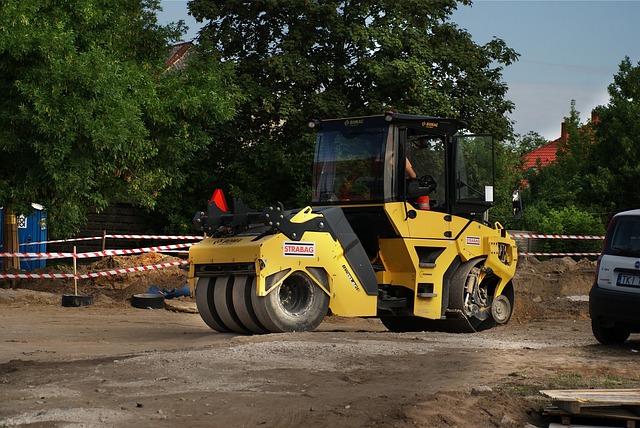
The main highlight of a tandem roller is the two-drum stand arrangement that is the real point which provides a double compaction in a single machine pass. Unlike the complex soil compactors that have the front drum and the rear with the tires made of rubber, the tandem rollers have steel drums for both the front and rear.
This drum on the both ends which are providing the pressure very evenly over the entire contact area ensures that the uneven compaction and the tracking marks which are possible to be created due to the different axles are are absolutely eliminated.
Besides the production capacity of the compactors, paving is primarily based on the use of dynamic forces to accomplish fast densification (that is adding volume by getting rid of air voids). The fact is that these complex machines with drums full of momentum can create vibratory or oscillatory impacts with the speeds they are rotating at, and these impacts together have high frequency.
As for HMA these high-frequency forces are lowering the friction temporarily just between two aggregate particles. This short-lived slipping helps the stones to be in the densest state possible under the static weight of the machine, leading to a dense and stable pavement structure before the mix cools down beyond the critical point.
- Uniform Pressure Distribution: The identical steel drums split the weight of the machine evenly over both the front and the rear axles, thus avoiding surface tracking and localized shifting which is typical with combinations of pneumatic wheels.
- Dual-Action Compaction Pass: Every single cross-rolling of the machine onto the hot mat is the dual compression actions, which means that their operating hours and fuel consumptions are halved, debt of time and the expenses are greatly lowered.
- Advanced Vibratory Systems: From the built-in eccentric weights are created the high-frequency dynamic forces that change the aggregate positioning in a very short time that is why trapped air voids are eliminated and density specifications can be achieved the most swiftly possible.
Top 3 Key Stages of Tandem Roller Operation
The fact that the newly paved roads have to be the smoothest really makes us think that we should not allow any loopholes, any mistakes in the work progress. Smoothness of the pavement is first and foremost the result of the rolling pattern as well as the control over the machine.
The tandem rollers being so versatile makes them even more special as one single piece of equipment is able to be used for different function such as breakdown, intermediate, and finish rolling just by changing the speed, amplitude, and vibration settings to gain the desired effect.
| Compaction Stage | Roller Setting | Primary Goal | Recommended Mat Temp |
| Breakdown Rolling | High Amplitude / Low-to-Medium Frequency | Initial densification of hot mix | 220°F to 275°F |
| Intermediate Rolling | Low Amplitude / High Frequency | Lock aggregates and reach target air voids | 175°F to 220°F |
| Finish Rolling | Static Mode (Vibration Off) | Remove surface marks and smooth minor ridges | Below 175°F |
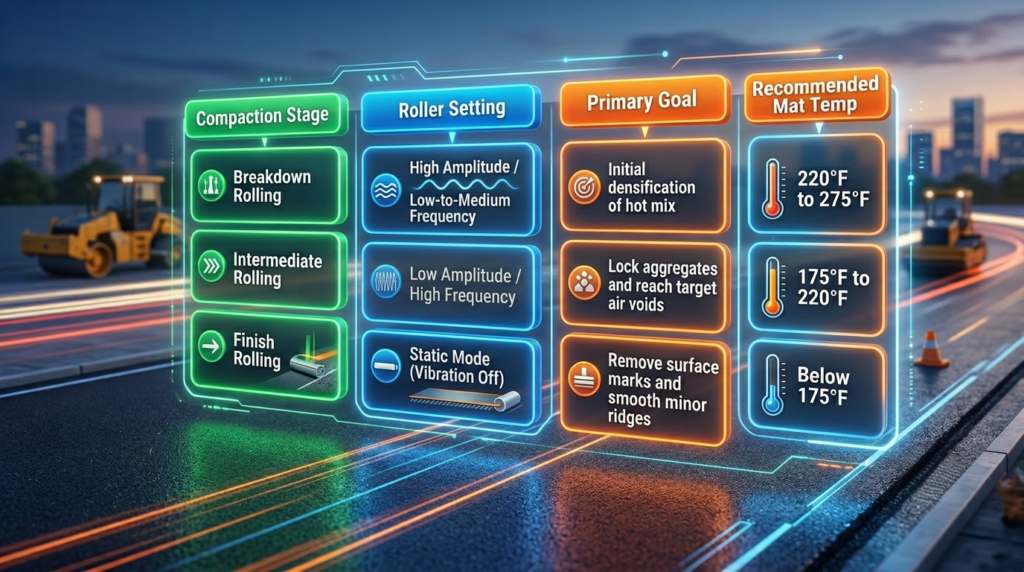
Below is a brief description of the major 3 phases of tandem roller operation:
1. Breakdown Rolling:
The very first and at the same time the most vital step is done right after the paving is complete and the asphalt is at the highest workable temperature. Utilizing the front drum vibration, the operators choose high-amplitude settings that help the force of compaction to reach deeper in the thick layer of hot asphalt and thereby providing the ductile nature of the material with the basis of structural density.
Benefits of Breakdown Rolling
- Maximum Utilization of Heat: Since the operators follow very close to the paver so that they can compact the asphalt in its highly malleable state, the initial reduction of air void content before cold setting of the mix is therefore maximized.
- Compresion by Deep Force: The high amplitude feature of this setting delivers strong vertical forces which is the most effective way to stabilize thick and coarse aggregate layers.
- Leading Drum Vibration: As per the standard practice, vibration is engaged only on the forward moving drum, while the rear drum remaining static which thereby prevents over-compaction or fracture of the aggregate.
2. Intermediate Rolling
The intermediate rolling is all about cementing the internal aggregate skeleton and fixing the pavement density to its final required value after the initial is taken care of. The tandem roller now becomes a tool for achieving the balance between the needs for breaking down the mix and finishing it by vibrating at a high frequency and low amplitude so as not to cause damage to the aggregate while still continuing to pack the mat better.
Main Advantages of Intermediate Rolling
- Attaining Target Density: This stage focuses on the final operations leading to the attainment of the set density requirements that usually can range from 92% to 97% of maximum theoretical density.
- Air Void Optimization: Using a high frequency-low impact vibration the particles of sand and stones are forced to occupy even the tiniest spaces, thereby providing the pavement with a level of impermeability to water.
- Prevention of Deformation: The continual overlapping of the foot print paths is helpful to avoid any occurrences of structural shifts or sideways spreading along the edges where the mix is not confined as it cools down to the point of stabilization.
3. Finish Rolling
Generally speaking, this phase is mostly concerned with the beauty and the rideability of the surface. During the final finish rolling, the tandem roller works only in the static mode (i.e., vibration off) where it is similar to a heavy iron plane smoothing out joints, steering marks and surface ridges.
Benefits of Final Rolling
- Surface Blemish Removal: The slight surface imperfections which are present on the newly laid pavement can be removed by static steel drums which results in a high smoothness index and top quality rideibility for transportation vehicles.
- Joining and Consolidating: The seams (both transverse and longitudinal) between separate paving lanes are getting compacted so well that it prevents joint separation and finally moisture intrusion.
- Temperature Cut-off: It operates at the bottom limit of asphalt workability thereby sealing the surface without leading to the internal cracks that arise when cold mixes are over vibrated.
Critical Machine Specifications and Selection Criteria
Keeping in mind the parameters of the work site along with asphalt mix design, lift thickness and production schedules will greatly help in the selection of the proper tandem roller. Starting from the compact and easy to maneuver rollers for parking lots to the huge and powerful highway rollers, are a typical example of standard industry configurations.
- Operating Weight and Drum Width: Heavy highway rolling machines usually weighs from 8 to 14 metric tons and having drum width from 50 to 84 inches that they can cover the wide lanes with minimum passes efficiently.
- Frequency and Amplitude Adjustments: Highly flexible compactors come with independent amplitudes and frequency controls that allow the operators to fine-tune the performance according to the mix stiffness.
- Intelligent Compaction: These days’ heavy rollers come with built-in GPS tracking, infrared temperature sensors, and accelerometers that carry out material stiffness measurements in real time and help in avoiding situations of both under-compaction and over-compaction.
Questions Asked Frequently – Tandem Roller
What is the main distinction between a tandem roller and a pneumatic tire roller?
A tandem roller rely on the two solid steel drums to provide a linear static weight combined with high-frequency dynamic forces (vibration or oscillation) that is why it is very suitable for initial breakdown and final finish rolling. On the other hand, pneumatic rollers are equipped with multiple overlapping rubber tires that exert vertical and kneading pressure, which helps seal the internal pore structure and reorient aggregates to prevent rutting.
How is the drum surface kept from being contaminated with pie-up asphalt?
Conventionally, tandem rollers use a pressurized water system onboard with sprinklers that are continuously releasing a fine mist to the steel surfaces. The water layer that is created acts as a thermal barrier that stops the hot, sticky bituminous binders from sticking to the cold metal drums. Usually, the operators use the specific release agents that are environmentally friendly to mix with the water supply to get better that non-stick property.
Why is over-compaction damaging the asphalt pavement?
In fact, excessive compaction results in breaking stones within aggregates that decreases properly interlocked stone matrix for load distribution and ultimately cracking of pavement occurs prematurely. Besides this, over rolling significantly drops air void content level under 3 % so that not enough space for binder to expand during summer leads to bleeding, flushing, and rutting almost immediately.
At what time should vibration function be shut off when using tandem roller?
Vibration must be completely switched off during the final finish rolling, compaction of thin pavement overlays (less than 1.5 inches), or when the mat is less than 175 °F surface temperature. Forcing vibration on cold, stiff asphalt will result in violent bouncing of the roller, this can then lead to aggregate breakdown, hairline fractures, and surface marking.
What is meant by intelligent compaction on tandem rollers?
Intelligent Compaction (IC) refers to a set of technologies that typically include GPS, drum accelerometers, surface temperature is sensors, etc., in the form of a system that displays real-time color-coded maps to the operator that are showing the exact pass count, material temperature, and relative stiffness values over the pavement to assure uniform density.
When working on a slope with a tandem roller, which drum should be the leading one?
The powered drum must always be leading the operation when moving uphill with the tandem roller on an incline. That way the roller will be pulling itself up the slope smoothly and the unpowered steering drum will not be sliding, slipping, or pushing the hot and unstable asphalt mix downward.
How many passes are generally necessary for tandem rollers to get to target density?
The number of passes required will vary from 3 to 7 coverages depending on the machine, the thickness of the lift, and the mix design. Following a pre-paving test strip, density growth curves are usually monitored with nuclear or non-nuclear gauges to establish the perfect pattern of style which reflects the point of maximum efficiency/gain before exposure to further effort.