Roller compactor principle of operation explained: Learn how these powerful machines transform!
In the ever-evolving world of modern infrastructure, the foundation of a stable structure always starts from the ground. It doesn’t matter if you’re constructing a multi-lane highway or setting up a skyscraper’s foundation, the roller compactor principle of operation in construction is the basic scientific method that guarantees durability and safety. By persistently removing air pockets and upping the dry density of the materials, heavy machines effectively convert the loose soil into a highly compacted platform that is capable of carrying enormous loads and resisting various natural forces.
Understanding the Roller Compactor Principle of Operation in Construction
Knowing how this is done mechanically is not only of interest to engineers; it’s a must for project managers and equipment operators who want to work with accuracy and high productivity. It is the combination of hefty machine mass, centrifugal spin, and material wetness that will ultimately decide if a project is a hit or miss. We are going to elaborate on the detailed technical issues, different types of machinery, and excellent ground compaction habits that stand out in this industry.
Top 6 Roller compactor principle of operation Tips:
1.Basic Soil Physics for Compaction
By design, the principle by which a roller compactor operates in construction involves putting mechanical energy into a soil mass or asphalt to alter the arrangement of particles so that they are pressed tighter to form a strong internal structure. The most important objective is to find the “Optimum Moisture Content” (OMC) at which point the material will have maximum possible density with minimum effort.
- Static pressure: The simplest mode of compaction is when the roller uses its own weight (dead load) to push down and densify the surface layers .
- Vibratory Force: Recently introduced rollers have an inner mass which vibrates at high frequency. This motion temporarily lowers friction inside so that the particles can be more tightly packed together .
- Kneading Action: Pneumatic-tired rollers, for example, use a “kneading” motion that is extremely effective at sealing asphalt surfaces (Al Marwan Machinery, 2024).
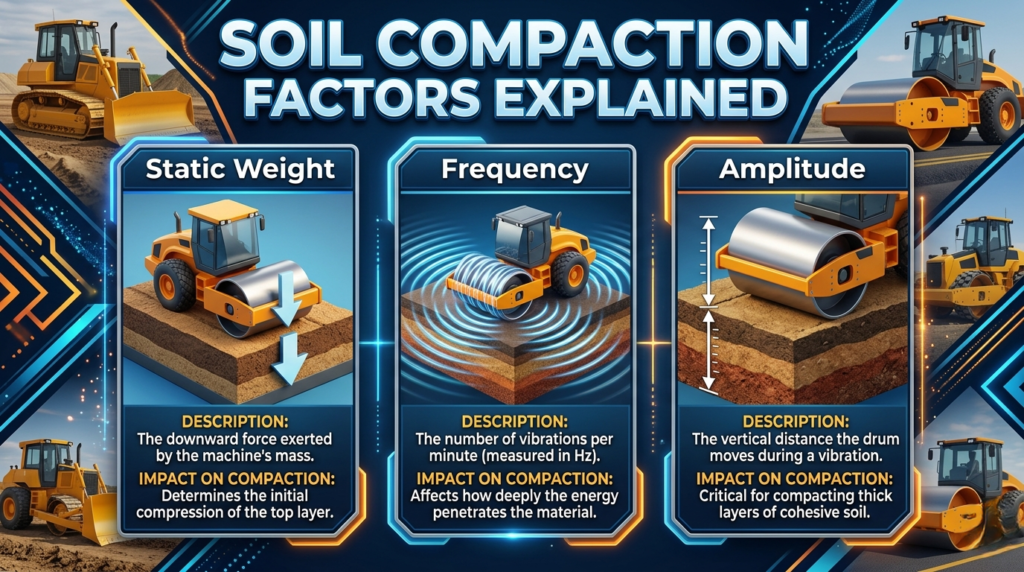
Table: Roller compactor principle of operation
| Factor | Description | Impact on Compaction |
| Static Weight | The downward force exerted by the machine’s mass. | Determines the initial compression of the top layer. |
| Frequency | The number of vibrations per minute (measured in Hz). | Affects how deeply the energy penetrates the material. |
| Amplitude | The vertical distance the drum moves during a vibration. | Critical for compacting thick layers of cohesive soil. |
2. Parts and System Layout
Any roller compactor can be considered a wonder of hydraulic and mechanical engineering. To fully grasp the roller compactor principle of operation in construction, one should look at how the internal systems not only work separately but also how they integrate to produce an unbroken pressure force.
Generally, industrial rollers are made up of three parts, i.e., power unit, transmission system, and compaction drums or wheels that contact with the ground directly.
- The Compaction Drum: It is normally a thick steel cylinder and is the main tool for imparting force. Depending on the material, it can be a smooth drum, padded drum (sheepsfoot), or even a grid-like pattern.
- The Exciter System: Eccentric weights assemble this system which is found inside the drum that spins at high speed to produce the necessary vibration for compaction of deeper layers.
- Hydraulic Drive: A feature that allows the user to have precise control at slow speeds, which is critical for rollers that usually operate at a speed range of 2-4 mph for optimum performance.
3. Various Roller Types and Their Intended Uses
Different types of ground require different machines for compaction. The roller compactor principle of operation in construction can be markedly different when you are dealing with different types of soil such as granular or cohesive. Making the right choice of machine means the difference between a solid foundation and an expensive failure.
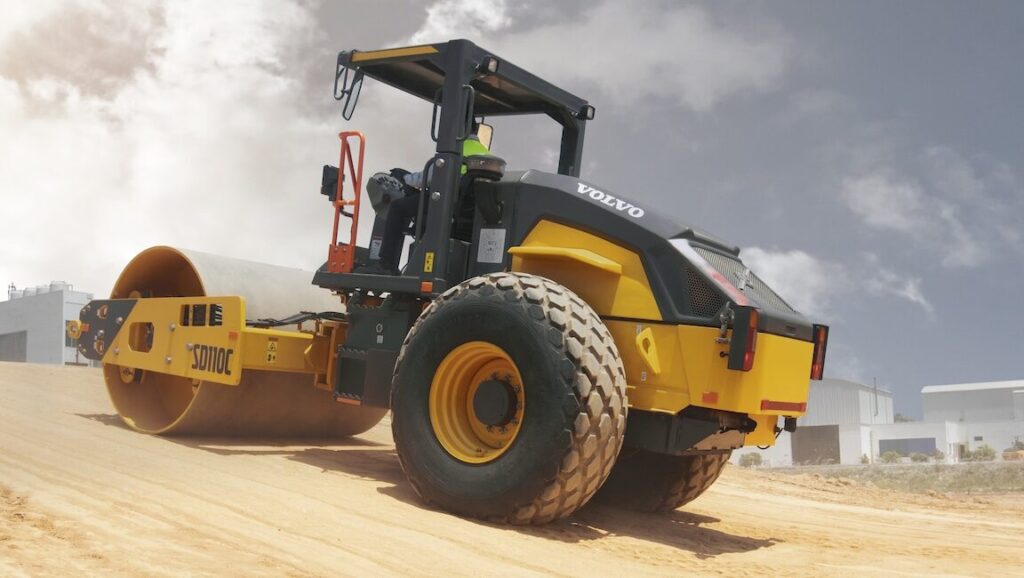
- Single Drum Vibratory Rollers: Single Drum Vibratory Rollers contain a large steel roll in front and back tires made of rubber. They are the “workhorses” when it comes to sub-grade and earthwork preparation (Moglix Business, 2025).
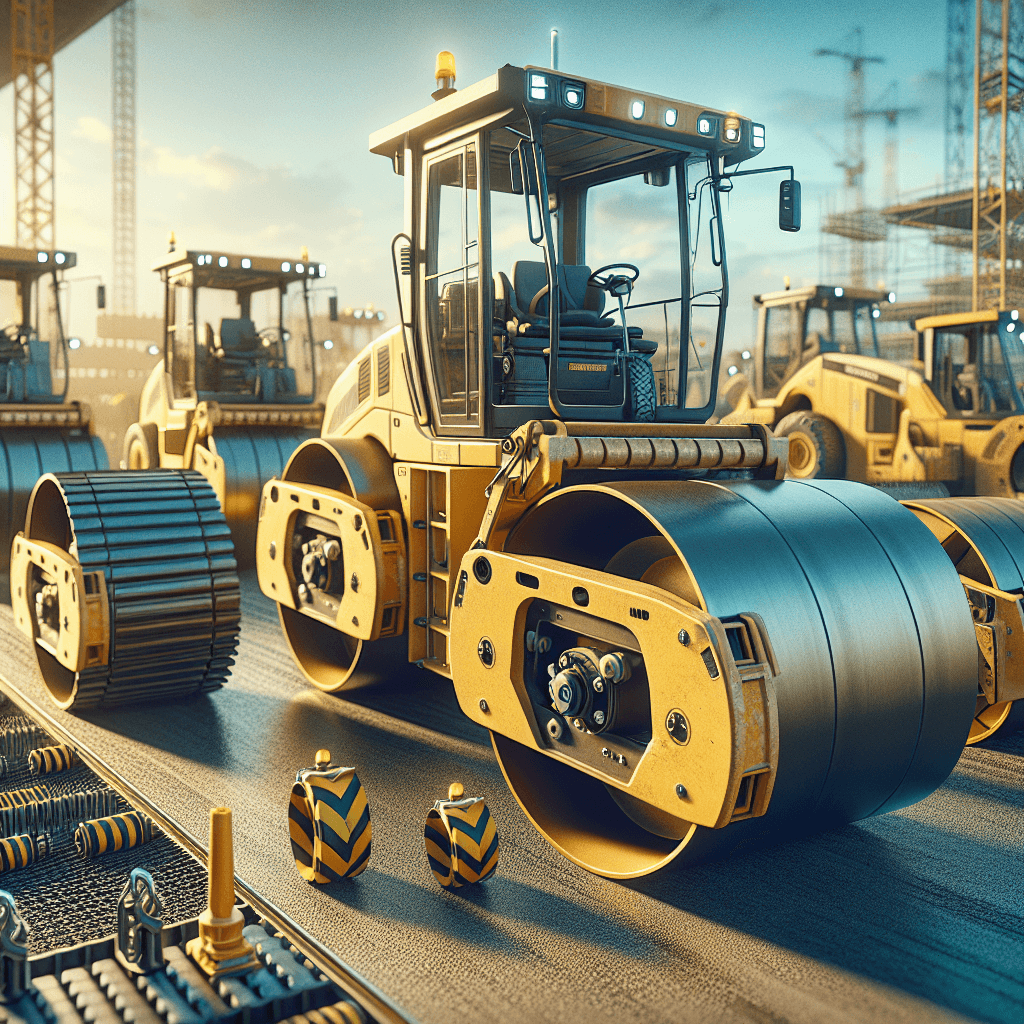
- Double Drum (Tandem) Rollers: Double Drum (Tandem) Rollers include two steel drums and are mostly used for all types of asphalt paving. They also ensure that road surfaces have smooth and even finishes (Sany Global, 2024).
- The padfoot rollers: The padfoot rollers are the same as the sheepsfoot rollers but only that they have pads which are raised on the drum. They are very good at compacting cohesive soils such as clay because the pads even “knead” the soil from the bottom up .
4. Factors Affecting the Compaction Efficiency
Even a mighty heavyweight can be easily defeated by a feeble condition at the site. roller compactor principle of operation in construction requires the careful monitoring of different external factors that will affect the outcome throughout the duration of the project.
- Soil Moisture Content: Overly dry soil will not allow the particles to move close enough to one another, and highly wet soil will have water pushing particles away from each other. On-site, the “hand test” is very popular as a way of evaluating the moisture level .
- Layer Thickness (Lift): Working in layers (“lifts”) of 6 to 12 inches is a norm. If you try to compact layers that are too thick, you will most likely get a “bridging” effect, where the bottom will still be loose .
- Number of Passes: Just like under-compaction, over-compaction can also be extremely harmful. It can produce crushed aggregates and consequently limit the permeability of the material .
5. Operating Manoeuvres
For great work to come out of it, machine operators have to adhere to a procedure. roller compactor principle of operation in construction can be utilized in a very effective manner when controlled overlapping drum passes are used in order to leave no uncompressed spots.
- Pre-Operation Inspection: Make sure that hydraulic fluids are at the right level, tire pressure is good, and the drum surface is clean from any debris that could lead to “material pickup” or uneven surfaces.
- Compaction Pattern: It is best to start from the low point or the perimeter and then go towards the center to avoid pushing or spilling of the material.
- Speed Control: Keep a steady and slow speed. Quick pace reduces the time of contact between the drum and ground, thus density achieved per pass is significantly lowered.
6. Safety and Maintenance for Durable Operation
Being a heavy machine operator, you have to comply with safety standards. Because roller compactor principle of operation in construction is related to machinery working at high frequency and vibration and heavy weights, maintenance is the only way to keep the equipment jamming free and operator safe.
- Safety Features: Make sure that before you begin anything the Rollover Protection Structure (ROPS), safety belts, and backup warning devices are working perfectly.
- Vibration Management: Days of being exposed to machine vibration have been known to produce fatigue in operators. To reduce this risk, ergonomic cabins come as a feature in many modern rollers.
- Routine Servicing: The eccentric housing always requires lubrication, and the hydraulic system must be checked for any leaks in order for the “centrifugal force” to be maintained which is essential for heavy compaction.
FAQ’s: Roller Compactor Principle of Operation
What is the roller compactor main principle?
Its main principle is to expel air voids from soil or asphalt by means of static pressure, vibration, or kneading thus elevating the material’s strength to bear loads.
Which roller type is most suitable for clay soil compaction?
Padfoot or Sheepsfoot rollers would be a better choice for clay soils because of the kneading action the feet perform that effectively compacts cohesive fine-grained soils.
How many passes usually work for compaction?
The number of passes depends also on the weight of the machine and the type of material. For instance, an 80 roller might do with as many as 12 passes for a 125mm layer whereas a 7T roller may only require 5 passes even at deeper levels.
What is the difference between static and vibratory rollers?
While static rollers are just heavy balls rolling over surfaces, vibratory rollers have an internal system that while adding their weight creates a downward force allowing for deeper soil layers to be compacted.
What is the operating speed of a roller compactor?
Rollers should keep a uniform pace of about 2 to 4 mph to be the most effective. When this speed is exceeded the time of effective contact with the material greatly decreases.
How does water influence compaction?
Water in soils acts like a lubricant making it easier for the soil particles to rearrange themselves thus resulting in a denser structure. The goal is to match the soil to its optimum moisture content so that it will have its highest dry density.
Is it possible to over-compact the ground?
Absolutely. Over compacting can either crush stone aggregate or cause very dense compaction which unfortunately serves to reduce natural drainage and permeability of the ground.