Smooth Drum Roller Maintenance Tips: Duration Enhancement
Operating smooth drum roller in heavy construction industry is no less an art. Across the heavy construction equipment your roller plays a major role in making your project successful. It is not just a tool that helps you in leveling the ground but the core of your project success with the best smooth drum roller maintenance.
Smooth Drum Roller Maintenance Tips for Extended Lifespan will encourage you to think beyond the repair and break notion and look at the larger picture that is your time, money and human safety.
Longevity’s Keystone: Daily Pre-Operational Inspections
Would you be able to steer your vehicle if your braking system stops working? The same things with machinery. I mean the stuff which ‘accidentally’ allows the machinery to work out of its original operation conditions and within the process decreases the machine’ life
These hidden things lead to the batteries being blown or the engine being completely broken down etc. Cleaning the machine and keeping it within its operation range is made possible only with regular working checks and daily inspections. You will use these inspections to make sure that the machine is in good working condition.
- Checking for Fluid Levels: Make sure the engine oil, hydraulic fluid and coolant levels are checked before starting the machine. Insufficient levels cause the machine to overheat and the metal surfaces to rub together, causing brake and other damage.
- Checking leaks visually: Walk around the mower, trying to locate puddles or “wet” spots on hoses and connectors. Early hydraulic leak detection can save the pump from cavitation.
- Testing Safety Systems: Check the emergency stops, alarms, and lights to ensure they are working.
Drum Maintenance and Vibratory
The roller drum together with the roller vibration system are the critical components of a roller that requires both system and component maintenance.
Keeping the drum clean and adjustment of scrapers: Remove any asphalt buildup and make sure the scraper bars have the right gap as per the manufacturer to prevent the material from sticking and causing blemishes on the surface.
- Lubricating Vibratory: Vibratory generates quite a lot of heat. For bearing protection, check the oil level in the vibratory gearbox and drum housing.
- Checking the Shock Mounts: Check the rubber isolators (shock mounts) that separate the drum from the frame. They should not be cracked or flattened. This is the cause of vibrations becoming transferred to the chassis which is going to damage components that are electronic and is also going to cause fatigue in the operator.
Hydraulic System Management and Contamination Control
Smooth drum rollers utilize advanced hydraulic components both for propulsion and vibration. Contamination is the biggest threat to hydraulic systems.
- Follow the filter replacement schedules: Hydraulic filters need to generally be changed after every 500 hours, or more frequently if the machine is used in very dusty conditions. So never ignore a filter change.
- Hose Integrity Checks: Check for any bulges, cracks or “weeping” at the crimps. Hydraulic hose burst can happen and this will lead to the machine being immobilized immediately and also cause environmental problems. So be vigilant.
- Fluid Quality Monitoring: If the hydraulic oil looks white and besides the oil smell a burnt one is detected, it means that the motor is contaminated or there is water load coming in the hydraulic system.
Flushing the system is an important repair step because this will prevent the motor from being damaged permanently.
Engine Performance and Air Quality
The engine is the powerhouse of the roller feeding the mechanical muscle required for the heavy lifting and heavy impacts frequency generation. Since rollers are prone to work even in dusty conditions, the air intake system is always getting bombed with dust and thus putting so much pressure to an engine to make it breathe which will cause the engine to overheat, lose power, and consume fuel extra.
- Air Filter Maintenance: The daily routine should include cleaning the pre-cleaner and changing the primary air filter when the restriction indicator is showing those signs. Under no condition should you “blow out” filters with high-pressure air, since this may cause pinholes to appear through which dust will enter the cylinders.
- Cooling System Hygiene: Consistent radiator fin and oil cooler cleaning is a must. Dust removal (via compressed air or water) of blocked areas is necessary to avoid the engine being derated due to heat.
- Fuel System Protection: Refuel at the end of the day so as to have the least possible air space in the tank where condensation can take place. Draining the water separator often will keep moisture from getting to the injectors.
Comprehensive Maintenance Interval Table
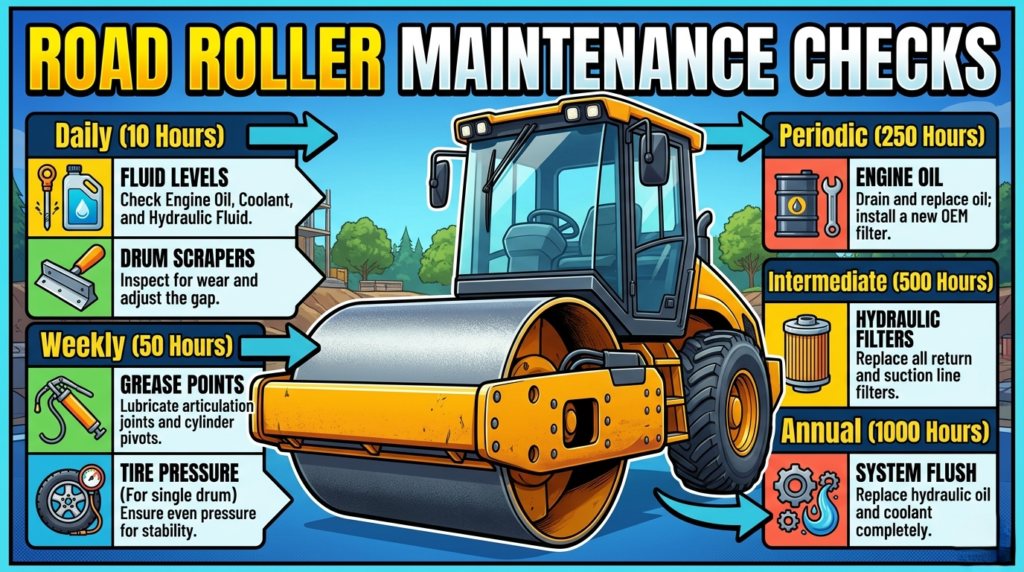
In order make your maintenance scheduling efficacious, the following table will be your cheat sheet in guiding you what to do at various work hours.
| Frequency | Component | Action Required |
| Daily (10 Hours) | Fluid Levels | Check Engine Oil, Coolant, and Hydraulic Fluid. |
| Daily (10 Hours) | Drum Scrapers | Inspect for wear and adjust the gap. |
| Weekly (50 Hours) | Grease Points | Lubricate articulation joints and cylinder pivots. |
| Weekly (50 Hours) | Tire Pressure | (For single drum) Ensure even pressure for stability. |
| Periodic (250 Hours) | Engine Oil | Drain and replace oil; install a new OEM filter. |
| Intermediate (500 Hours) | Hydraulic Filters | Replace all return and suction line filters. |
| Annual (1000 Hours) | System Flush | Replace hydraulic oil and coolant completely. |
Chassis and Articulation Point Lubrication
The articulation joint of a roller is its waist, and just like the human waist, it is a weak spot and therefore requires special attention. It must be strong enough to support the entire weight of the machine when turning; without adequate lubrication, the metal-on-metal friction will lead to “slop” in the steering which will eventually necessitate a costly line-boring repair.
- Consistent Greasing: Use a good quality lithium grease to lubricate all grease points. Greasing should be continued until a small amount of fresh grease comes out of the seals, squeezing out the contaminants.
- Pivot Pin Inspection: Make sure there is no excessive play in the center pivot. If while steering the machine feels “loose,” the bushings are likely already worn and will need replacing soon.
- Corrosion Prevention: Washing regularly to remove road salt and chemicals can prevent the paint from being eaten and the frame from rusting structurally.
Electrical Smooth Drum Rollers and Safety Electronics
Modern smooth drum rollers come with compaction meters, GPS, and complex ECUs (Engine Control Units). These systems are very sensitive to moisture and vibrations. Keeping the electrical “nervous system” healthy is a key part of modern job site compliance.
- Battery Terminal Care: Make sure the terminals are always clean and well tightened. Corrosion can cause starting to become intermittent and also the computer system may display “phantom” error codes.
- Wiring Harness Inspection: Look out for any chafing in the wires where they are going through the frame. Using plastic looms or zip ties is a good way to secure loose wires that could be snagged by debris.
- Sensor Calibration: If your roller is fitted with an Intelligent Compaction (IC) system, make sure that the accelerometers and sensors are calibrated according to the manufacturer’s manual for obtaining accurate density readings.
Storage and Seasonal Protection
How you treat your roller when it is not working is as important as the way you treat the roller on the job. If you are not going to use the machine for a while or will be closing down operations for the winter or in between projects, take these steps to keep the machine safe:
- Indoor Storage: When possible, keep the roller indoors where the temperature is controlled. UV rays do gradually degrade the materials of hydraulic hoses and tires.
- Drum Protection: If the machine will be idle for more than 30 days, applying a light coat of oil or metal rust inhibitor to the drum surface will prevent pitting.
- Battery Maintenance: Either disconnect the battery or a use slow charger to keep the battery charged. A battery that has been discharged too deeply may never regain its full starting power.
Frequently Asked Questions (FAQs) – Smooth Drum Roller Maintenance
How often should I change the oil in a smooth drum roller?
Generally speaking, engine oil and filters for good rollers are to be changed every 250-500 hours of operation. One should always consult the manual of the machine since depending on the intensity such as extra load or high-dust environment, the intervals may be shorter.
Why is my roller vibrating unevenly?
Low vibration levels are usually the result of loose shock mounts, insufficient oil levels in the vibratory gearbox, or a damaged eccentric weight. The rubber isolators should be examined for cracks and the drum oil levels should be checked right away.
What is the best way to clean a smooth drum?
The best way is to start with a pressure washer loading the water at the highest setting and gradually going down to a smoother one. At the last stage the wash should be finished with the mild detergent or the specialized cleaner that the lubricant supplier recommends.
How do I prevent hydraulic system overheating?
Overheating in the hydraulic system can be attributed to several causes, namely, clogged oil coolers, low fluid levels, or usage of degraded/old oil. Ensure that the cooling fins are free of debris and that you are using the correct hydraulic fluid viscosity for your operating climate.
How long does a smooth drum roller typically last?
With regular maintenance, a top-notch smooth drum roller should easily last 10,000 – 15,000 hours of operation. Maintenance is key to the life of the roller and things like changing the fluids on time and replacing wearing parts like scrapers and filters are major factors.
Should I grease the articulation joint while the machine is running?
None. For safety reasons, one should always stop the engine, engage the parking brake, and install the steering lock bar before performing any maintenance near the articulation joint to prevent accidental crushing.
Why is my compaction density inconsistent?
Uneven density is usually a result of the drum speed being incorrect, worn scraper bars causing material buildup, or the vibratory mechanism not working correctly. Make sure that your frequency and amplitude settings correspond to the material type that you are compacting.