Wheel Loaders: The Versatile Workhorse of Construction Sites
If you’ve ever stepped foot on a bustling job site, you already know that wheel loaders run the show. Often called front-end loaders or bucket loaders, these heavy-duty machines are built for one main purpose: getting a lot of material from point A to point B without wasting any time.
Introduction to the Ultimate Workhorse – Wheel Loaders
As construction projects get more complex and deadlines get tighter, contractors are relying on these machines more than ever. Unlike tracked bulldozers that can chew up the ground, wheel loaders run on heavy rubber tires. Combine that with a smart articulated steering setup, and you get a machine that can weave through crowded sites without destroying the pavement you just laid down.
You rarely see a list of equipment to rent or buy from a project manager that doesn’t have a good loader at the very top. They have the right amount of speed, lift and flexibility. Whether you’re starting a large commercial project or just doing some simple grading in a residential neighborhood, the right wheel loader makes back-breaking manual labor into a smooth, efficient operation.
- Wheel loaders significantly increase the amount of bulk material you can move each day, whether it’s dirt, gravel or sand.
- The articulated steering frames provide the operator with a surprisingly tight turning radius, a life saver in crowded areas.
- Heavy duty rubber tires allow them to drive over finished concrete and asphalt without leaving a scratch.
The Anatomy and Raw Power of Wheel Loaders
To really get why these machines are so indispensable, you have to take a look at what makes them tick. The beating heart of any good wheel loader is a high-horsepower turbo-diesel engine. That engine pumps out the raw torque needed to jam a bucket into a dense pile of compacted dirt without stalling out. But all that engine power doesn’t mean much without the hydraulics.
A high-flow hydraulic system is what actually takes that mechanical energy and turns it into the lifting force you need to hoist tons of material in a single scoop. Up front, you’ve got heavy-duty steel lift arms and, usually, a quick-coupler system that makes switching out tools a breeze.
Then there’s the cab. Manufacturers have finally realized that a comfortable operator is a productive operator. Modern cabs are reinforced for safety but are designed for comfort, offering 360-degree visibility, climate control, and low-effort joystick controls. When you’re sitting in one of these for ten or twelve hours a day, that vibration-dampening seat makes a world of difference.
- Big diesel engines dish out the essential torque you need to dig aggressively into tough, compacted materials.
- Smooth, highly responsive hydraulic systems give the operator precise control over the bucket, making loading haul trucks much safer.
- Modern operator cabs focus on fighting fatigue by including great air conditioning, clear sightlines, and ergonomic joysticks.
Primary Applications Across Diverse Job Sites
People don’t just call them versatile for the sake of marketing; wheel loaders earn their keep by tackling a crazy variety of jobs. The most obvious use is earthmoving. You’ll constantly see them scooping up excavated dirt or blasted rock and dumping it into waiting haul trucks. But their day-to-day work goes way beyond just filling up dump trucks.
During the messy early stages of a build, contractors use them for land clearing. They’re great for dragging away big tree stumps, moving boulders, and getting the foundational footprint ready for the real work. On road construction and civil engineering projects, they are the go-to machine for managing huge stockpiles of aggregate or laying down base materials.
When the project is finally wrapping up and the site looks like a disaster zone, wheel loaders step in for the cleanup. They can easily scoop up scrap metal, broken concrete, and leftover trash in a fraction of the time it would take a manual crew.
- They are hands-down the best option for efficiently loading dirt, gravel, and debris into high-sided dump trucks.
- Contractors rely on them heavily during the site prep phase to clear away massive obstacles like fallen trees and boulders.
- In material yards and batching plants, they keep operations running by managing and organizing towering stockpiles of sand.
Different Sizes and Classes of Wheel Loaders
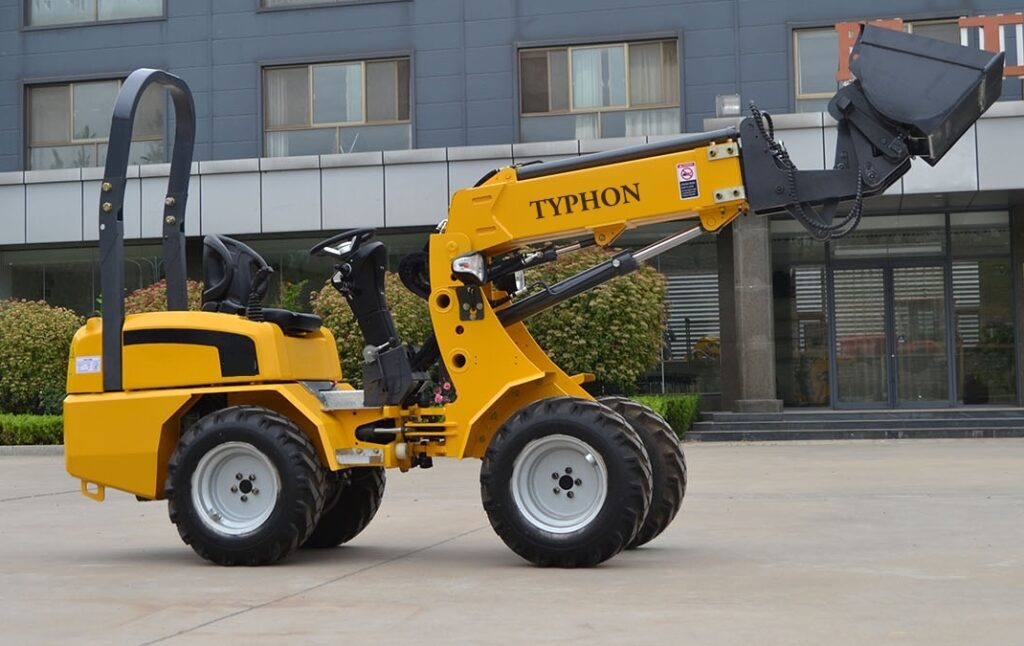
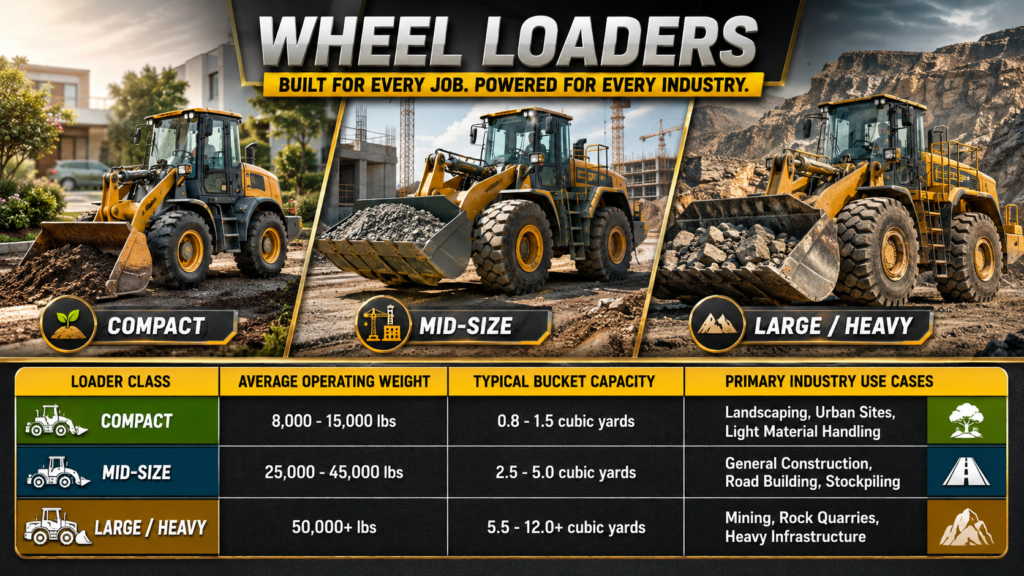
You wouldn’t use a sledgehammer to drive a finishing nail, and the same logic applies to heavy equipment. Manufacturers break wheel loaders down into different size classes to match specific job requirements. Compact wheel loaders are the darlings of urban construction and landscaping. They don’t take up much space, but they still pack enough punch to move pallets of brick or scoop topsoil in tight backyards. Moving up a weight class, mid-size loaders are the ultimate all-rounders.
If you visit a standard commercial build or roadwork project, this is usually what you’ll see. They hit the sweet spot between bucket capacity and job site mobility. Then you have the large loaders. These are absolute beasts built for rock quarries, surface mining, and major infrastructure projects. They can fill up a massive articulated haul truck in just two or three passes. Picking the right size is a huge deal—go too small, and you’ll fall behind schedule; go too big, and you’ll burn through fuel and struggle to maneuver.
Table: Wheel Loaders Use Cases
| Loader Class | Average Operating Weight | Typical Bucket Capacity | Primary Industry Use Cases |
| Compact | 8,000 – 15,000 lbs | 0.8 – 1.5 cubic yards | Landscaping, Urban Sites, Light Material Handling |
| Mid-Size | 25,000 – 45,000 lbs | 2.5 – 5.0 cubic yards | General Construction, Road Building, Stockpiling |
| Large / Heavy | 50,000+ lbs | 5.5 – 12.0+ cubic yards | Mining, Rock Quarries, Heavy Infrastructure |
- Compact models give you the agility you need for tight urban spaces without sacrificing too much lifting power.
- Mid-size loaders offer the best balance of horsepower and mobility, making them the most popular choice for general contractors.
- Large heavy-duty loaders are built strictly to maximize material handling volume per pass in extreme environments like quarries.
Expanding Functionality Through Versatile Attachments
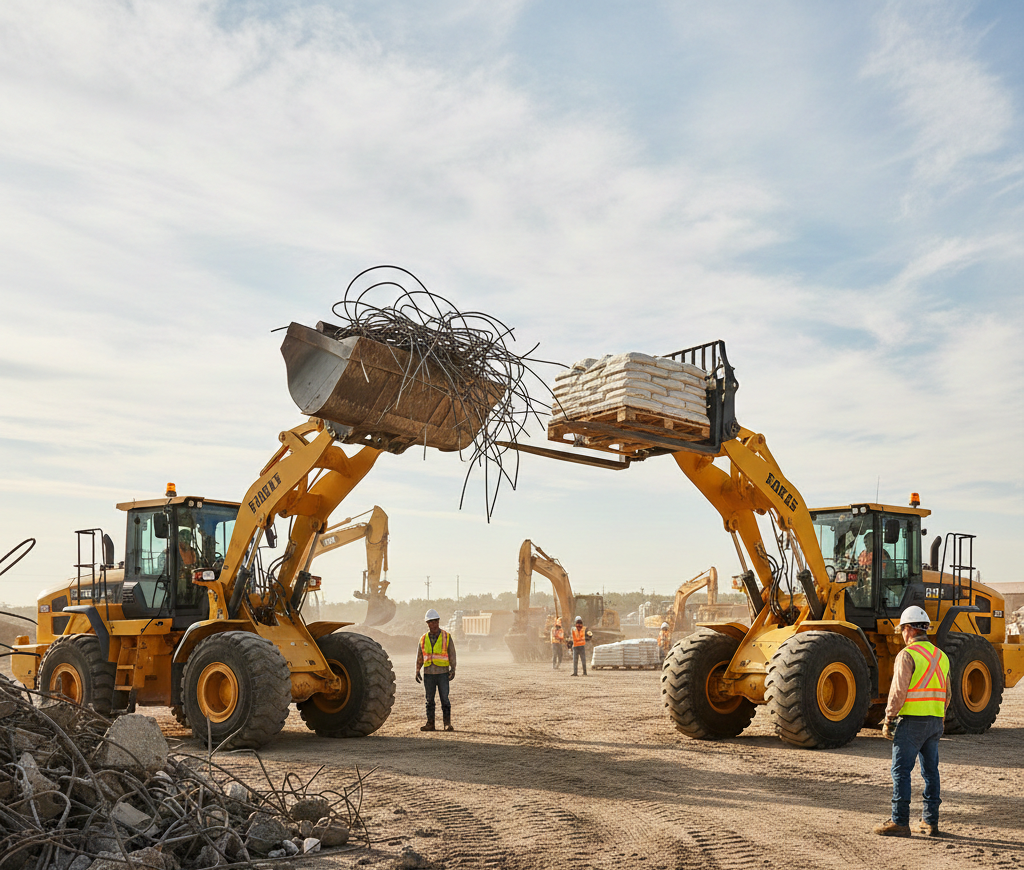
What really transforms a wheel loader from a basic dirt-pusher into the Swiss Army knife of the job site is its attachments. Sure, the standard bucket gets a lot of use, but the real magic happens when you use a quick-coupler system. Without even leaving the cab, an operator can drop the bucket and snap onto a set of heavy-duty pallet forks. Suddenly, you have an all-terrain forklift that can carry heavy lumber or cinder blocks across deep mud—places where a standard warehouse forklift would get stuck immediately. If you’re dealing with messy, awkward debris like brush, tree limbs, or scrap metal, a grapple attachment lets you clamp down hard so nothing spills during transport. And let’s not forget winter. In colder regions, throwing a massive snow pusher or plow on the front of a loader is the most efficient way to clear out huge commercial parking lots or airport runways. It basically means you’re getting three or four different machines for the price of one.
- Quick-coupler systems let operators swap out heavy attachments in just a few minutes, keeping the workflow moving.
- Slapping on pallet forks turns the machine into a rugged forklift perfect for muddy, uneven construction sites.
- Grapple buckets allow you to clamp down on awkward, shifting loads like scrap metal and logs so they don’t fall out during transit.
Why Choose rollercompactor.net for Your Heavy Machinery Needs
Let’s be real: buying heavy machinery is a massive financial commitment. You need a supplier who actually understands the dirt-world, not just a salesperson trying to hit a quota. That’s exactly why contractors trust rollercompactor.net. We know that every minute your machine is down, you’re bleeding money and falling behind schedule.
We focus heavily on equipment reliability and real customer support. Our inventory of wheel loaders and compaction gear is thoroughly inspected to make sure it can handle the daily abuse of a real construction site. But we don’t just hand you the keys and wave goodbye.
We work with you to figure out exactly what size machine and which attachments make the most sense for your specific project. We want you to feel totally confident in your investment, knowing you have a partner who has your back when it comes to maintenance tips and operational advice.
- We only stock heavy machinery that has been rigorously inspected to survive the toughest conditions you can throw at it.
- Our team offers personalized advice to make sure you don’t overspend or buy the wrong size machine for your site.
- We stick around after the sale to provide ongoing support and maintenance tips so your equipment stays profitable for years.
Maintenance and Safety Best Practices for Wheel Loaders
You can buy the toughest machine on the market, but if you don’t take care of it, it’s going to fail on you. Preventative maintenance isn’t just a suggestion; it’s how you protect your investment. It all starts with the daily walk-around. Before firing up the engine, operators need to check tire pressure, look for sneaky hydraulic leaks, and make sure all the pivot points and pins have fresh grease.
Construction sites are incredibly dusty, so keeping those engine air filters clean and checking the coolant is a daily must. On the safety side, management has to set the tone. Seatbelts are non-negotiable. Operators need to know their machine’s exact tipping load limits so they don’t end up on their side when lifting heavy wet dirt. Also, if a site is crowded, use a ground spotter when backing up. Good maintenance and strict safety rules are what keep your crew safe and your machines running well past the 10,000-hour mark.
- Daily walk-around inspections catch small hydraulic leaks and tire issues before they turn into expensive breakdowns.
- Greasing the bucket linkages and pivot points every single day prevents the metal-on-metal wear that destroys machines.
- Knowing your load limits and using ground spotters significantly cuts down on the risk of tipping over or backing into a coworker.
FAQs About Wheel Loaders
What exactly is a wheel loader used for on a construction site?
At its core, a wheel loader is used to scoop up loose material, lift it, drive it somewhere else, and dump it. They are the king of loading high-sided dump trucks with dirt, gravel, and sand. You’ll also see them heavily used for site preparation, clearing out demolition debris, and organizing material yards.
- They are the standard choice for loading bulk dirt and aggregate into haul trucks quickly.
- Contractors use them to clear out large rocks and debris to keep the site organized.
- They are essential in supply yards for managing huge piles of sand and gravel.
How do wheel loaders differ from tracked loaders?
The biggest difference is right there on the ground: tires versus tracks. Wheel loaders use heavy-duty rubber tires, making them fast and safe to drive on finished concrete or asphalt without chewing it up. Tracked loaders, on the other hand, spread their weight over steel or rubber tracks. This gives them incredible traction in deep mud and soft soil, but they are much slower and will destroy a paved road in seconds.
- Rubber tires allow wheel loaders to travel quickly across large, sprawling sites.
- Tracked machines won’t get stuck in deep mud, but they operate at much slower speeds.
- Wheel loaders are the safer choice if you need to drive over hot asphalt or fresh concrete.
What is the average lifespan of a standard wheel loader?
If you stay on top of your maintenance, a good wheel loader should give you around 10,000 to 12,000 hours of solid performance before you have to worry about rebuilding the engine or transmission. Of course, this depends heavily on what you’re doing with it. Moving soft dirt is a lot easier on the machine than ripping into abrasive rocks all day. Keep it greased, and it will last.
- Most well-maintained loaders will reliably hit 10,000 to 12,000 operating hours.
- Not pushing the machine past its weight limits saves the transmission from early failure.
- Greasing pins and checking fluids daily is the secret to extending the machine’s life.
How do I choose the correct size wheel loader for my project?
You have to match the machine to the site and the job. First, look at your space—if you’re in a tight alley, you need a compact loader. Next, do the math on your material. If you need to move hundreds of tons of rock a day, you need a large bucket. Finally, check the dump height of the trucks you are loading to make sure the loader’s arms can actually reach over the sides.
- Measure your site’s choke points to make sure you have room to turn the machine around.
- Figure out how much dirt you need to move per hour to pick the right bucket size.
- Ensure the loader’s maximum reach can safely dump into your specific haul trucks.
What are the most common attachments used with wheel loaders?
While the bucket does most of the heavy lifting, quick-couplers have made attachments incredibly popular. Pallet forks are probably the most common add-on, letting the loader act like a rough-terrain forklift. Grapples are huge for land clearing and demolition, and snow pushers turn the loader into a snow-removal beast during the winter months.
- Pallet forks let you carry building supplies like lumber across muddy ground.
- Grapples allow operators to safely grab and move awkwardly shaped debris.
- Snow plows turn the machine into a profitable winter workhorse.
Do I need a special license to operate a wheel loader?
If you are strictly driving the loader on a private job site, you usually don’t need a commercial driver’s license (CDL). But that doesn’t mean just anyone can jump in the cab. OSHA requires that operators receive formal, documented safety and operational training. If you plan to drive the machine down public roads from site to site, local laws might require additional licensing.
- A CDL usually isn’t required for private job site operation.
- OSHA strictly requires all operators to be trained and certified before using the equipment.
- Training ensures the operator understands load charts and knows how to avoid tipping over.
Can a wheel loader be used for deep excavation?
No, not really. Wheel loaders are amazing at scooping loose dirt from the surface, but they aren’t designed to dig deep holes. Their digging depth is basically limited to where their front tires sit. If you need to dig a deep utility trench, a basement, or a foundation, you need to bring in an excavator or a backhoe.
- Loaders are built to scoop surface-level material, not dig deep holes.
- They don’t have the downward reach needed to pull dirt out of a trench.
- If you need to dig below grade, a tracked excavator is the right tool for the job.