Wheel Loader Attachments: Snow Blade or Material Handling Bucket
Choosing the right wheel loader attachments is important to get the most out of your heavy machinery. Whether it’s a massive winter blizzard that could shut down city operations or moving tons of gravel on a bustling commercial construction site, the tools you put on your machine will ultimately determine your operational success.
Here at rollercompactor.net we know that heavy equipment is a major investment and you need your machines to perform flawlessly in all seasons, weather conditions and difficult terrains.
This is why knowing the differences between wheel loader attachments is so important for contractors, site managers and municipality workers who want to get the most from their fleet.
Today we are doing a thorough deep examination of two of the most popular and heavily used tools in the construction and maintenance industries. We compare snow blades and material handling buckets to help you make a very informed, cost effective decision on your next big project.
Getting a Grip on the Versatility of Wheel Loader Attachments
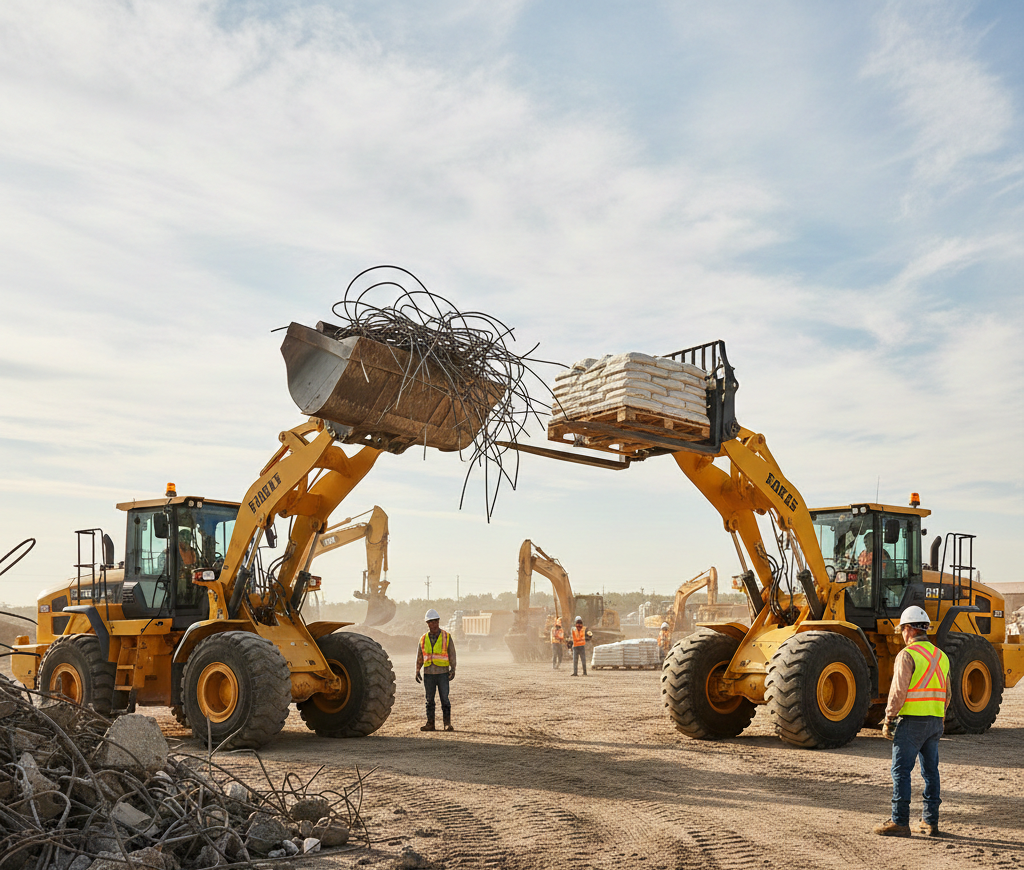
A wheel loader’s beauty isn’t just in the brute force of its engine or the size of its tires, but in its ability to become an entirely different machine by changing its front-end attachments.
With high quality wheel loader attachments, one piece of heavy equipment can perform the job of several different vehicles, saving companies thousands of dollars in rental, storage and maintenance costs for equipment. As you browse the resources available at rollercompactor.net you will quickly see that the most effective way to increase your profit margins is to match your equipment to the specific demands of your job site.
Don’t let your loader sit idle through the snowy months of winter or struggle to move loose dirt with the wrong type of blade, investing in the right wheel loader attachments will keep your crew productive 365 days a year.
- Cost Efficiency: The variety of wheel loader attachments means you don’t have to buy different machines for seasonal operations, drastically reducing the capital costs of your fleet.
- Reduced Downtime: Today’s fast coupler systems allow operators to change out attachments in minutes, which translates to less downtime on the job site and faster project completion rates.
- Expanded Service Offerings: A summer landscaping company can simply buy a new attachment and easily transition into a profitable winter snow removal business without having to buy a new truck.
The Mighty Snow Blades: Winter’s Best Friend
With the temperatures dropping and the area blanketed in heavy snow, choosing the right attachments for your wheel loader for winter is a public safety issue and a matter of keeping your business going. Snow blades, also called snow plows or angle blades, are designed to cut through heavy, wet snow and push it effectively to the side of roads, parking lots and runways.
Unlike standard buckets that just scoop up snow and quickly fill up, a snow blade allows the operator to keep moving forward, clearing huge swaths of pavement in a fraction of the time. Many of these attachments can be hydraulically angled so the driver can angle the snow to the left or to the right, without having to continually reposition the large vehicle.
Also, a good snow blade will normally have special trip edges and rubber or polyurethane cutting edges to prevent devastating scrape damage to the surface underneath such as asphalt or decorative concrete during the plowing process.
- Constant Plowing Capability: Snow blades roll snow to the side, allowing the wheel loader to clear long stretches of road or massive parking lots without having to constantly stop to dump material.
- Surface Protection Engineering: Spring-loaded trip edges and specially designed rubber cutting blades on the attachments will prevent serious damage to the road surface as well as to the machine itself in the event of a collision with a hidden obstacle.
- Hydraulic Angling: Today’s snow blades let the operator angle the blade up to 30 degrees from inside the warm cab, giving you the control and precision you need for those intricate snow removal jobs.
Material Handling Buckets: The Year Round Work Horse
Winter requires specialized tools, but the rest of the year calls for pure, unadulterated volume movement. That’s where material handling buckets come in, one of the most important wheel loader attachments on the market.
These rugged, heavy-duty attachments are the backbone of the construction, mining and agricultural industries because they are built for scooping, lifting, transporting and dumping massive quantities of loose materials such as soil, gravel, sand and mulch.
Material handling buckets are constructed from high-strength, abrasion-resistant steel that can endure the daily abuse of scraping against jagged rocks and concrete debris without compromising their structural integrity.
If you’re a contractor who depends on the heavy machinery data from rollercompactor.net, you’ll want to know the capacity and breakout force of your material handling bucket to load dump trucks quickly. Having the right-sized bucket means your operators can fill a transport truck in just two or three passes, cutting fuel use and keeping the entire supply chain moving at a fast, profitable pace.
- Huge Volumetric Capacity: These buckets are designed to maximize the cubic yards of material moved per scoop, greatly decreasing the number of cycles required to load a truck.
- Rugged Durability: Built with high-tensile steel, and often reinforced with heavy-duty wear plates and bolt-on cutting edges, to withstand the most punishing digging conditions.
- Year-Round Use: Unlike seasonal tools, a material handling bucket is used throughout the spring, summer and fall for grading, backfilling, site preparation and bulk material transport.
Snow Blades vs Material Handling Buckets: How They Compare
The decision between these two different wheel loader attachments comes down to understanding the basic mechanics of how they work with the materials you’re trying to move.
People tend to think that a regular bucket is “good enough” for snow removal but while it does physically lift snow it is extremely inefficient for removing large flat surfaces as it fills up rapidly and must be dumped constantly.
If you tried to push heavy dense gravel around with a snow blade you would soon have a broken blade and a frustrated operator . The point of a snow blade is to push lighter stuff not to lift dense aggregates . To provide our rollercompactor.net readers with the most accurate comparison, we should look at the particular design aims of each tool.
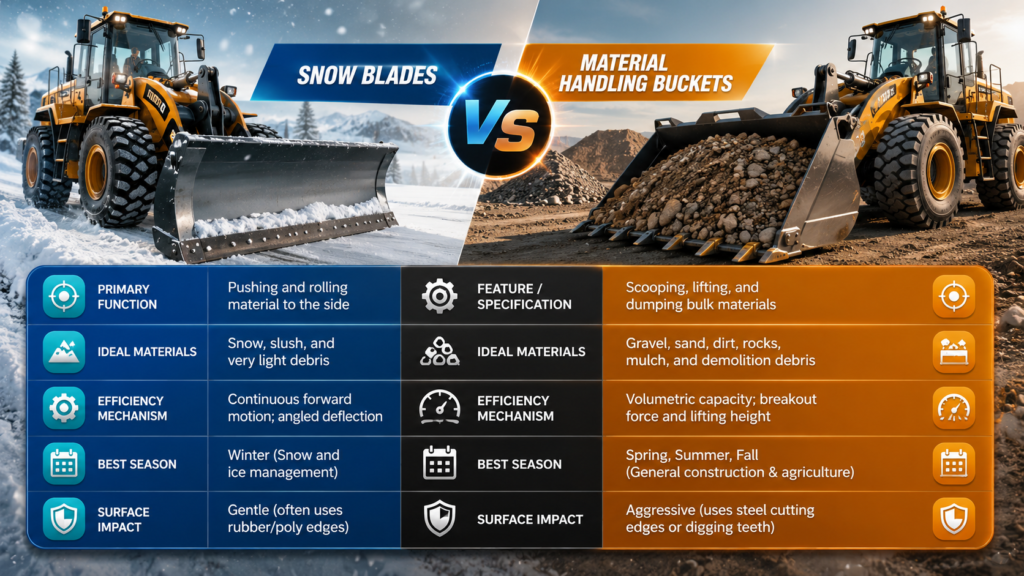
The following table highlights the operational differences between these two essential wheel loader attachments. It proves that while both are valuable, they serve very different masters on the job site.
Table: wheel loader attachments Comparison
| Feature / Specification | Snow Blades | Material Handling Buckets |
| Primary Function | Pushing and rolling material to the side | Scooping, lifting, and dumping bulk materials |
| Ideal Materials | Snow, slush, and very light debris | Gravel, sand, dirt, rocks, mulch, and demolition debris |
| Efficiency Mechanism | Continuous forward motion; angled deflection | Volumetric capacity; breakout force and lifting height |
| Best Season | Winter (Snow and ice management) | Spring, Summer, Fall (General construction & agriculture) |
| Surface Impact | Gentle (often uses rubber/poly edges) | Aggressive (uses steel cutting edges or digging teeth) |
- Operational Motion: Snow blades are all about horizontal pushing power and material handling buckets need vertical lifting and curling mechanics to work.
- Material Density: Material Density Limitations Buckets are reinforced heavily to allow for extremely dense, heavy materials such as wet clay, while blades are designed for the lighter, fluffier volume of snow.
- Cycle Times: A snow blade is on the move constantly with almost zero cycle times, while a bucket has to stop-lift-dump-reverse for every load it moves.
How to Select the Correct Accessory for Your Needs
Heavy machinery and their respective wheel loader attachments are a large financial investment, so you can’t afford to make a decision based on guesswork or incomplete information. We always advise our readers to do a full site audit and seasonal operational review when evaluating the resources available at rollercompactor.net before purchasing new equipment.
You need to ask yourself some hard questions. What is the core material I am moving 80% of the time? Does my location receive sufficient snowfall to justify a dedicated winter attachment or can I use temporary solutions? Also, you should make sure that the hydraulic flow and the operating capacity of your particular wheel loader are appropriate for the attachment you have in mind.
Mounting a huge, oversized material handling bucket on a small wheel loader can create dangerous tipping hazards. Mounting a small snow blade on a huge machine will result in extremely inefficient clearing operations.
- Assess Local Weather Patterns: If you’re in an area where you’re guaranteed to get significant winter precipitation for months on end, a dedicated snow blade will more than earn its keep in a single season of commercial plowing.
- Compare Machine Specs: Always compare the wheel loader’s lifting capacity, tipping load and hydraulic flow with the attachment manufacturer’s specifications.
- Analyze Job Site Terrain: For finished, delicate surfaces such as decorative concrete, you’ll need to choose attachments (poly-edge snow blades, for example) that don’t cause major disturbance to the ground.
Tips for Maintaining Wheel Loader Attachments
If not subjected to a rigorous, consistent preventative maintenance schedule, even the most rugged and most expensive wheel loader attachments will fail prematurely. Maintaining your equipment will ensure that it runs at peak efficiency, keep your operators safe and keep the resale value of the tools going forward.
The operator of a material handling bucket also has to be constantly checking the integrity of the weld seams, the sharpness of the bolt-on cutting edge and the condition of any digging teeth, replacing them long before they wear into the base structure of the bucket.
Hydraulic cylinders that control the angling of snow blades must be kept free of ice and corrosive road salts, and pivot points must be heavily greased to ensure smooth operation in sub-zero temperatures.
Adhering to a strict maintenance protocol, such as the ones suggested by the experts at rollercompactor.net, will ensure that your wheel loader attachments are always ready to be deployed the moment a job demands them.
- Daily Greasing: All pivot points, hinges and hydraulic cylinder pins must be greased daily to avoid grinding wear and tear.
- Corrosion Management: Attachments need to be thoroughly washed to remove road salt and de-icing chemicals that can quickly rust the steel components. This is especially critical for snow blades.
- Replace The Replaceable Cutting Edges Before They Are Worn Out: Don’t let the replaceable cutting edges on your buckets or blades wear out completely. Replace them early to prevent permanent damage to the primary moldboard or bucket shell.
FAQs About Wheel Loader Attachments
Can you use a wheel loader for snow removal?
Yes, of course. Wheel loaders are very good at moving snow, especially if they have certain wheel loader attachments like snow blades or snow pushers. They can clear a large commercial lot much faster than a regular pickup truck.
Do wheel loader attachments fit all models?
Not all of them. Many modern wheel loaders have quick-coupler systems that can accommodate a variety of universal attachments, but you still need to verify the pin sizes, hydraulic flow requirements, and weight capacities to ensure compatibility with your particular machine brand.
What is the Best Wheel Loader Attachment for Snow Moving?
For large open areas, a hydraulic snow blade or box style snow pusher are by far the best choice. Unlike a standard bucket, they provide the operator with the ability to constantly push large volumes of snow without having to stop to dump.
What is the price of a wheel loader snow blade?
Prices can vary wildly depending on size, brand and features such as hydraulic angling or trip edges. You can expect to pay anywhere between $4,000 and over $15,000 for a commercial snow blade for a wheel loader.
Can a material handling bucket be used to plow snow?
You can technically use a material handling bucket to move snow, but it’s very inefficient for plowing flat surfaces. Buckets fill up fast and you have to stop and dump them all the time so they’re better for lifting snow into dump trucks than plowing lots.
How to Extend the Life of a Material Handling Bucket
The best way to extend your bucket’s life is to make it repairable with replaceable wear parts including bolt-on cutting edges and weld-on heel plates. These parts are sacrificial and wear away but can be replaced so that the actual structural steel of the bucket does not wear away.
Which is better a snow pusher or an angle snow blade?
Depends on the property. Box plows are great for pushing large amounts of snow straight ahead on big, wide open parking lots. Angle snow blades are much better at clearing long roads or dealing with complex obstacles where you need to windrow the snow to the side.