Wheel Loader Attachments for Roadwork and Paving: What You Need to Know
Let’s be honest—managing a road construction or paving site is a massive headache if you don’t have the right gear. You are constantly fighting the clock, weather, and budget constraints. On these job sites, your wheel loader is pretty much the undisputed MVP. But the machine itself is only half the story. The real magic happens when you hook up the right tools. Figuring out the best wheel loader attachments for roadwork and paving is exactly how smart contractors turn a single piece of heavy machinery into a multi-tool that does the work of three different machines.
Getting the attachment right means you finish the job faster, keep your crew safer, and avoid burning cash on rental equipment you only use for a few hours. Getting it wrong? You risk tearing up your materials, burning out your loader’s hydraulics, and bringing the whole project to a grinding halt. If you want to get the absolute most out of your iron, you need to know exactly what to hang on the front of it. Let’s break down the wheel loader attachments for roadwork and paving that are actually worth your time and money.
The Everyday Essentials: Core Attachments You Simply Can’t Ignore
Before you start looking at crazy, specialized gadgets, you need to make sure your baseline setup is solid. Every single paving job is going to require you to move dirt, haul supplies, and swap tools out fast. If your loader isn’t set up for the basics, you are going to bleed time and money right from day one. These core tools ensure your loader never has an excuse to sit idle in the staging area.
- Heavy-Duty Material Buckets: You might think a bucket is just a bucket, but that couldn’t be further from the truth on a paving site. Standard, high-capacity buckets are your bread and butter for moving massive mounds of gravel, sand, topsoil, and loose aggregate. Getting a bucket with the right yardage capacity means your operator makes fewer trips to load dump trucks, saving fuel and drastically cutting down cycle times.
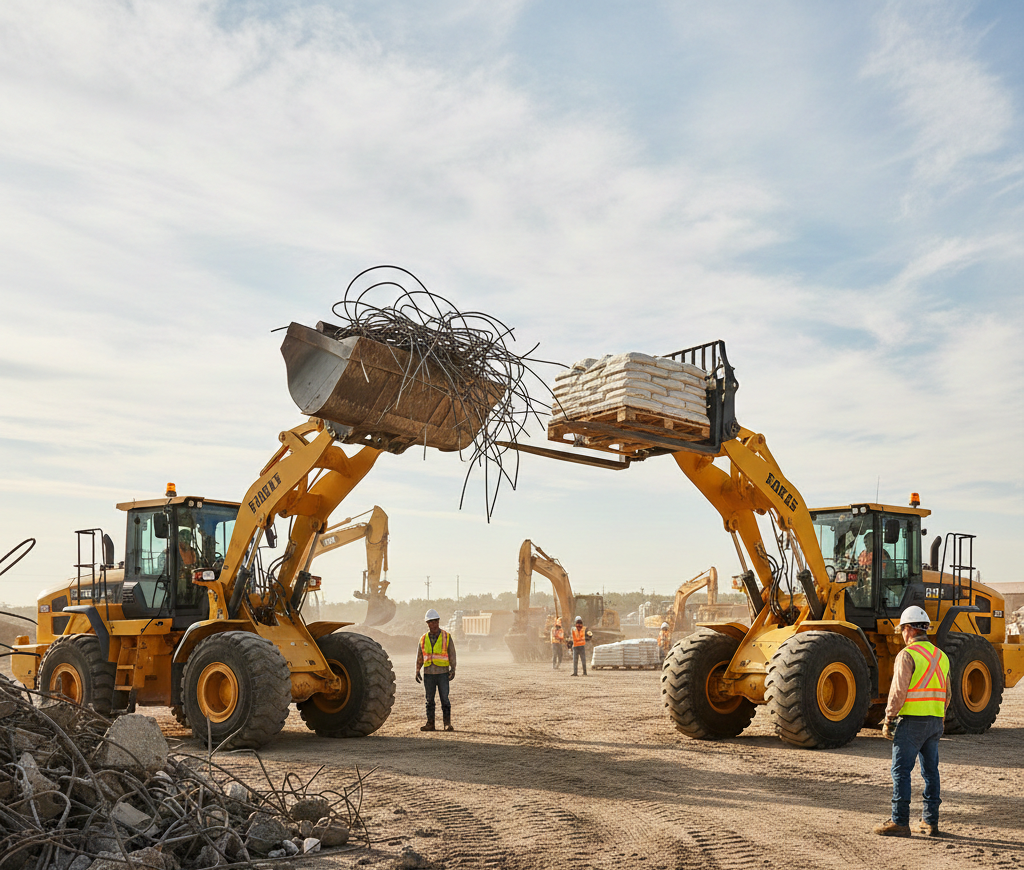
- Hydraulic Quick Couplers: Honestly, if your loader doesn’t have a quick coupler yet, you are living in the past. This isn’t a dirt-moving tool itself, but it completely changes how your job site flows. It lets your operator drop a dirt bucket and hook up to pallet forks in about thirty seconds without ever stepping out of the cab. That means no more hammering out pins in the blazing sun or freezing cold.
- Industrial Pallet Forks: The second you unchain your loader and swap to pallet forks, you suddenly have an all-terrain forklift at your disposal. Paving jobs require moving heavy pallets of block, bags of cement, and drainage pipes across soft, uneven ground that a standard forklift simply cannot handle. Forks give you the stability and reach to put materials exactly where your crew needs them.
The Heavy Hitters: Tackling Brutal Demolition and Debris
Roadwork isn’t just laying down fresh, smooth asphalt. Half the job usually involves ripping out the old road and dealing with absolute garbage terrain. Standard buckets will get shredded if you try to use them for heavy demolition. You need attachments built with high-tensile steel that can take a serious beating without bending out of shape.
- Reinforced Rock Buckets: When you are tearing up old pavement, ripping out concrete curbs, or handling sharp, abrasive riprap, a rock bucket is mandatory. These are built with thicker steel, hardened wear plates, and a specialized curved design that helps roll the heavy stuff back into the pocket safely. They are designed to take the impact of huge boulders and concrete slabs without busting the welds.
- Grapple Attachments: Trying to pick up irregular debris like tree stumps, brush, or jagged chunks of rebar-laced concrete with a regular bucket is a nightmare. Stuff just spills out the sides. A grapple bucket uses powerful hydraulic jaws to clamp down on awkward loads, pinning them in place. It keeps your haul secure while you bounce across rutted job sites, making it a massive safety upgrade.
- Root and Debris Rakes: Site prep is everything. Before you even think about putting down a sub-base, the dirt has to be clean. Rake attachments let you sift right through the topsoil, snagging rocks, roots, and trash while letting the good dirt fall right back through the tines. You can get these with or without hydraulic grapples on top, and they are perfect for getting the ground leveled and prepped fast.
Specialty Tools for Paving and Flawless Prep Work
Once the heavy lifting and demolition are out of the way, the job shifts to precision. Paving requires a perfect surface, and there are specific attachments built exactly for this phase. Instead of sub-contracting this work out or renting dedicated machines, a smartly equipped loader can handle the finish work.
- Cold Planers (Milling Heads): If you are doing street repairs, patching, or tying a new driveway into an existing road, a cold planer attachment is a game-changer. It mills off the top layer of damaged asphalt or concrete so you have a flush surface to pave against. While it won’t replace a massive highway milling machine, it is wildly profitable for localized repairs and trenching.
- Rotary Sweeper Brooms: You absolutely cannot lay asphalt on a dirty surface. If there is dust or loose millings on the ground, the new road will just peel right off. Hydraulic sweeper brooms snap onto the front of your loader and scrub the road surface totally clean just before the tack truck rolls through. They usually come with water kits to keep the dust down, which keeps your crew happy and OSHA off your back.
- Snow and Angle Blades: Roadwork contractors need to make money in the winter, too. When paving season slows down, throwing an angle blade or a snow pusher on your loader turns it into a snow-clearing beast. Using a wheel loader attachments for roadwork with a blade is incredibly efficient for clearing massive commercial parking lots, access roads, and staging areas, keeping your equipment profitable year-round.
Making the Call: How to Choose the Right Setup
Buying attachments is an investment, and you don’t want to waste money on something your loader can’t even run. It is really easy to look at a massive grapple bucket and think it will solve all your problems, only to realize it makes your machine tip forward. You have to match the tool to the tractor by choosing the right wheel loader attachments for roadwork and paving.
- Checking Hydraulic Flow (GPM and PSI): This is the number one mistake buyers make. Attachments with moving parts—like cold planers, sweepers, and grapples—need hydraulic fluid to spin and squeeze. You have to check your loader’s manual to see if it provides standard flow or high flow, and make sure those numbers match what the attachment demands. If they don’t, the tool will just stall out.
- Understanding Safe Operating Load: An attachment is basically dead weight sitting way out in front of your front axle. You have to calculate the weight of the attachment itself plus the heaviest load you plan on picking up. If that total weight exceeds your loader’s tipping load capacity, the back wheels are going to come off the ground. That is incredibly dangerous for the operator and the crew.
- Traction and Tire Considerations: Heavy attachments completely change the physics of your machine. If you are running a heavy rock bucket and trying to push into a pile of concrete on loose gravel, regular tires are going to spin out and get chewed up. You need to evaluate if your current tire tread (or track setup, if running a compact loader) has enough grip to handle the extra resistance these heavy-duty attachments create.
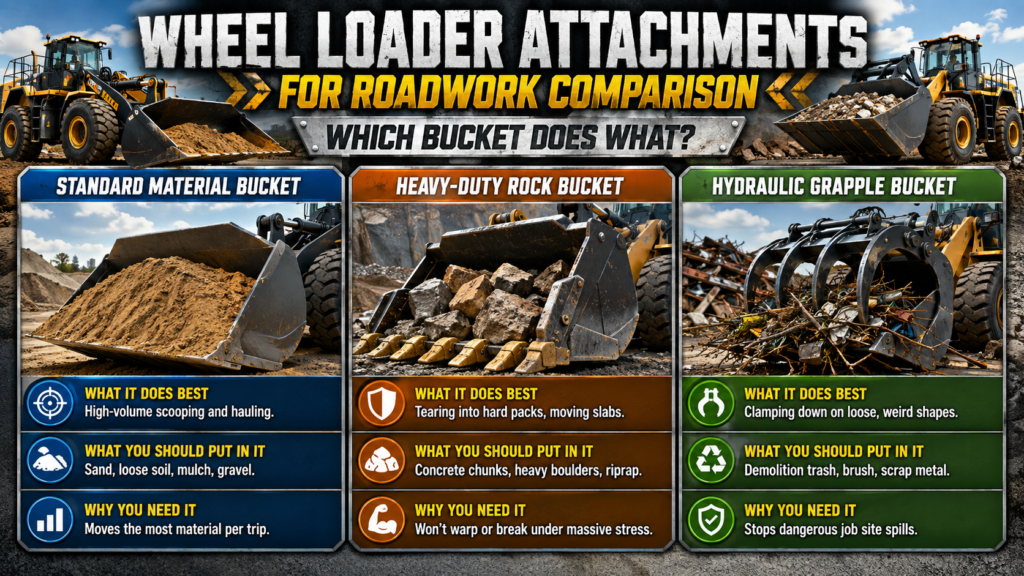
Table: Wheel Loader Attachments for Roadwork Comparison: Which Bucket Does What?
| Attachment Type | What It Does Best | What You Should Put In It | Why You Need It |
| Standard Material Bucket | High-volume scooping and hauling. | Sand, loose soil, mulch, gravel. | Moves the most material per trip. |
| Heavy-Duty Rock Bucket | Tearing into hard packs, moving slabs. | Concrete chunks, heavy boulders, riprap. | Won’t warp or break under massive stress. |
| Hydraulic Grapple Bucket | Clamping down on loose, weird shapes. | Demolition trash, brush, scrap metal. | Stops dangerous job site spills. |
FAQs – Wheel Loader Attachments for Roadwork
What are the absolute most common wheel loader attachments for roadwork and paveing?
For most road crews, standard dirt buckets, pallet forks, hydraulic sweeper brooms, and quick couplers make up the core setup. You’ll see these on almost every single paving site because they handle 90% of the day-to-day lifting, cleaning, and staging work.
How do I actually know if a wheel loader attachments for roadwork will fit my specific need?
You have to check three things: first, does the mounting plate match your loader’s coupler system (like ISO, JRB, or a pin-on setup)? Second, can your machine lift the attachment when it’s totally full of dirt? Third, if it has hoses, does your machine pump out enough hydraulic gallons per minute (GPM) to run it?
Can I use a wheel loader instead of renting a real milling machine?
Yes and no. If you just need to mill out a few utility trenches, fix some potholes, or shave down a transition joint, a cold planer attachment on a loader is perfect. But if you need to mill two miles of a four-lane highway, you need to hire a dedicated high-production milling machine.
Why should I spend the extra money on a quick coupler?
Because time is quite literally money. If your operator has to spend 20 minutes banging out rusty pins with a sledgehammer to switch from a bucket to forks, you are paying your whole crew to stand around and watch. A quick coupler lets them switch tools in seconds, keeping the whole job moving.
Are grapple buckets really worth the money for paving?
If you are strictly laying asphalt, probably not. But if you are doing the site prep, ripping out old curbs, tearing down small structures, or clearing trees to widen a road, a grapple bucket is worth its weight in gold. It makes handling demolition garbage much safer and way faster.
Why do I need a sweeper attachment before laying asphalt?
Asphalt needs to stick to the surface below it. If you spray your tack coat (the glue) over a layer of dust, dirt, or loose gravel left behind by the milling process, the new asphalt will eventually peel up or crack. Sweepers scrub that surface totally raw so the new road bonds perfectly.
Can I use my wheel loader for snow removal to keep making money in winter?
Absolutely. Paving might stop when it freezes, but loaders are amazing for snow removal. By snapping on a massive snow pusher box or a hydraulic angle blade, you can contract out your loader to clear shopping malls, hospital lots, and local roads until paving season starts back up.