How Modern Attachments are Redefining Wheel Loader Efficiency in Heavy Construction
Let’s be honest about how things actually work on a modern job site. The heavy construction industry doesn’t leave much room for error, and it certainly doesn’t leave room for wasted time. You are constantly fighting against strict deadlines, unpredictable weather, and budgets that seem to shrink by the day. At the absolute center of all this controlled chaos is the wheel loader attachments.
For the longest time, this machine was just the resident muscle of the job site—a heavy lifter relied upon purely for its brute force and ability to push dirt from point A to point B. But the landscape of civil engineering, roadwork, and general contracting has changed.
You can’t just throw a bunch of single-use machines at a problem anymore; it costs too much money and clutters up the site. This is exactly where modern wheel loader attachments come into play, completely flipping the script on how we approach material handling.
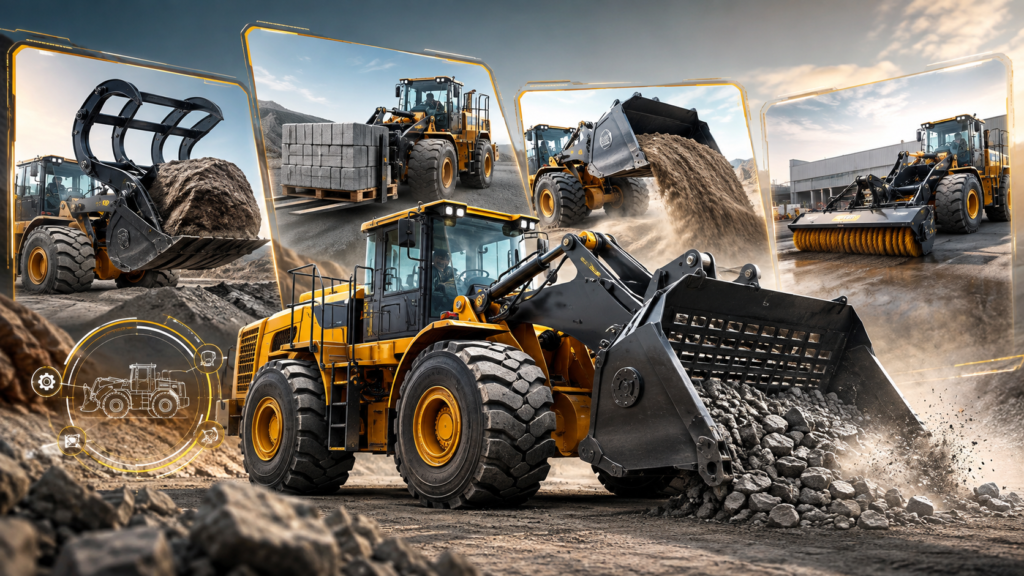
By ditching the standard bucket for highly specialized, hydraulically driven tools, crews are turning their everyday earthmovers into incredibly versatile workhorses. Instead of waiting for a forklift to arrive to move some pallets, or a dozer to clear brush, the loader handles it all.
This shift means you need fewer machines burning expensive diesel on site, which slashes your maintenance overhead and massively boosts your overall wheel loader efficiency. As projects get tighter and more demanding, adapting your iron with the right attachments isn’t just a nice upgrade—it is the only way to stay competitive and keep your workflow moving smoothly from the first ground-breaking to the final grade.
The Evolution of Wheel Loader Attachments in Construction
If you look back a couple of decades, wheel loaders were pretty much one-trick ponies. You bought the machine, it came with a massive general-purpose bucket, and that was exactly what you used it for—scooping and dumping dirt, gravel, or sand day in and day out.
It was great for basic earthmoving, but this limitation meant construction companies had to spend a fortune building out massive fleets. If you needed to move pipes, you had to bring in a forklift.
If you had to clear large debris, you needed an excavator with a thumb. The evolution of modern wheel loader attachments has completely shattered that outdated way of operating. Today’s attachments are built from high-yield steel and hook into incredibly advanced hydraulic systems that give operators a crazy amount of precision.
It is completely normal now to see a single wheel loader clear a wooded lot, lay down aggregate, move heavy palletized stone, and sort through demolition scrap all before the crew breaks for lunch. This shift toward multi-tool machinery doesn’t just make logistical headaches disappear; it physically frees up space on tight, congested job sites where too much equipment can actually become a hazard. Modern wheel loader attachments have evolved from being optional add-ons to becoming the very heartbeat of job site productivity.
- Shrinks the required equipment fleet: When one machine can do the job of three, you instantly stop wasting capital on renting or buying specialized, single-purpose heavy equipment.
- Massively improves job site safety: Less iron driving around a cramped construction site means fewer blind spots, less traffic, and a much lower risk of accidents involving your ground crew.
- Keeps project timelines aggressive: Operators don’t have to sit around drinking coffee while waiting for a delivery truck or a specialized machine to show up; they just swap the tool and keep working.
- Drives down daily operating costs: Running one multi-use machine cuts your daily diesel fuel consumption, reduces the number of oil changes you need to do, and lowers your overall insurance premiums.
Essential Wheel Loader Attachments for Maximum Productivity
To actually get the most out of your iron, you need to understand exactly what these different tools can do when the pressure is on. Maximizing wheel loader efficiency means pairing the right implement with the right material, and a few specific attachments have become absolute staples in the heavy construction world.
General-purpose buckets are still the bread and butter for moving loose, easy materials. But what happens when the terrain gets nasty? That is where rock buckets step up. They are built with heavy-duty tines and gaps that let loose dirt fall right through while holding onto massive, abrasive boulders.
This keeps the loader from lifting unnecessary weight and saves wear on the arms. Then you have grapple buckets, which are absolute lifesavers during demolition or land clearing. With hydraulic upper jaws that bite down hard, grapples can securely grab oddly shaped debris like twisted rebar, tree stumps, and busted concrete chunks that would normally just spill out of a regular bucket.
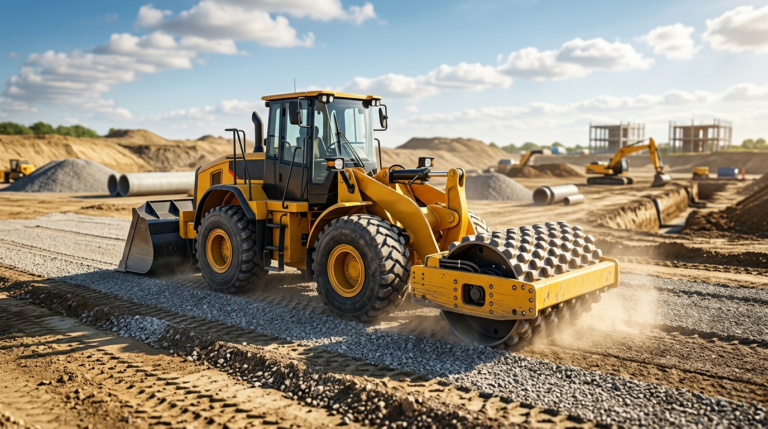
And for pure logistics, nothing beats a solid set of heavy-duty pallet forks. You pop these on, and suddenly your massive earthmover is a rough-terrain forklift that can carry heavy pipes, block, and equipment across deep mud where a standard warehouse forklift would immediately sink. By keeping these specific wheel loader attachments on hand, a good crew can pivot to handle almost any material challenge without breaking a sweat.
- Grapple buckets lock down ugly loads: The hydraulic biting mechanism grabs hold of awkward, uneven demolition debris and brush, making site cleanup significantly faster and safer.
- Rock buckets save your machine’s lifting capacity: By sifting out the loose dirt and only holding the heavy rock, these buckets prevent you from maxing out the loader’s payload with useless soil.
- Pallet forks solve off-road logistics: You can effortlessly move heavy, palletized construction materials across rutted, muddy job sites without having to rely on a separate, dedicated forklift.
- General-purpose buckets stay in the mix: Even with all the fancy tools out there, these rugged buckets remain the best option for quickly loading aggregate into dump trucks and hoppers.
Quick-Coupler Systems: The Catalyst for Wheel Loader Efficiency
You can own all the wheel loader attachments in the world, but if it takes your crew an hour to swap them out, you are losing money. Anyone who has been in the industry for a while remembers the nightmare of manual attachment changes.
You had to get out of the cab, grab a sledgehammer, and try to manually line up heavy, greasy steel pins and hydraulic lines while fighting the mud and the weather. It was frustrating, dangerous, and killed your productivity for the morning. Today, hydraulic quick-coupler systems have completely eliminated that headache.
With a modern quick-coupler, an operator can drop a rock bucket, drive up to a set of pallet forks, hook in, and lock the hydraulics without ever opening the cab door. The whole process takes maybe two or three minutes. This kind of rapid interchangeability is what actually unlocks true wheel loader efficiency.
It keeps the machine in constant motion. If a flatbed full of cement blocks unexpectedly shows up during a grading task, the operator can switch to forks, unload the truck, and get right back to grading before the concrete crew even knows what happened. The sheer speed of these couplers ensures that you are paying your guys to actively move materials, not to wrestle with stubborn machinery pins.
- Practically eliminates tool-change downtime: Swapping heavy implements takes minutes instead of an hour, meaning the machine spends its entire shift actually being productive and making money.
- Keeps operators safe and comfortable: Nobody has to risk smashed fingers, pulled backs, or slip-and-fall injuries wrestling with heavy steel pins and sledgehammers in the mud.
- Pushes equipment utilization to the max: A loader equipped with a quick coupler never sits idle; it constantly adapts to whatever the job site throws at it throughout the day.
- Gives foremen ultimate site flexibility: Site managers love them because they can instantly redirect a loader to handle surprise deliveries or urgent cleanup tasks without ruining the day’s schedule.
Leveraging Attachments for Roadwork and Paving Applications
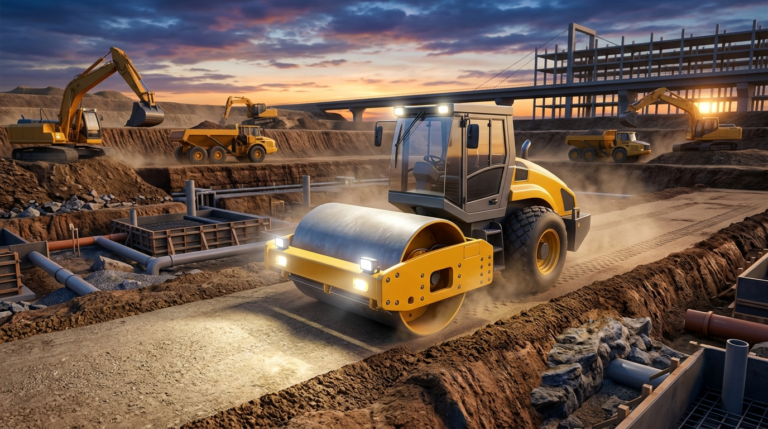
When you get into road construction and paving, the pressure gets cranked up to a whole new level. Paving sites are fast-paced, highly orchestrated, and heavily reliant on companion equipment like vibratory and static roller compactors.
If the asphalt gets cold, or the sub-base isn’t perfectly prepped, the whole job is a bust. In this environment, wheel loader efficiency is critical, and modern wheel loader attachments are the unsung heroes keeping the paving train moving.
Think about site prep—sweeper attachments can be hooked up to rapidly clear a milled surface of dust and loose gravel before the roller compactor comes in to do its final pass. If that base isn’t clean, the compactor won’t get the right density.
You also see heavy-duty milling buckets being used to scrape away degraded asphalt patches in tight urban environments. And when the hot mix is actively being laid down, loaders equipped with large-capacity material buckets are constantly running aggregate back and forth to keep the hoppers full. If that loader stops, the paver stops, and that costs serious money.
By utilizing these specialized attachments, a single loader acts as the ultimate support vehicle, ensuring that everything from the initial dirt work to the final pass of the roller compactor happens flawlessly.
- Creates the perfect base for compactors: Using grading and sweeper tools ensures the ground is pristine and leveled, which allows roller compactors to hit their required compaction density much faster.
- Stops paving delays dead in their tracks: High-capacity material handling buckets keep asphalt pavers and material transfer vehicles constantly fed, preventing the dreaded cold joints in the road.
- Eats through heavy road debris: Grapples and reinforced buckets make quick work of massive chunks of torn-up asphalt and old concrete curbing that need to be cleared out of the way.
- Acts as a heavy-duty highway gopher: Switching to forks allows the loader operator to quickly move heavy concrete jersey barriers and massive drainage pipes right to the edge of the active trench.
Comparing Traditional vs. Modern Attachment Workflows
If you really want to see how much things have changed, you have to look at the numbers and the workflow of the old way versus the new way. In a traditional setup, a contractor buys a loader with a standard bucket and treats it as a single-purpose tool.
When the scope of work naturally shifts—say, the dirt work finishes and now you need to stage massive pallets of brick—that loader becomes completely useless. It just sits there idling while the contractor scrambles to pay daily rental rates for a rough-terrain forklift.
It creates logistical bottlenecks, wastes money, and clogs up the workspace. Now look at the modern workflow. A contractor brings in a single machine equipped with a hydraulic quick-coupler and a handful of smart wheel loader attachments.
That one operator can dig the foundation in the morning, use a grapple to move downed trees at lunch, and switch to forks in the afternoon to unload supply trucks. It is a completely fluid, highly adaptable way to work. The return on investment (ROI) is incredibly obvious when you realize you are only fueling, maintaining, and transporting one engine instead of three. It is the smartest way to handle modern heavy construction.
- Supercharges your Return on Investment: Spending money on a few high-quality iron attachments is vastly cheaper than financing, transporting, and maintaining three separate pieces of heavy machinery.
- Kills job site waiting times: You completely eliminate the downtime associated with waiting for a rental company to deliver a specialized machine just to do a two-hour job.
- Slashes your overhead operating costs: When you consolidate your workflow into one machine, you buy less diesel, do fewer oil changes, and deal with far less equipment depreciation.
- Makes fleet management a breeze: Keeping track of maintenance schedules, winter storage, and insurance policies for one loader is infinitely easier than managing a sprawling fleet of vehicles.
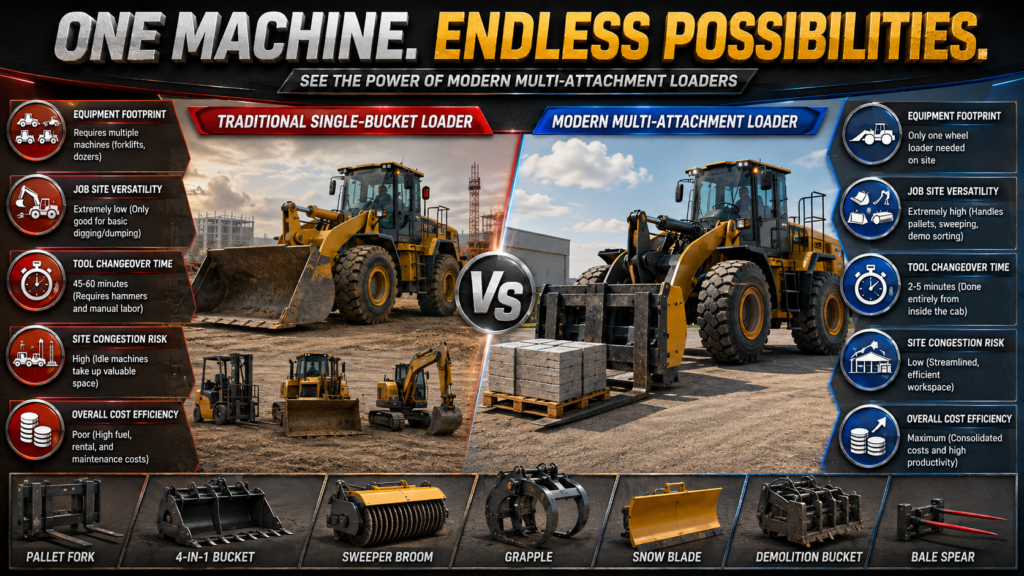
Table: Wheel Loader Attachments Operational Metrics
| Operational Metric | Traditional Single-Bucket Loader | Modern Multi-Attachment Loader |
| Equipment Footprint | Requires multiple machines (forklifts, dozers) | Only one wheel loader needed on site |
| Job Site Versatility | Extremely low (Only good for basic digging/dumping) | Extremely high (Handles pallets, sweeping, demo sorting) |
| Tool Changeover Time | 45-60 minutes (Requires hammers and manual labor) | 2-5 minutes (Done entirely from inside the cab) |
| Site Congestion Risk | High (Idle machines take up valuable space) | Low (Streamlined, efficient workspace) |
| Overall Cost Efficiency | Poor (High fuel, rental, and maintenance costs) | Maximum (Consolidated costs and high productivity) |
FAQs – Wheel Loader Attachments
What are the most common wheel loader attachments used today?
The heavy hitters you will see on almost every job site include general-purpose buckets for standard digging, rock buckets for sifting out dirt from heavy stones, grapple buckets for gripping demolition debris, and pallet forks for moving palletized materials.
How do quick-coupler systems actually improve wheel loader efficiency?
They eliminate the manual labor of changing tools. Quick couplers use hydraulics to let the operator drop one attachment and pick up another in just a few minutes without leaving the cab, meaning the machine never stops working.
Can a wheel loader equipped with attachments replace a standard forklift?
Absolutely. If you throw a set of heavy-duty pallet forks on a loader, it essentially becomes a massive, rough-terrain forklift that can carry incredibly heavy loads through deep mud and uneven ground where a warehouse lift would get stuck immediately.
What is a grapple bucket primarily used for in heavy construction?
Grapple buckets have powerful, hydraulically operated top jaws that clamp down on awkward, bulky stuff. They are perfect for grabbing tree stumps, scrap metal, brush, and uneven concrete rubble that would otherwise roll right out of a normal bucket.
Are rock buckets really better than standard buckets for earthmoving?
If you are dealing with rocky soil, yes. They are built with thick steel tines that let the loose dirt sift through while holding the heavy rocks. This prevents you from maxing out the machine’s weight limit with dirt you don’t even want to move.
How do I choose the exact right wheel loader attachment for my project?
You have to look at what you are doing the most. Match the attachment to the primary material density, factor in your machine’s tipping load and operating weight, and always check the manufacturer specs to ensure you aren’t overloading the hydraulics.
How do modern attachments actually reduce heavy construction costs?
They let one machine do the work of three. By using attachments, you stop renting extra equipment, you burn way less diesel fuel, you cut down your regular maintenance costs, and you don’t need to pay three different operators.
Wheel Loader Attachments – Roller Compactors
At Roller Compactor, we know firsthand that whether you are doing deep soil stabilization, prepping a massive commercial parking lot, or laying down fresh highway asphalt, having the right iron makes or breaks the job. In the brutal world of heavy construction, being adaptable is exactly how you stay profitable.
Modern wheel loader attachments have taken a standard piece of earthmoving equipment and turned it into the ultimate job site multi-tool. By utilizing things like heavy grapple buckets, rock sifters, and rugged pallet forks—and tying them all together with a rapid quick-coupler system—you can strip away bottlenecks and push your crew’s daily output through the roof. Investing in these versatile tools protects your bottom line and ensures your fleet is always ready for whatever the dirt throws at you next.
Wheel loader attachments