The Future of Compaction: Innovations in Roller Compactor Technology
Let’s face it, when most people think construction equipment they think sheer force. That’s what really held the road building and foundation work back for a long period. You grabbed the biggest piece of steel you could find, rolled it over dirt or asphalt until it looked flat and prayed for the best. But the needs of contemporary infrastructure have totally transformed the game with the latest roller compactor technology innovations in today’s modern trending market.
We need roads that don’t crack up after one bad winter. Foundations that don’t settle under the weight of enormous buildings. The heavy machinery business had to get smart on how to fulfill these crazy new demands. At the core of this tremendous shift is the rapid growth of roller compactor technology. We’re no longer dependent on dead weight.
Today’s compactors are filled with digital software, innovative hydraulics and eco-friendly power systems that transform these lumbering beasts into precise engineering tools. By abandoning the traditional “guess and check” approaches, today’s contractors are getting the job done faster, safer and with a whole lot less rework. “The future of compaction is really about being smarter, using data to get the perfect density every time and ultimately saving a ton of money in long-term maintenance.”
The Rise of Intelligent Compaction Systems (ICS)
If you’ve spent any time on a job site lately, you’ve probably noticed that the days of just guessing if a subgrade is packed tight enough are long gone. That’s all thanks to Intelligent Compaction Systems, or ICS for short. This is where modern roller compactor technology really shines. Think of ICS as a giant, rugged smartphone built right into the dashboard of the machine.
In the old days, an operator had to rely on their gut feeling or wait for someone to come out and do physical core sampling. It was slow, and honestly, it left a lot of room for error. You’d either under-compact the soil, leading to potholes later on, or over-compact it, which crushes the aggregate and ruins the material. Intelligent systems completely fix this by using heavy-duty sensors and GPS tracking. The roller constantly reads the stiffness of the ground underneath the drum and shows the operator a real-time, color-coded map on a screen in the cab. You know exactly where you’ve been, exactly how many passes you’ve made, and exactly when you hit the sweet spot.
- No More Guesswork: Operators get instant, real-time feedback on screen showing the actual stiffness of the soil or asphalt, letting them adjust their speed or vibration on the fly.
- Pinpoint GPS Tracking: The onboard GPS maps out the entire job site, meaning the operator knows exactly where they’ve rolled. This completely stops missed spots and overlapping mistakes.
- Built-in Accountability: These systems record every single byte of data during the job. If a state inspector or project manager wants proof that the compaction hit the required specs, you can just hand them the digital report.
- Saving Fuel and Time: Because the computer tells the operator exactly when maximum density is reached, they don’t waste fuel doing unnecessary passes that could actually damage the material.
Advancements in Vibratory Roller Mechanisms
When it comes to getting a really deep, solid base, static weight just doesn’t cut it. That’s why vibratory rollers have been a staple in road building equipment for years. But the latest innovations in roller technology have taken vibration to a whole new level. A modern vibratory compactor uses internal weights inside the steel drum that spin fast to create a massive amount of shaking force.
This shaking breaks the friction between the dirt, gravel, or asphalt particles, forcing them to lock together tightly. Older machines usually just had a simple “on” or “off” switch for the vibration. You got what you got. Today’s roller compactor technology is way more adaptable. Operators can now tweak the exact amplitude (how hard the drum hits) and frequency (how fast it hits) to perfectly match whatever material they are driving over. This is a huge deal when you need a machine versatile enough to aggressively pound cohesive clay in the morning and then gently smooth out a fresh asphalt overlay in the afternoon.
- Dialing in the Perfect Force: Operators have total control over variable amplitude and frequency settings, meaning one machine can handle multiple types of materials without breaking a sweat.
- Directional Vibration: The newest tech actually lets the operator direct the vibrational force straight down for deep compaction, or more horizontally to avoid tearing up delicate surface layers.
- Smarter Hydraulics: Upgraded hydraulic drive systems give the machine the raw torque it needs to keep a steady speed, even when pushing through thick, sticky mud or steep inclines.
- Protecting the Surroundings: Some high-end compactors can automatically sense the ground’s natural resonance and adjust their shaking so they don’t accidentally crack the foundations of nearby buildings or bust underground pipes.
Autonomous and Eco-Friendly Compaction Equipment
Construction has always been a loud, diesel-heavy industry, but the push for going green is finally hitting the pavement. As environmental regulations get tighter, especially in big cities, manufacturers are leaning hard into eco-friendly roller compactor technology. We are starting to see fully electric and hybrid compactors rolling out on major job sites. These machines produce zero emissions where they work, which is an absolute lifesaver for indoor jobs, tunnels, or urban neighborhoods where people don’t want to hear a roaring diesel engine at six in the morning. But the battery power isn’t even the craziest part—it’s the self-driving tech. Autonomous rollers are stepping right out of sci-fi and onto the dirt. Using a mix of 3D mapping, radar, and LiDAR sensors, these machines can literally drive themselves around a construction zone. Taking the operator out of the cab removes a ton of safety risks, especially when working on dangerous edges or steep embankments, all while delivering a flawlessly precise rolling pattern that a human driver would struggle to match perfectly.
- Quiet, Clean Power: Battery-powered electric drives eliminate on-site greenhouse gases and dramatically cut down on engine noise, keeping neighbors happy and hitting sustainability goals.
- Keeping Workers Safe: By letting the machine drive itself, companies keep their crew out of high-risk situations like rollover hazards on steep slopes or toxic landfill environments.
- Robotic Precision: Autonomous compactors follow digital blueprints to the exact inch. They don’t get tired, they don’t get distracted, and they execute the perfect rolling pattern every single time.
- Better Fuel Efficiency: Even the new hybrid models use smart tech to manage engine loads perfectly, burning way less diesel and cutting down operational costs for the contractor.
Improved Roller Compactor Parts and Predictive Maintenance
You can have all the fancy software in the world, but if your machine breaks down, you’re still losing money. That’s why a massive chunk of recent innovation has been quietly focused on the physical roller compactor parts themselves, along with how we take care of them. Compacting dirt and rock is brutal work.
The friction and pressure wear down steel drums, chew up scraper blades, and blow out hydraulic seals. To fight this, manufacturers are now casting parts from highly specialized, wear-resistant steel alloys and using heavy-duty polyurethane for things like scraper systems. But the real game-changer is predictive maintenance. Thanks to tiny IoT (Internet of Things) sensors baked into the machine’s guts, the compactor essentially monitors its own health.
Instead of just changing the oil every few months and crossing your fingers, the machine will send an alert to your phone telling you a hydraulic pump is getting slightly too hot, weeks before it actually breaks. This means you fix the small stuff in the shop instead of dealing with a catastrophic breakdown in the middle of a massive asphalt pour.
- Tougher Materials: Drums and heavy-wear parts are now built using advanced metallurgy, meaning they resist pitting and scratching much longer, even when rolling over sharp, abrasive rocks.
- Fix It Before It Breaks: Onboard sensors track everything from fluid temperatures to abnormal vibrations, allowing mechanics to practice predictive maintenance rather than reactive repairs.
- Smarter Scraper Blades: New self-adjusting scrapers automatically keep the perfect amount of pressure against the drum. This keeps the steel perfectly clean when rolling sticky asphalt without grinding down the metal unnecessarily.
- Less Downtime, More Profit: By catching worn-out roller compactor parts before they fail on the job site, contractors avoid massive delays and keep their projects moving on schedule.
Tabular Comparison: The Old Way vs. The New Way
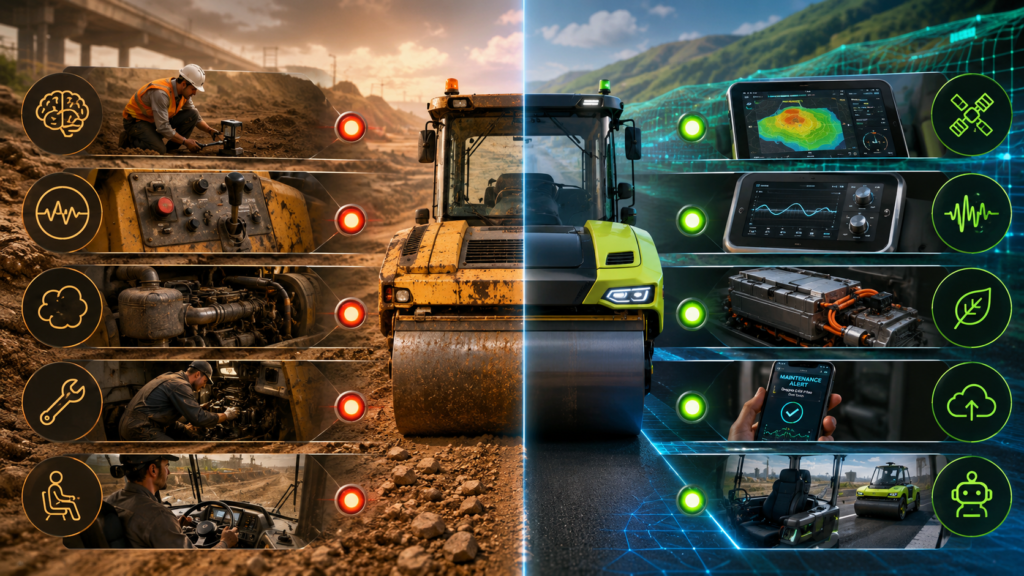
If you want to really see how much things have changed, just look at a side-by-side comparison of how we used to compact dirt versus how we do it today with advanced roller compactor technology.
| What We Look At | The Old School Way | The Modern Way |
| Knowing When It’s Done | Relying on the operator’s gut feeling and slow physical core testing. | Real-time GPS mapping and instant soil stiffness readouts on a screen. |
| Handling the Vibration | Basic fixed frequency. Just an “on/off” switch for the shaking. | Fully adjustable amplitude and automated systems that read the ground. |
| Power and Noise | Loud, heavy diesel engines that burn a lot of fuel. | Electric, hybrid, and super quiet eco-friendly drive systems. |
| Fixing the Machine | Waiting for something to break or following a rigid calendar. | Predictive maintenance alerts sent straight to a mechanic’s phone. |
| Driving the Thing | A guy in a bumpy cab, dealing with fatigue all day. | Assisted steering, super comfortable cabs, or literal self-driving robots. |
FAQs on Roller Compactor Technology
What exactly is intelligent compaction?
Think of it as putting a smart computer in a heavy roller. Intelligent compaction uses GPS, advanced software, and sensors to track exactly where the machine has been and how stiff the ground is in real-time, completely removing the guesswork from the job.
How do vibratory rollers actually work?
Inside the heavy steel drum, there are weights that spin off-center really fast. This causes the whole drum to shake violently. When that shaking hits the ground, it vibrates the dirt or asphalt particles, making them settle together much tighter than static weight alone could ever do.
What are the different types of roller compactors?
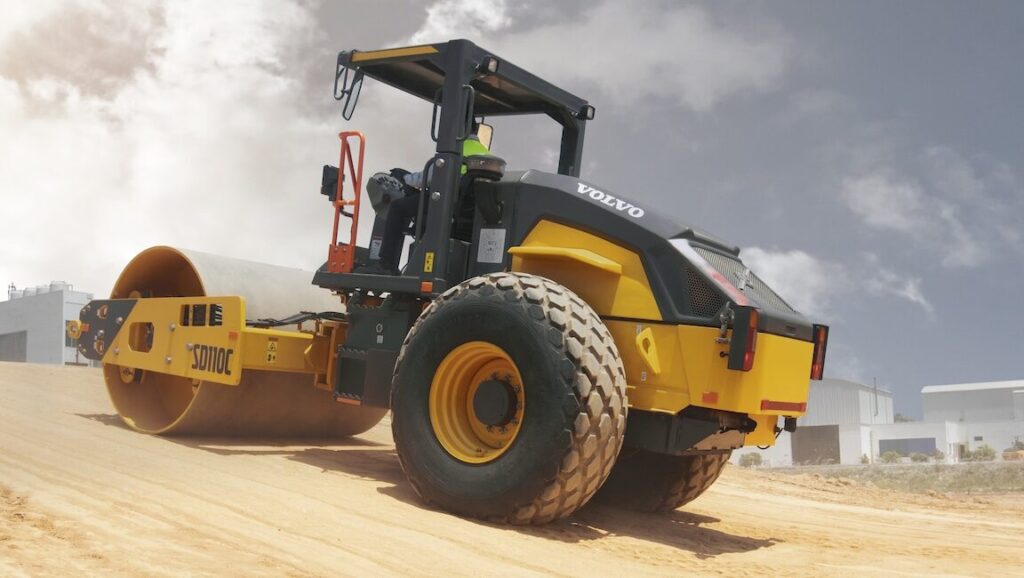
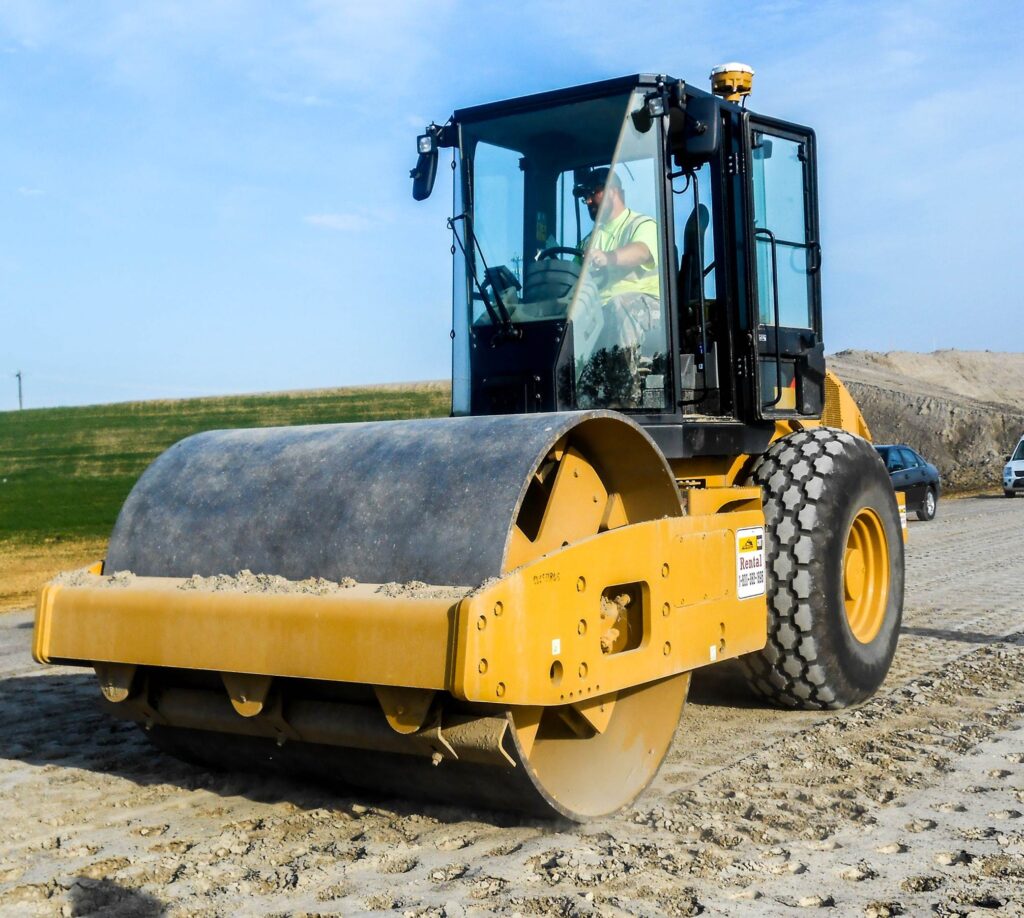
The main ones you’ll see are single drum rollers (great for heavy dirt work), double drum rollers (usually used for asphalt rollers to get a smooth finish), pneumatic tire rollers (used to knead and seal the surface), and padfoot or sheepsfoot rollers (used for sticky clay).
How often should I be replacing roller compactor parts?
It totally depends on how hard you run the machine, but you should be doing daily walk-arounds to check scraper blades and fluid levels. The good news is that modern machines use predictive maintenance sensors to actually tell you when a specific part needs to be swapped out.
Why use a double drum roller instead of a single drum?
A single drum has tires on the back, giving it great traction for rough dirt and trenches. A double drum has steel rollers on both the front and back. It doesn’t have great traction, but it gives maximum smooth coverage, making it the go-to choice for laying down fresh asphalt.
Can one machine do both dirt and asphalt?
Sometimes, yes. If you have a highly adjustable vibratory roller, you can change the settings to handle both. But generally, asphalt rollers need completely smooth drums and a built-in water spray system to stop the hot tar from sticking to the metal.
Are self-driving compactors actually real?
Absolutely. They are becoming more common on highly controlled, large-scale job sites. They use LiDAR, radar, and 3D mapping to drive themselves, which is safer for workers and results in an absolutely perfect, mathematically precise compaction route.
Wrapping It Up – Future of Roller Compactor Technology
The construction industry is moving incredibly fast, and if you are still relying on old-school methods, you’re going to get left behind. The shift toward Intelligent Compaction Systems, highly adjustable vibratory mechanisms, and eco-friendly power is proving that advanced roller compactor technology is the only way forward.
By dropping the guesswork and leaning into data-driven road building equipment, contractors are delivering better roads, safer job sites, and wider profit margins. As we look to the future, keeping up with these trends—and staying on top of your predictive maintenance and quality roller compactor parts—is going to be what separates the pros from the amateurs.
If you’re ready to upgrade your fleet’s efficiency and learn more about how to get the most out of your heavy machinery, checking out the resources and equipment guides over at rollercompactor.net is the smartest move you can make.