Static vs Vibratory Rollers—Choosing the Right Compactor for Your Project
If you’ve ever worked on a paving or earthmoving job site, you know that the end result is only as good as its foundation. Proper compaction is the unsung hero of the building industry. It does this by squeezing air pockets out of soil, gravel or asphalt so the material can support enormous structural loads without sinking or splitting down the road. It’s not just a brand preference when contractors get together to argue static vs vibratory rollers.
They are investigating the specific geology and logistical challenges of the site. Whether you’re laying down asphalt on a miles-long stretch of road or just finishing up a local commercial parking lot, understanding how these big equipment accomplish their job is a prerequisite.
The Critical Role of Compaction in Construction Projects: Static vs Vibratory Rollers
At rollercompactor.net we always tell our clients that if you go with the proper machinery from the beginning you are going to save yourself a lot of hassles, fuel and money down the road. If you speed up the compaction or do it improperly, water will almost always get in the base, and that destroys roads and foundations faster than anything else.
- The main objective on any compaction job is to pack the material as tightly as possible to boost its overall load-bearing capacity.
- Getting the compaction right from day one stops water from sneaking into the sub-base, which prevents potholes and foundational shifts.
- Picking the right roller compactor speeds up the job, cuts down on the fuel you burn, and frees up your crew for other tasks.
Understanding the Mechanics of a Static Roller
The static roller is the old-school heavyweight champion of the job site. It gets the job done using pure, unadulterated gravity. When we call these machines “static,” it just means they press down on the material with a constant, steady weight without any internal shaking or hammering going on.
You’ll usually see them sporting massive steel drums, and operators often fill those drums with water or wet sand to dial in the exact operating weight they need—usually somewhere between 8 and 20 tons. Because gravity is doing all the heavy lifting, a static machine usually needs to make a few more passes over the material to get the density right. But what they lack in deep-penetrating power, they easily make up for in finesse.
They leave behind a glass-smooth surface, which is exactly what you want when you’re putting the final touches on a fresh batch of hot asphalt. They are straightforward, reliable, and remain a staple in just about every major contractor’s fleet.
- Because they don’t rely on spinning internal weights, static rollers run quietly, making them perfect for jobs tucked into busy residential neighborhoods.
- These machines are the absolute best choice for the final sealing stage of an asphalt job, leaving behind a crisp, unblemished finish.
- With fewer moving parts rattling around inside, static rollers tend to cost less off the lot and spend way less time in the repair shop.
Exploring the Power of a Vibratory Roller Compactor
If a static machine is a rolling pin, a vibratory roller is a jackhammer on wheels. Instead of just relying on weight, a vibratory roller compactor uses a rapidly spinning eccentric weight hidden deep inside the steel drum. As that weight spins around, it creates a high-frequency vibration—sometimes hitting up to 3,000 vibrations per minute. This shaking action shoots kinetic energy deep down into the ground.
It literally vibrates the soil or gravel particles until they shake loose, slide together, and lock into an incredibly tight, dense pattern. Because of this one-two punch of downward weight and dynamic shaking, a relatively light vibratory machine can out-compact a much heavier static machine any day of the week. This ability to achieve deep density fast has made vibratory models the go-to standard for heavy highway base preparation and deep trench work where you absolutely cannot afford any future settling.
- Vibratory machines hit your target density in far fewer passes, which is a massive win when you’re looking at tight fuel budgets and looming deadlines.
- The deep-reaching kinetic force means you can put down thicker “lifts” of soil or gravel and still get perfect compaction all the way to the bottom.
- You can find these workhorses in several setups, from rugged single-drum models built for dirt work to double-drum versions designed specifically for asphalt.
Key Differences: Static vs Vibratory Rollers
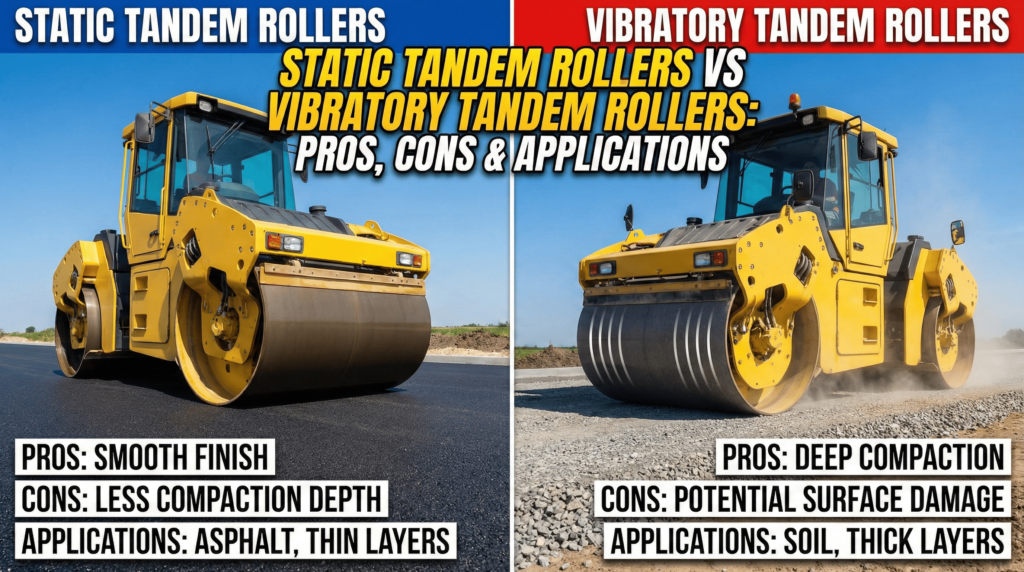
When you really break down the static vs vibratory rollers debate, it all comes down to how the energy meets the dirt. A static machine simply pushes down, whereas a vibratory machine pushes down and shakes things up at the same time. This mechanical difference dictates exactly where and when you should use them.
Vibratory models are famous for their aggressive nature, which is exactly what you need when you’re trying to pack down a foot of loose crushed stone. However, that same aggressive shaking can send tremors through the ground that might crack a nearby historic foundation or rattle an old water main. That is where the static rollers come in. They are the gentle giants that smooth out the top layer without beating up the surroundings or crushing the delicate aggregates in cooling asphalt. To make the right call, you really have to look at your site constraints, your material, and what is buried underground before you turn the key.
- How They Work: Static models lean entirely on their own dead weight, while vibratory models multiply their force using high-speed internal rotation.
- Site Safety: Static machines are the clear winner in tight urban areas because they don’t produce the ground-shaking tremors that get contractors in trouble.
- Upkeep: Vibratory models cost a bit more up front and demand a stricter maintenance routine simply because all that shaking puts stress on the machine over time.
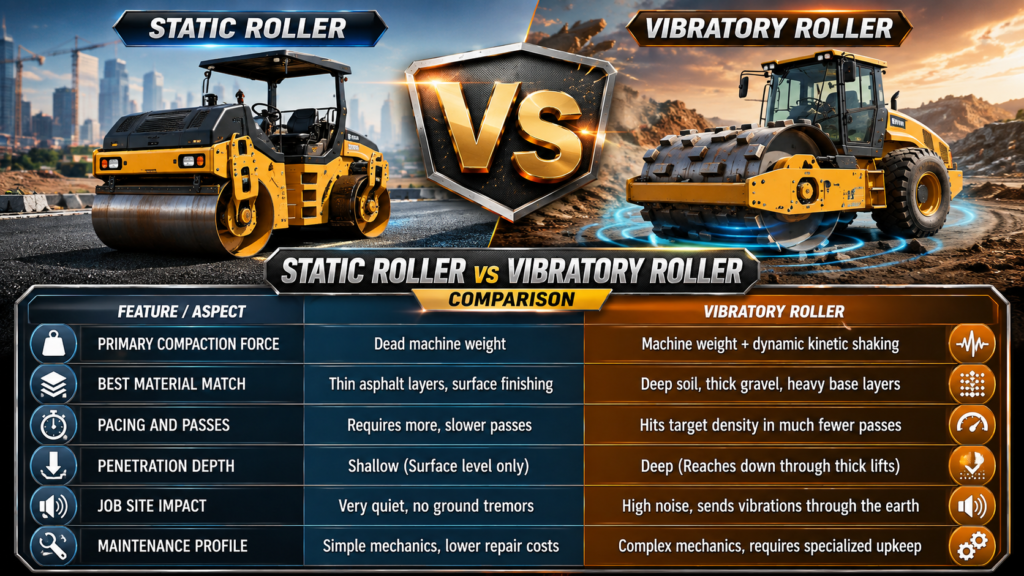
Table: Static Vs Vibratory Roller Comparison
| Feature / Aspect | Static Roller | Vibratory Roller |
| Primary Compaction Force | Dead machine weight | Machine weight + dynamic kinetic shaking |
| Best Material Match | Thin asphalt layers, surface finishing | Deep soil, thick gravel, heavy base layers |
| Pacing and Passes | Requires more, slower passes | Hits target density in much fewer passes |
| Penetration Depth | Shallow (Surface level only) | Deep (Reaches down through thick lifts) |
| Job Site Impact | Very quiet, no ground tremors | High noise, sends vibrations through the earth |
| Maintenance Profile | Simple mechanics, lower repair costs | Complex mechanics, requires specialized upkeep |
Selecting the Right Roller Compactor for Your Job Site
Figuring out the winner between static vs vibratory rollers for your specific site takes a bit of planning. You can’t just guess. First, look at the sheer size of the job. If you are building a runway or laying miles of road base, the fast, deep-hitting power of a vibratory roller compactor is going to save you weeks of labor. On the flip side, if you’re patching a suburban street or rolling out a decorative path, a smaller static machine is probably all you need to get that perfect look.
At rollercompactor.net, we always tell folks to check the engineer’s spec sheet first. Look at the lift thickness and the density requirements. You also have to think about your wallet. A vibrating model is going to cost more on day one, but if you run a high-volume paving crew, the fuel you save by making fewer passes will pay for the machine in no time.
- Walk the site and check for older buildings or shallow utilities. If the area is fragile, you need to stick with a static machine to avoid costly damage.
- Look at how thick your material layers are going to be. Thick dirt requires vibration to settle, while a thin asphalt topcoat needs a gentle static touch.
- Keep your mechanic in mind. Vibrating machines need regular TLC to keep the eccentric weights and shock isolators in good working order.
Material Suitability: Cohesive vs Granular Soils
The dirt you are standing on should be the final judge in the static vs vibratory rollers conversation. Granular materials—like sand, crushed concrete, and standard gravel—are stubborn. They don’t want to lock together on their own, which means they need the intense shaking of a vibratory machine to break their natural friction and snap into place. On the other hand, you have cohesive materials like wet clay and silt. These soils stick together in big clumps and trap pockets of water.
A standard smooth drum roller will just slide right over the top of wet clay, making a mess. For that, you need a specialized padfoot vibratory roller. It has heavy metal studs that punch down into the mud to squeeze the water out from the bottom up. Once you move away from dirt and start talking about Hot Mix Asphalt, the game changes again. You usually want the vibratory machine to do the heavy lifting early on, and then bring in a heavy static roller with rubber tires to iron out the wrinkles and seal it all up.
- Granular Soils (Sand/Stone): These absolutely beg for a vibratory machine. The shaking action locks the jagged pieces together fast.
- Cohesive Soils (Clay/Mud): You need a padfoot roller here. The studded drum punches through the sticky clumps to force trapped air and water to the surface.
- Asphalt Paving: The best crews use a combo. They break down the fresh asphalt with vibration, then finish it off with a static machine to seal the pores.
FAQs on Static vs Vibratory Rollers
What is the main difference between a static and a vibratory roller?
The real difference comes down to how they tackle the dirt. A static roller relies purely on its heavy steel drums or thick rubber tires to slowly press the ground flat. Think of it like a heavy rolling pin. A vibratory roller compactor, however, has a spinning weight inside the drum that shakes the machine up and down thousands of times a minute. This means a vibratory machine is punching the ground while it rolls, allowing it to pack dirt much deeper and faster than a static machine ever could.
- Static machines just use gravity and heavy steel to flatten out a job site.
- Vibratory machines use high-speed shaking to vibrate the dirt particles into a tight lock.
- Because of the shaking, vibratory models compact deep down, while static models just handle the top layer.
Which roller compactor is better for asphalt finishing?
When you are on the final stretch of an asphalt job, the static roller is your best friend. After the initial passes are done and the asphalt starts to cool down, it gets a bit fragile. If you hit cooling asphalt with a heavy vibratory machine, you risk shattering the rocks inside the mix and creating tiny cracks that will ruin the road come wintertime. A static roller, especially a rubber-tired pneumatic one, just gently irons out the tire marks and seals the surface tight so rain can’t get in.
- Static rollers give you a gentle, even press that won’t break the rocks in cooling asphalt.
- Rubber-tired static models are famous for kneading the surface, which seals out water beautifully.
- If you have to use a vibratory machine for the final pass, make sure the vibration is turned completely off.
Can vibratory rollers be used safely near buildings or fragile structures?
You have to be really careful using them in tight spots. The shaking from a vibratory roller compactor doesn’t just stop at the edge of the drum; it sends seismic waves straight through the ground. If you are working right next to an old brick building, a historic home, or shallow water lines, those vibrations can rattle the foundation and cause serious, expensive damage. In those situations, operators have to be smart about how they work.
- The vibrations from the drum can travel surprisingly far through tightly packed earth.
- Many contractors keep static machines on hand specifically for working inside city limits to avoid property damage.
- Most modern vibratory machines let you flip a switch in the cab to turn the shaking off, letting you use it just like a static roller when things get tight.
Are static rollers cheaper to maintain than vibratory rollers?
Generally speaking, yes. Static machines are built a lot simpler. Because they don’t have heavy metal weights spinning around inside the drums, they don’t beat themselves up all day. Vibratory models have complex hydraulic systems, specialized bearings, and heavy-duty rubber isolators that eventually wear out from the constant shaking. If you run a smaller crew and want to keep your mechanic bills as low as possible, a static machine is a very safe financial bet.
- Without the internal shaking mechanism, there are just fewer things that can break on a static model.
- You don’t need a highly specialized mechanic to fix a static roller, which keeps labor costs in check.
- Because the machine isn’t constantly rattling its own engine and electronics, static rollers tend to stay on the job longer between services.
Which type of roller is best for deep soil and sub-base compaction?
If you are trying to pack down thick layers of dirt or heavy stone, you have to go with a vibratory roller. A static machine just doesn’t have the muscle to reach down into a 12-inch layer of soil; it will only pack down the top few inches, leaving the bottom loose. The hammering action of a vibratory machine shoots energy deep into the ground, forcing all those buried rocks and dirt clods to settle tightly together. If you skip the vibration on a deep base, whatever you build on top of it is eventually going to sink.
- The vibrations break the friction between rocks, letting them slide into a tight, solid base.
- Vibratory models let you put down thicker layers of dirt at a time, keeping the whole job moving faster.
- Using a static machine on deep dirt usually results in a weak base that will fail under heavy traffic.
Do vibratory rollers really require fewer passes to achieve desired density?
Yes, and this is exactly why big paving companies love them. Because the drum is actively hammering the ground while it rolls, it forces the air out of the dirt much faster than a machine that’s just lazily rolling over it. Achieving the engineer’s density requirement in three passes instead of six is a massive deal when you look at the big picture. It means you burn less diesel, put fewer hours on the engine, and get your crew off the clock sooner.
- Fewer passes mean your operator can cover a lot more ground before the end of the shift.
- Cutting down on engine hours immediately saves you a ton of money on your weekly fuel bill.
- Getting the density right quickly stops operators from accidentally over-rolling the dirt, which can actually ruin the compaction.
When should I use a padfoot roller instead of a smooth drum?
It all comes down to the mud. If you are dealing with cohesive dirt—which is just a fancy way of saying sticky clay or wet silt—a smooth drum is practically useless. It will just slide over the wet clay, sealing the top while leaving the mud underneath full of water. A padfoot roller has heavy metal knobs sticking out of the drum. These knobs punch deep into the clay, breaking it apart and forcing the wet air up to the surface where the sun can dry it out.
- Padfoot drums are built specifically for nasty, sticky clay where smooth drums just spin out.
- The metal studs create a kneading effect that builds a solid foundation from the bottom up.
- By punching holes in the clay, a padfoot lets trapped water evaporate, stopping the ground from turning to mush later on.