Tandem Rollers in Action: Examples in Pavement Construction
If you have ever stood twenty feet behind an asphalt paver on an August afternoon, you know that hot mix does not wait around for anyone. The haul trucks dump at roughly 300°F, the tractor lays out the mat, and from that exact second, you are racing ambient temperature, wind speed, and base chill. In this high-stakes window, tandem rollers in pavement construction carry the entire burden of getting the road up to density before the bitumen stiffens into an unworkable, brittle sheet.
The Reality of Working Behind the Screed
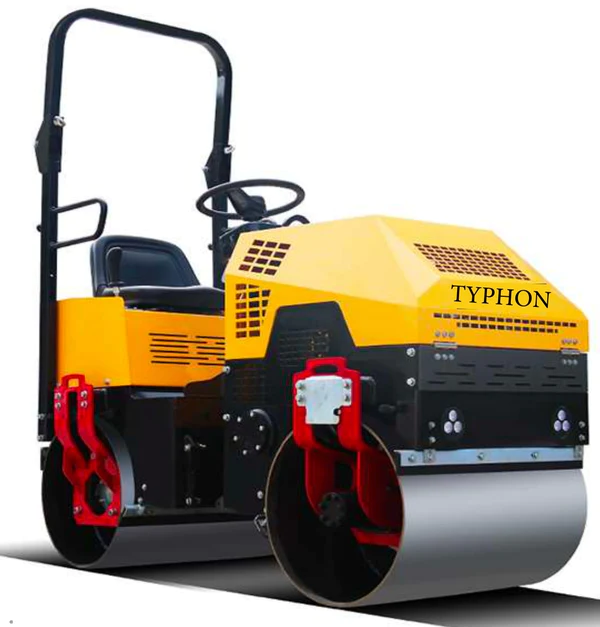
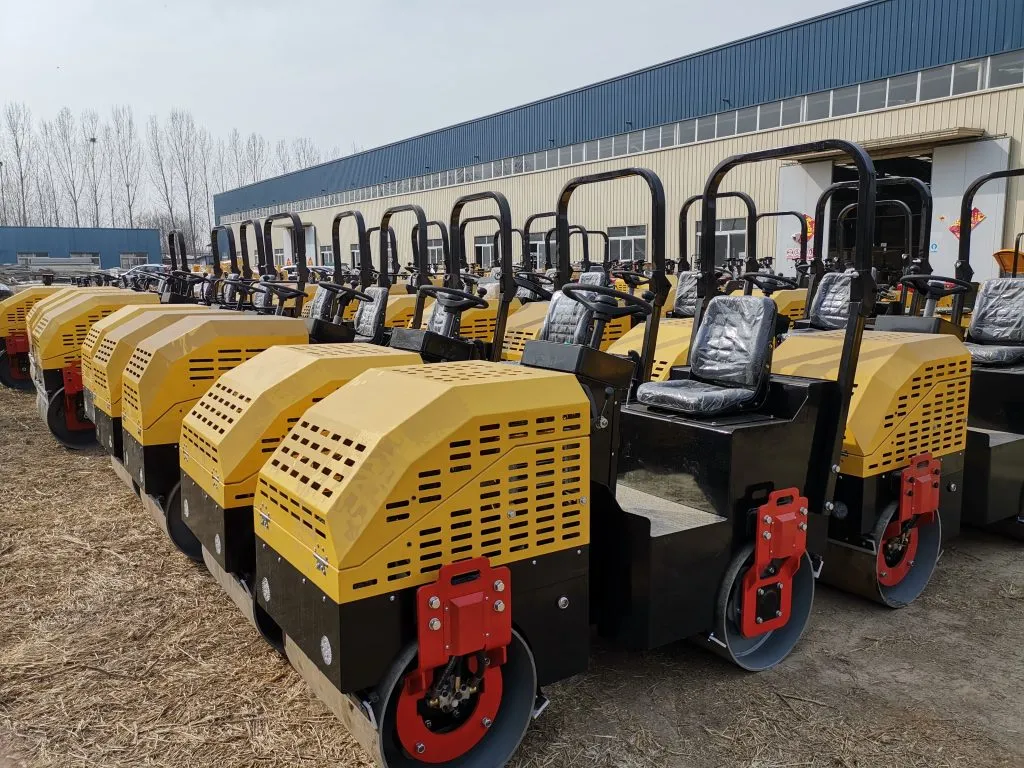
Unlike a utility tractor or a dirt compactor that relies on heavy lugged rubber tires in the rear to push through raw earth, a tandem roller runs on two smooth steel drums positioned inline. If you brought heavy pneumatic tires directly onto hot, tender asphalt right out of the gate, you would leave deep, ugly tire ruts, shove the aggregate forward into waves, and essentially ruin the ride quality before the road even opened to passenger cars.
The two steel drums solve that headache completely. They create a flat, uninterrupted footprint across the entire pass width, locking coarse and fine aggregate into an interlocking matrix without cutting or scarring the surface. Over at RollerCompactor.net, we talk to fleet owners every week who try to cut corners with whatever iron happens to be on the lowboy, but when an inspector is standing there with a nuclear density gauge and a straightedge, nothing takes the place of a properly ballasted double-drum machine.
- Twin smooth-steel drums spread the machine’s operating weight evenly across both axles, keeping hot binder from rutting, pinching, or shoving sideways.
- They carry out every critical phase of the rolling train—from the high-temperature breakdown pass right down to cold joint pinching and final finish passes.
- Drum widths scale from narrow 35-inch setups built for municipal trenches up to massive 84-inch highway drums that can knock down full lane widths in fewer trips.
Mechanics That Actually Dictate Density on Site
Operating tandem rollers in pavement construction is far more nuanced than simply driving back and forth over steaming rock. Under the hood, these rigs rely on closed-loop hydrostatic drive systems that feed hydraulic fluid directly to wheel motors tucked inside both drums, which gives the operator feather-light creep control without jerky starts or sudden stops that create washboard dips in the mat.
Inside those steel cylinders sits the hardware that actually matters: heavy eccentric weights turning on oil-bathed bearings. When you flick the vibratory switch on the joystick, those shafts spin up to generate centrifugal force, delivering thousands of rapid vertical strikes each minute.
Dialing in amplitude and frequency is where good operators earn their wage. If you hammer a thin 1.5-inch surface lift on high amplitude, you will literally pulverize the stone beneath the drum, drop your air void numbers through the floor, and cause the pavement to flush oil when summer traffic rolls in. Shift to high frequency and low amplitude, however, and the vibrations simply persuade the aggregates to nestle together tightly without breaking aggregate faces.
Paired with that mechanical vibration is the water system. Hot liquid asphalt loves sticking to dry steel. A high-pressure water pump pushing water through clean brass nozzles creates a microscopic fluid barrier on the drum face, keeping hot bitumen from tearing away in messy sheets known across the industry as asphalt pickup.
- Hydrostatic propulsion ensures smooth acceleration and deceleration, preventing the machine from shoving the tender mat into lateral ridges at turning points.
- Variable amplitude and frequency controls let operators adjust impact energy depending on whether they are compacting a thick base course or a fragile surface friction course.
- Dual water filtration systems and pressurized spray bars work alongside cocoa mats or spring-loaded scrapers to keep hot bitumen from sticking to bare steel drums.
Real-World Field Applications: From Interstates to City Alleys
Look at tandem rollers in pavement construction across different job sites, and you quickly realize how much job conditions dictate machine behavior. Take a four-lane interstate widening project where production speed is everything. Here, the paving train rarely stops, and you will typically see two 10-ton tandem rollers working in tight echelon formation immediately behind the paver’s floating screed.
The lead roller handles the breakdown passes while the hot mix is still sitting between 280°F and 300°F, working from the unsupported low edge inward to pinch the mat and lock in core bulk specific gravity. The second roller follows closely behind to grab intermediate compaction, smoothing out transverse joints and ironing down the seam before the asphalt drops into the dreaded tender zone—that awkward temperature pocket where the mix becomes unstable under load.
Now flip that scenario over to a regional commercial airport runway. The FAA’s surface tolerance guidelines make highway specs look like child’s play; an eighth-of-an-inch dip over sixteen feet can cause a landing gear to bounce at 140 knots. On runways, tandem rollers run dead-straight trajectories with zero sudden steering corrections, matching drum overlap down to the inch.
Finally, drop down to municipal alleyway paving or suburban cul-de-sacs, where contractors run agile 2-to-4-ton tandem rollers that can pivot tightly around manhole covers, track alongside poured concrete curbs, and back into tight residential driveways without chipping concrete or marring the fresh seam.
- Interstate Mainline Paving: Heavy 8-to-12-ton tandem rigs run strict echelon patterns to hit 93% to 96% target density before the mix dips below its critical compaction window.
- Commercial Airport Runways: Dual-drum rollers run uninterrupted, straight-line rolling sequences to satisfy stringent smoothness indices and prevent micro-ripples that affect high-speed aircraft.
- Municipal Streets and Commercial Lots: Compact tandem units navigate tight radiuses, storm drains, and parking stalls where full-sized highway rollers cannot safely turn without tearing edges.
Steel vs. Rubber: Comparing Single Drum and Tandem Configurations
Contractors stepping into roadwork often ask why they cannot simply hook up an existing dirt roller to knock down a freshly paved asphalt parking lot or an industrial access road. While both rigs fall under the broad compaction family, their mechanical setups tackle entirely different physics problems.
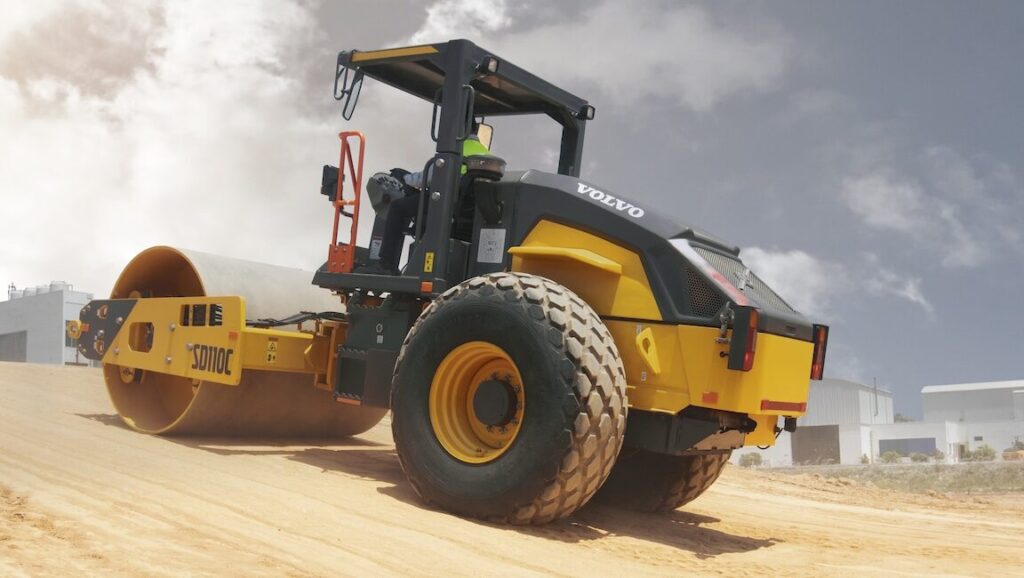
A single drum compactor is an earth-moving animal designed for dirt, gravel, subgrade stabilization, and rock fills. It features one massive steel drum up front—either smooth or padfoot—and two heavy-ply, deep-lug pneumatic drive tires out back. Those rear tires supply the raw tractive effort needed to power up steep embankments, churn through loose aggregate, and claw through muddy subgrades.
But drive that same machine onto a steaming 275°F asphalt mat, and those rubber drive tires will dig deep trenches, displace hot bitumen laterally, and create permanent surface depressions that no finish pass can ever buff out.
Tandem rollers in pavement construction, by design, run exclusively on twin smooth steel drums. They carry no aggressive drive tread that could scuff or pinch hot mix. While they will spin out and slide if you try to climb a steep, loose dirt spoil pile, their double-drum footprint is the only setup that delivers the mirror-smooth, uniform surface that transportation departments require for road surfaces.
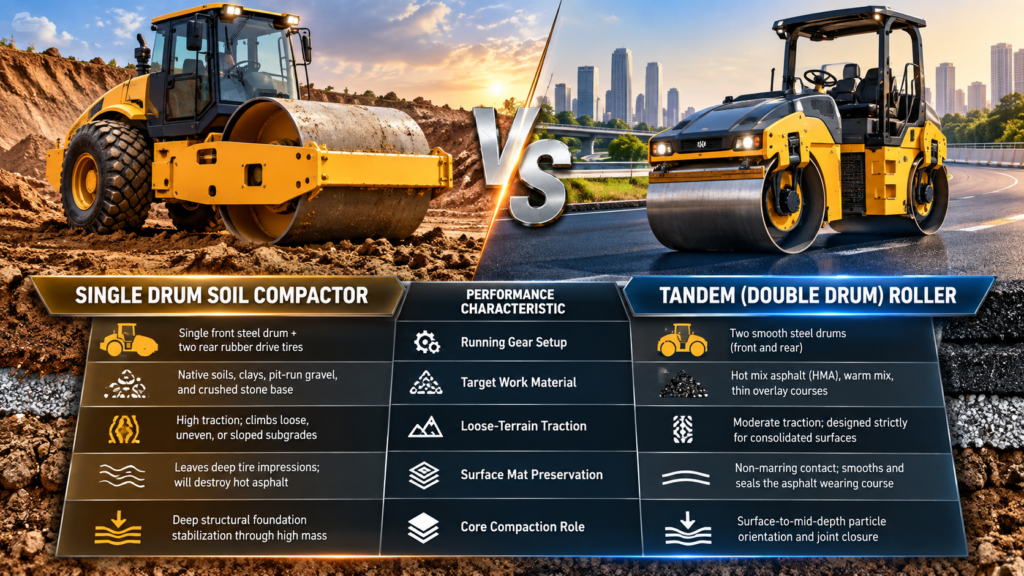
Table: Single Drum Vs Tandem Rollers in Pavement Construction
| Performance Characteristic | Single Drum Soil Compactor | Tandem (Double Drum) Roller |
| Running Gear Setup | Single front steel drum + two rear rubber drive tires | Two smooth steel drums (front and rear) |
| Target Work Material | Native soils, clays, pit-run gravel, and crushed stone base | Hot mix asphalt (HMA), warm mix, thin overlay courses |
| Loose-Terrain Traction | High traction; climbs loose, uneven, or sloped subgrades | Moderate traction; designed strictly for consolidated surfaces |
| Surface Mat Preservation | Leaves deep tire impressions; will destroy hot asphalt | Non-marring contact; smooths and seals the asphalt wearing course |
| Core Compaction Role | Deep structural foundation stabilization through high mass | Surface-to-mid-depth particle orientation and joint closure |
- Single drum machines deliver the deep impact energy and traction needed to stabilize raw grades, clays, and unbonded sub-bases.
- Tandem rollers keep both contact points on flat steel, protecting hot bituminous binder from scuffing, edge tearing, and tire tracking.
- Using both machines in tandem across a full build sequence ensures the dirt foundation is rock-solid long before the surface asphalt is dumped.
Modern Tech on the Deck: What’s Actually Worth Having
A quick glance at a modern roller silhouette might make it look like little has changed over the past few decades, but the digital tech running inside modern tandem rollers in pavement construction tells a completely different story. One of the most practical engineering updates in recent years is oscillatory compaction.
Traditional vibratory drums pound straight down like a sledgehammer, sending vertical shock waves deep into whatever is beneath the machine. Oscillatory drums, on the other hand, house two synchronized eccentric shafts rotating in the same direction, generating a horizontal twisting, massaging action.
This exerts a dynamic shearing force that compacts the asphalt without hammering downward. Paving outfits lean on oscillation when working on bridge decks where vertical resonance can damage pre-stressed concrete beams, or on municipal streets directly above century-old cast-iron gas mains. Then you have the rollout of Intelligent Compaction (IC) platforms. In the past, an operator had to track passes in their head while keeping an eye on a basic dial thermometer.
Modern IC cabs integrate high-precision GPS antennas, accelerometers, and infrared thermal sensors wired directly to touchscreen displays. The console paints a color-coded map showing exactly how many passes the drums have made over every square foot of the road, alongside live mat temperatures. This completely eliminates the guesswork that leads to under-compacted cold spots or over-crushed aggregate seams.
- Oscillatory drums exert dynamic horizontal shear force, pulling air voids out of the asphalt while protecting fragile bridges and nearby utilities from vertical shock waves.
- Intelligent Compaction systems map pass coverage and mat temperatures in real time on in-cab displays, preventing costly density test failures.
- Pivoting operator stations slide out past the edge of the cab chassis, giving operators clear lines of sight directly down the drum edge to prevent curb hits.
Sizing Up Your Fleet: Insights from RollerCompactor.net
Getting real production out of your equipment always hinges on matching drum width and machine weight to your typical daily tonnage. Here at RollerCompactor.net, we frequently see smaller paving outfits make the costly mistake of assuming that heavier always means better.
If your operation primarily focuses on commercial parking lots, driveways, and patch jobs, dragging an 11-ton highway tandem onto the site will often work against you. Massive static weights on thin, 1.5-inch wearing courses can easily over-compact the material, fracturing the aggregate faces, crushing the air voids below the safe 3% threshold, and causing the asphalt to bleed binder under summer heat.
On the flip side, trying to pull off a state DOT mainline paving run with an undersized 3-ton utility roller is just as disastrous. Your operator will have to run six, seven, or eight frantic passes just to coax the asphalt into density, losing heat the entire time.
Once that asphalt slips below roughly 175°F, aggregate particles refuse to shift, and you end up with low density that will ravel within two winters. Daily maintenance is another major sticking point we emphasize to our readers.
Make sure your crew cleans out water tank inline strainers, checks the brass spray nozzles for hard-water buildup, and inspects the drum scraper blades before every shift; a single clogged water jet during an afternoon run can cause asphalt pickup that strips twenty feet of hot mat in seconds.
- Size machine operating weight and drum width to match the paver’s output speed, ensuring your roller covers the mat before temperatures drop.
- Watch out for over-compaction on thin asphalt lifts, which crushes individual aggregate stones and ruins the mix design’s void structure.
- Flush out spray bars, clean water filters, and adjust drum scraper bars before every shift to prevent asphalt binder from sticking to cold steel drums.
Frequently Asked Questions – Tandem rollers in pavement construction
Why are tandem rollers preferred over pneumatic rollers for finish passes?
Pneumatic tire rollers do a great job in the intermediate compaction spot because their pliable rubber tires knead the hot asphalt, closing internal micro-voids. However, those rubber tires leave subtle tracking marks and can scuff the surface as the mat begins to cool. Tandem rollers feature smooth steel drums that iron out those wheel tracks completely, making them the industry standard for delivering the clean, mirror-like finish required on the final pass.
What is the ideal mat temperature range for tandem breakdown rolling?
Breakdown rolling with a tandem roller should begin immediately while the mix sits between 280°F and 300°F, right behind the screed. Intermediate passes typically wrap up as the asphalt cools down toward 220°F. Once the mat drops below 175°F, it enters a critical cool state where further vibration can shatter stone-to-stone aggregate bonds rather than consolidate the mix.
How much should a tandem roller overlap on longitudinal passes?
Operators typically keep a consistent 6-inch overlap along the longitudinal seam between passes. When pinching a cold joint—where fresh hot mix butts up against a previously paved and cooled lane—the roller should ride primarily on the cold lane, overlapping roughly 6 to 12 inches of drum width onto the hot material to firmly seal the joint without bridging.
What causes asphalt to stick to a tandem roller’s drums during compaction?
Asphalt pickup happens when hot bituminous binder touches bare, dry, or cold steel. If the pressurized water spray system clogs, runs out of water, or is overpowered by strong crosswinds, the sticky bitumen adheres to the drum instantly. Once pickup begins, the drum will peel up chunks of asphalt with every rotation, requiring the crew to stop, scrape the steel clean, and patch the torn mat.
Can tandem rollers operate safely on steep grades and slopes?
Yes, provided the machine is equipped with dual-drum hydrostatic drive systems that power both drums evenly. Because smooth steel drums have significantly less friction against asphalt than rubber tires do against dirt, operators must use gentle throttle inputs, maintain low travel speeds, and keep the drive drum pointed uphill to prevent sliding or shoving the hot mix downhill.
What is the correct rolling pattern for a tandem roller on a crowned roadway?
The established pattern starts at the lowest elevation along the outer road edge and progresses systematically toward the higher center crown. This keeps the unsupported outer edge firmly anchored and uses gravity to help seat the material inward, finishing with a final pass directly down the center crown to lock the joint flat.
What causes hairline checking cracks directly behind a tandem roller?
Transverse checking or hairline cracking usually points to an operator running the machine too fast, turning the drums while stationary, or vibrating the mat while it is sitting in the tender temperature zone (typically between 200°F and 240°F depending on the binder grade). Slowing the ground speed, turning off vibration, or waiting for the mix to stiffen slightly will typically stop the issue.