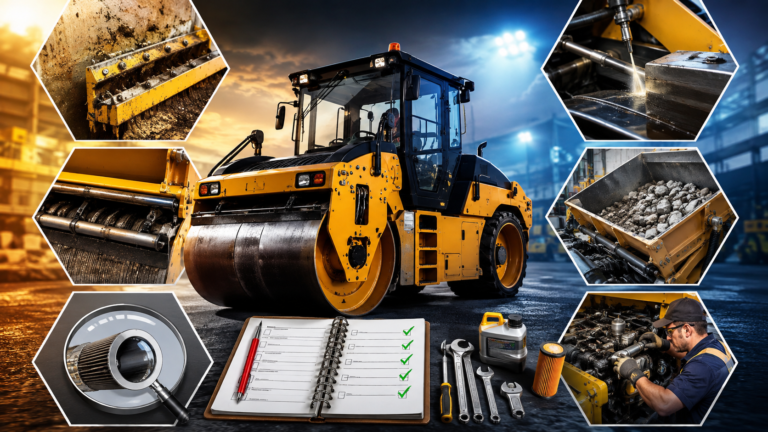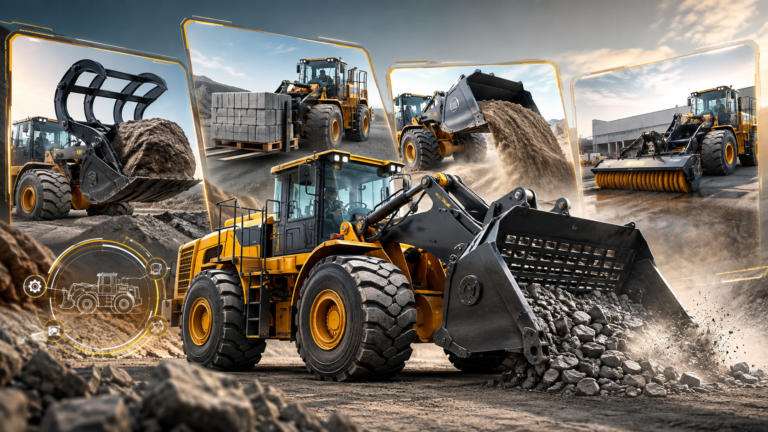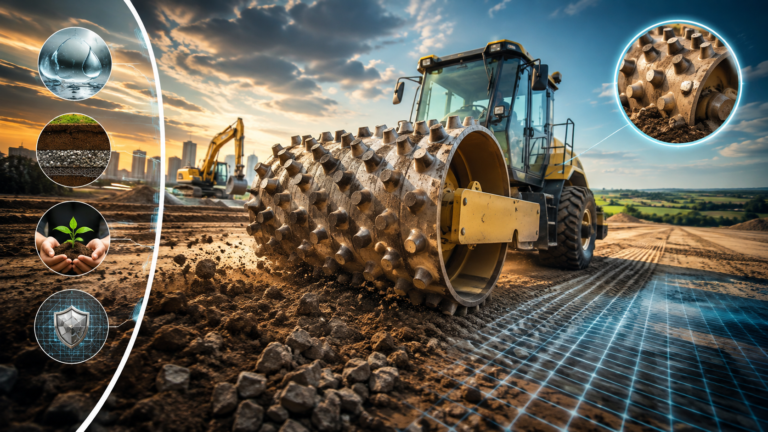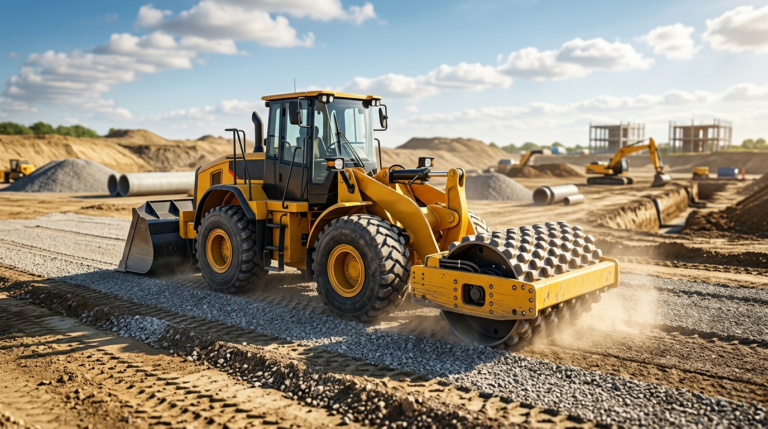

Beyond Compaction: The Role of Smooth Drum Rollers in Site Preparation
When assessing the quality of an infrastructure project, the first actions at the groundbreaking moment dictate the whole process. Site preparation is not just about removal of debris or earthworks; it is a precise science that ensures the final building will be long-lasting, safe, and capable of bearing heavyweight. Although a variety of different heavy machinery are used at this stage, the smooth drum roller is undoubtedly the cornerstone of the industry but most of the issues can be resolved by smooth drum rollers.
Many times it is considered only as a device to compact the asphalt in roadworks, but in reality, its presence in site preparation is very crucial. Such heavy-duty equipment have several important functions from the stabilization of a structure to the creation of perfect operational planes. Knowing about these different facets of the roller will be helpful to realize why it is one of the main tools in contemporary construction sites.
One cannot fully recognize the value of a smooth drum roller by just referring to its primary function of compressing loose materials. In fact, the equipped device at a site is used to:
- improve the strength of granular layers beneath the ground,
- form moisture protection layers, and
- develop highly consistent and uniform surfaces which are ideal for further construction work.
With a reference to these intricate workings of the device, it is possible for managers to better apply it for prevention of shifting of foundations, reduction of construction cost, and even the avoidance of structural failures.
Top Features and Roles of Smooth Drum Rollers in Site Preparation
1. Achieving High Load-Bearing Capacity
The ultimate aim of first site preparation is to construct a base which can support even the heaviest of loads without undergoing any movement, settling, or distortion. When earth is disturbed or excavated, a large amount of air is introduced into the subsurface creating a very unstable grid.
Smooth drum rollers are capable of changing this almost immediate failure scenario by performing the compression action in a very controlled manner and applying it equally over the whole width of their enormous steel drums.
By rolling over loose aggregates such as sand, gravel, or crushed rock, the heavy steel drum compels constituent particles into a configuration which is highly compacted and mechanically interlocked.
Secondly, this rearrangement greatly decreases the volume of air trapped inside, and finally, the material is such that it is capable of transferring loads in the horizontal direction as opposed to the obvious vertical compression when subjected to a load.
Without going through this deep and thorough site preparation during which the ground is consolidated, the foundations of concrete, heavy commercial buildings, or carrying heavy vehicles will cause the subgrade to deform.
- Particle Realignment: The drum face impresses the multi-sized granular particles together closely so that a mechanical bond is formed putting up resistance against any structural shifting.
- Settlement Prevention: By expelling deep-lying air pockets, the danger of localized sinking or structural depressions is removed.
- Structural Optimization: By maximizing density, native or imported subgrade can be made to support higher load thresholds safely in compliance with strict architectural specifications.
2. Reducing Permeability to Ward Off Water Intrusion
The element water is perhaps the most destructive force that a finished construction site has to face. If subsurface layers remain permeable to water, then not only will you be dealing with the effects of rainfall and surface runoff but also water drawn up through the ground by capillary action.
The accumulation of moisture will eventually result in total breakdown of the soil structure, subgrade erosion, and hardcore damages to concrete arising from freeze-thaw cycles working their way from underground.
The smooth drum roller acts as the first line of defense keeping the structural problems caused by moisture at bay by significantly lowering the ground layer’s permeability. It makes a dense, impermeable layer that moisture must run off along the planned surface drainage routes rather than seep down into the structural subgrade by compacting granular materials to their maximum density.
In other words, the routes through which water can move at a significant pace have been drastically reduced or even sealed off entirely so that the resulting barrier is very dense and compact.
- Pore Minimization: The uniform static and vibratory pressures reduce the size of the internal micro-channels to such an extent that capillary action cannot draw moisture up into foundations.
- Erosion Resistance: Having a surface layer that is a tightly bound prevents the running surface water from washing away fine aggregates and creating underground voids.
- Freeze-Thaw Protection: By not allowing the pockets where water can accumulate, the site is kept safe from the damaging effects of freeze-thaw cycles that cause expansion of soil and cracks in concrete structures.
3. Producing a High-Quality Uniform Base Surface
Even though it is structural stability that matters most, the flatness of a finished site actually determines how quickly and accurately all other subsequent work can be performed.
It is only smooth drum rollers that can be trusted to provide a perfectly level, uniform finish on really large surface areas. Repeated passes by this type of roller shear off surface irregularities. In contrast, other types of rollers are known to leave deep ruts, pits, or localized impressions.
This kind of planarity can be essential when a site will be used for pouring concrete foundations or floors or as a parking lot. In case of an uneven subgrade surface, the thickness of concrete varies and weak spots occur which is a waste of expensive materials and is structurally dangerous. A smooth subgrade not only facilitates adherence to exact grades but also deposition of materials in accurate volumes.
- Material Conservation: Since thickness of concrete or asphalt will be uniform throughout, base layers are perfect and no extra materials are required for filling of unexpected depressions.
- Structural Uniformity: Isolated pressure points will be avoided by the smooth and even transfer of load from the structure to the ground.
- Operational Speed: Various construction vehicles such as concrete trucks and material handlers will find it easier and safer to move around the site after being provided with a flat and firm surface.
4. Increasing Compaction of Non-Cohesive Soils
Different types of soil react to mechanical stress in their own way and thus assessing which equipment is most suitable for the site is of top priority. Smooth drum rollers tend to deliver outstanding performance when used for non-cohesive, granular soils such as sand, gravel, and crushed stone compactions.
Since these materials do not naturally stick to each other, combining them into a compacted material requires a specific type of force.
A smooth drum roller deals with such materials in the most natural manner by exerting tremendous downward force along with sophisticated vibratory systems. For the very short period of time, the rapid vibration breaks the friction that the dry granules have amongst each other making it easier for them to move and fill in the tiniest empty spaces.
From surface to bottom, granular materials are compacted efficiently through the rolling and vibrating operations so that it is possible to achieve rock-solid properties which are normally only available through complicated rolling techniques.
- Friction Reduction: The rapid vibrations produced by drum result in gravity and direct pressure sliding the particles into an interlocking pattern.
- Even Pressure Distribution: Since the contact area is wide and continuous, there is no material that would shove outward or pile up in waves ahead of the roller.
- Optimized Layer Density: Granular soils tend to settle from the surface downward whereby an ultra-dense layer with structural predictability is formed across large zones.
5. Safeguarding Nearby Infrastructure Sensitively
Nowadays construction happens in extremely tight spaces or close to commercial, residential, and utility areas. One of the main safety concerns that arise in such complex scenarios is the ability to manage vibrations arising from the ground. Deep earthwork heavy vibrating equipment can result not only in structures with cracks but also can damage sensitive electronics in nearby buildings.
Smooth drum rollers give field managers a very handy feature since apart from operating in vibratory mode, they can also be used in static mode. This means that operators can just switch off the vibratory function and use only the tremendous static weight of the machine when working close to sensitive structures.
A jit allows them to perform surface smoothing and light compaction safely and effectively without sending harmful shock waves through the surrounding ground.
- Static Pressure Mode: Keeping the machine on a static mode by turning off the vibratory weights inside the roller will help to preserve the structural integrity of foundations and underground utility lines of neighbors.
- Acoustic Management: Since static operation lowers noise level considerably, it is good for operation in hospital zones, schools, and densely populated residential areas.
- Precise Site Control: Operators have the ability to fine-tune the machine frequency settings to provide the needed compaction level not breaking local structural safety codes.
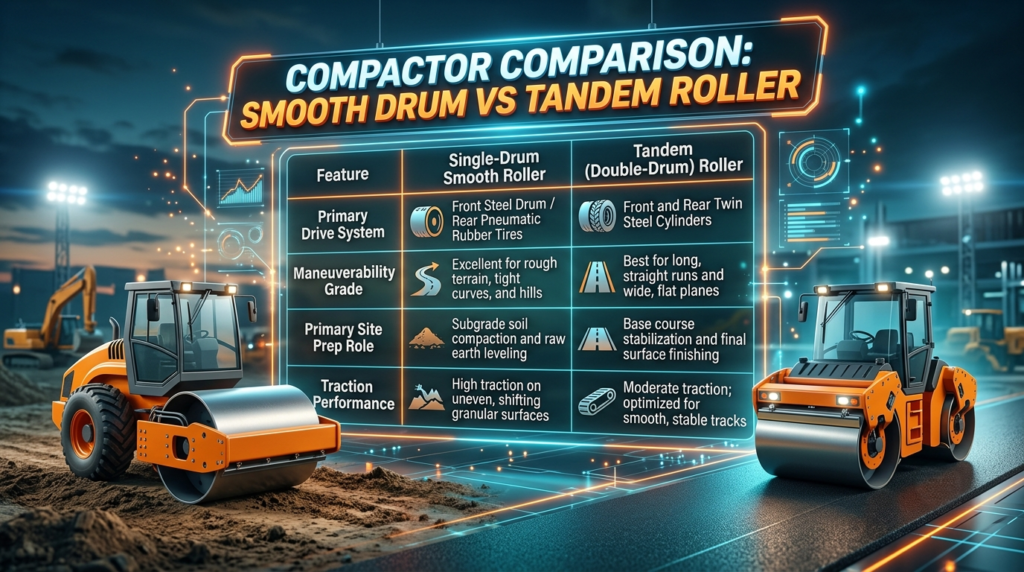
6. Comparison of Single-Drum vs. Tandem Roller Layouts
For highest productivity in site preparation, it is essential to make correct choice of machine configuration as per site layout. Usually the smooth drum rollers are divided into two main categories: single-drum units and tandem (double-drum) ones. Both kinds of rollers offer their respective mechanical advantages which are best suited for certain stages of earthwork and structural finishing.
A single-drum roller is equipped with a big drum at the front and large rubber tires with heavy treads at the rear. Such rollers are excellent at rough site grading, embankment works, and deep soil compaction. In contrast, the tandem roller features two heavy metal drums, one at each end.
It is designed for maximum coverage and efficiency in flattening, and therefore the gold standard when it comes to the finishing of base courses, compacting asphalt paving, and smoothing final capping layers.
Table: Compactor Features: Role of Smooth Drum Rollers Vs Tandem Roller
| Compactor Feature | Single-Drum Smooth Roller | Tandem (Double-Drum) Roller |
| Primary Drive System | Front Steel Drum / Rear Pneumatic Rubber Tires | Front and Rear Twin Steel Cylinders |
| Maneuverability Grade | Excellent for rough terrain, tight curves, and hills | Best for long, straight runs and wide, flat planes |
| Primary Site Prep Role | Subgrade soil compaction and raw earth leveling | Base course stabilization and final surface finishing |
| Traction Performance | High traction on uneven, shifting granular surfaces | Moderate traction; optimized for smooth, stable tracks |
- Drive Adaptability: By choosing the drum orientation in accordance with the terrain, it will be possible to avoid slippage and provide uniform density even over variable grades.
- Pass Optimization: For flat, wide zones, double-drum rollers are able to accomplish twice the compaction contact per pass which results in significant schedule reductions.
- Precision Steering: Single-drum units are typically articulated so allowing operators to make tight turns, go around utility vaults, and structural columns very easily.
7. Controlling Project Expenditures Long-Term
Site preparation with smooth drum rollers is a very necessary investment and one that will reward the project throughout the whole duration of the work. On the other hand, neglecting this step or using unfit machinery results in a weak foundation resulting in costly continuous maintenance.
When subgrades settle unevenly, structures crack, roads develop dangerous potholes, and utility lines can rupture. By using efficient smooth drum rollers, contractors can achieve specified compaction densities in far fewer passes. This not only cuts down the operating hours of machinery but also reduces fuel consumption as well as wear and tear of heavy equipment fleet. Moreover, a very stable and moisture-resistant base will greatly decrease future structural failures and protect developers from expensive warranty claims, repair, and possible legal issues.
- Lower Rework: Achieving the desired compaction levels correctly from the start eliminates the need to tear up and re-lay the worked foundational materials.
- Fuel Efficiency: Very low consumption during wide area coverage is made possible by optimal weight distribution which is a feature of modern smooth drum rollers.
- Asset Longevity: By preventing soil subgrade shifting and water ingress, finished infrastructures such as roads and buildings will be functional for many years.
FAQs – A Smooth Drum Roller Compaction in Site Preparation
What is a smooth drum roller best used for?
Basically, smooth drum rollers are designed for compacting loose materials like sand, gravel, and asphalt on level surfaces. Their smooth steel drums are excellent in leveling irregularities and this is why they are perfect for roadwork, parking areas, and foundation layouts.
When should you use a smooth drum roller versus a padfoot roller?
Go with a smooth drum roller if you are dealing with free-draining granular soils (sand and gravel) to produce a smooth and even surface. On the other hand, a padfoot roller is the best option for cohesive soils (clay and silt) since the pads can penetrate and work up the sticky soil layers deeply.
Do smooth drum rollers use static pressure or vibration?
Actually, they operate with both. The static mode (pure machine weight) is selected by the operator for very thin finishing layers or areas close to vulnerable structures. On the contrary, the vibratory mode (internal shaking weights) is utilized for a quick resettlement of deep granular particles.
Can a smooth drum roller be used on clay or muddy ground?
Definitely no, it would be a big mistake. The smooth drum in this case is just going to be sliding over the sticky clay and thereby sealing the moisture and air pockets that are hidden. In other words, it will create a slick surface and not actually result in any compaction.
What is the difference between a single-drum and a double-drum smooth roller?
For a single-drum roller, only the front drum is made of steel whereas the rear wheels are normal rubber tires that provide better grip on rough terrain. Meanwhile, a double-drum (tandem) roller makes use of two steel drums or cylinders which are very efficient in flattening large and flat surfaces like roads.
How deep can a smooth drum roller compact soil layers?
It really depends on the weight of the machine and the vibration settings. With a powerful enough roller and aggressive vibratory mode, loftily filled granular materials can be compacted well at a depth of 6 to 12 inches or so. If deeper soil layers are to be compacted, then the best approach is to lay down the soil in thin layers and roll each.
Is it better to rent or buy a smooth drum roller for site preparation?
If you want to get rid of the hassle of maintenance and storage costs, renting would be a viable option for short-term and specific projects. Buying should be the way to go if your company operates compaction equipment non-stop throughout multiple projects and thus needs round-the-clock fleet availability.