Mini Roller Compactor vs Large Road Roller: Choosing the Right Size
Deciding about the best equipment for soil or asphalt densification is a major decision that affects the strength and durability of any construction project. rollercompactor.net knows that the decision between a Mini Roller Compactor vs Large Road Roller is about much more than the physical size; it is about the machine matching centrifugal force, drum width, and maneuverability with the job site requirements.
Both machines aim at eliminating air pockets in materials to produce a solid base; however, they work at totally different scales of efficiency and application. A large road roller is a robust machine made for large scale construction projects while a mini roller delivers the exactness needed for small urban areas and residential paths.
To pick the right size you will have to thoroughly analyze the project details that include the Three S’s – Scale, Space, and Specifications. For example, large-scale earthmoving operations may need the heavy weight of a ride-on unit to effectively compact soil deeply in very few passes.
On the other hand, places like utility trenches or residential sidewalks would be off-limits to heavy machinery so the mini roller would be the indispensable workhorse on the site. This all-inclusive tutorial will help you in breaking down technical distinctions, operational perks, and cost impact for making an educated choice for your next project.
Understanding the Mini Roller Compactor: Precision and Portability
The Mini Roller Compactor (call it a walk-behind or compact tandem roller) is the favored equipment of contractors that need to perform work in very limited space conditions and where bigger machines just cannot move around. Usually, these units weigh less than 3 tons and their drum widths are between 24 and 47 inches.
Thanks to their small size, they can be operated very close to curbs, walls, and even inside narrow trenches without putting at risk adjacent structures. Being lighter, they can also safely be used for “thin lifts” where the use of a large roller may result in over-compaction or material displacement.
- Exceptional Maneuverability: Thanks to their small size, the rollers can easily maneuver even the tightest spots such as garage doors, flower beds, and other landscaping features.
- Cost-Efficient Operation: Compared to their heavy-duty counterparts, mini rollers are not only significantly fuel saving but also require less maintenance due to their simpler mechanical structures.
- Ease of Transportation: Such machines often can be transported on a regular flatbed truck or smaller trailer, which means that there are no specific heavy-haul permits required.
The Power of the Large Road Roller: Efficiency on a Grand Scale
Large road rollers are the top machines at construction sites that have highways, airport runways, and huge industrial facilities as their main targets. They are machines typically weighing 8 to over 20 tons that make use of high-amplitude vibration along with immense static weight to compact heavy layers of material—often referred to as “deep lifts.”
The drum width for a large roller can be greater than 84 inches thus covering large areas in less time compared to smaller units. This high production level is what makes it possible to meet deadlines even for multi-million dollar infrastructure projects.
- Deep Compaction Depth: Large rollers produce very high centrifugal force and as such, compaction energy is guaranteed to reach the bottom of thick material layers which in turn results in a stable foundation.
- Advanced Technology Integration: Several new models of large rollers are manufactured with intelligent compaction systems that supply soil density data in real-time directly to the operator.
- High Production Rates: These machines feature wider drums along with faster travel speeds thus not only reducing the number of passes but ensuring 95% to 98% compaction density as well.
Technical Comparison: Mini vs. Large Rollers
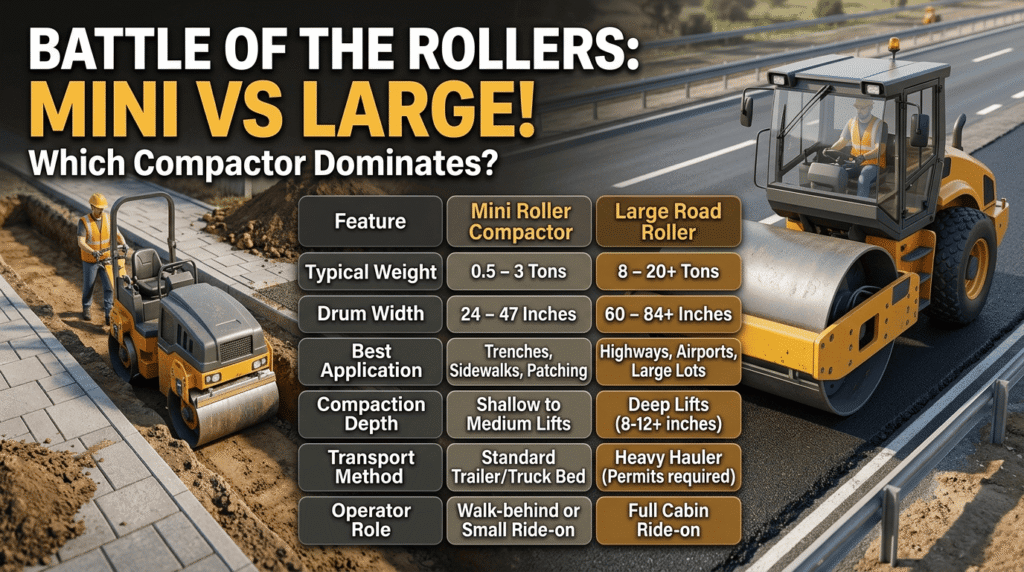
It will be easier for you to decide which machine is suitable for you if you first compare the technical specifications of these two types of machines side by side. The table below emphasizes the main distinctions between a standard Mini Roller Compactor vs Large Road Roller.
Table: Mini Roller Compactor vs Large Road Roller
| Feature | Mini Roller Compactor | Large Road Roller |
| Typical Weight | 0.5 – 3 Tons | 8 – 20+ Tons |
| Drum Width | 24 – 47 Inches | 60 – 84+ Inches |
| Best Application | Trenches, Sidewalks, Patching | Highways, Airports, Large Lots |
| Compaction Depth | Shallow to Medium Lifts | Deep Lifts (8-12+ inches) |
| Transport Method | Standard Trailer/Truck Bed | Heavy Hauler (Permits required) |
| Operator Role | Walk-behind or Small Ride-on | Full Cabin Ride-on |
Factors Influencing Your Choice: Soil Type and Lift Thickness
The level of compaction needed for the material being used would be one of the deciding factors in sizing the machine. For example, granular soils such as sand and gravel are most effectively compacted using high-frequency vibrations that are a feature of many mini rollers.
On the other hand, cohesive soils like silt and clay usually call for a form of “kneading” or the heavy weight of a large padfoot (sheepsfoot) roller. Along with that, the thickness of the material (lift) being compacted is also a major factor. If you are compacting a 12-inch layer of soil, a mini roller will simply not have the force to reach the bottom, potentially leading to future settling and structural failure.
- Material Compatibility: Make sure to pair the roller type (smooth drum, padfoot, or pneumatic) with the soil or asphalt characteristics of your site.
- Lift Thickness Accuracy: When it comes to deep lifts, use larger rollers to get uniform density all the way through the thickness of the material.
- Moisture Content Control: Ensure soil is at Optimum Moisture Content (OMC) level to get the highest density with minimum effort regardless of size.
Operational Costs and Long-Term ROI
You cannot ignore the financial aspect when investing in a Mini Roller Compactor vs Large Road Roller. While the upfront buying or renting price of a large road roller is higher, its ability to quickly finish large jobs can actually translate into lower labor costs over the duration of the project.
A small landscaping business, however, would find that a mini roller offers a much better Return on Investment (ROI) since it can be utilized in many small-scale residential job scenarios with very little overhead. Besides, from a maintenance perspective, smaller machines with fewer complex hydraulic systems are generally cheaper to repair and keep running.
- Reduced Labor Costs: The speed of large rollers allows finishing wide-open spaces much faster; this means less man-hours are spent on the compaction part of construction.
- Lower Maintenance Overhead: Mini rollers are characterized by a simple design, which facilitates troubleshooting and maintenance thanks to their inexpensive replacement parts.
- Fuel Economy: It would be a waste to use a large roller for small tasks, fuel-wise; mini rollers deliver the proper balance of power and consumption for minor works.
Site Accessibility and Safety Considerations
Very often, safety and accessibility top the list of deciding features. In many ways, a large road roller is a potent piece of equipment but it may become a hazard within limited working spaces, especially near trench walls where its weight might cause a collapse.
Moreover, in congested urban settings with heavy pedestrian traffic and narrow alleyways, the Mini Roller Compactor will be the only feasible alternative. The foldable handles along with compact frame of these machines make them easy to store and operate with safety even in high-traffic zones. rollercompactor.net reminds that for choosing the right size, safety counts as much as performance.
- Trench Safety: Smaller, even remote-controlled trench rollers can be used to ensure the operator safety in the case of deep excavations.
- Urban Accessibility: Mini rollers can easily fit standard gates and narrow paths where larger machines would be off-limits.
- Landscape Protection: Lighter machines help avoid “over-compaction” that can cause damage to underground utilities or existing landscaping roots.
FAQs – Mini Roller Compactor vs Large Road Roller
What is the main difference between a mini roller and a large road roller?
The main difference is the project scale. Mini rollers (less than 3 tons) are primarily for precision in tight spaces such as trenches and driveways. Large road rollers (8-20+ tons) are mainly for high-volume compaction such as on highways and large industrial sites.
Can a mini roller compactor be used for asphalt road repair?
Mini rollers are ideal for compacting asphalt, especially for patching, pothole repairs, and sidewalks or parking lot edges where maneuvering a large roller would be a problem.
How many passes are typically required with a roller compactor?
The number of passes depends on the material and moisture content but generally, 3 to 5 passes are needed to achieve a compaction density of 95% to 98% which is standard.
Is a ride-on roller better than a walk-behind roller?
Basically, it depends on the “Three S’s”: Scale, Space, and Specifications. Ride-on rollers are preferred in large, open areas because of their speed and operator comfort, whereas walk-behind rollers are better suited for confined spaces and narrow trenches.
Which roller is best for compacting clay soil?
The padfoot (sheepsfoot) roller will do the best job of compacting clay soil as it provides the necessary kneading action and both large ride-on and smaller trench-roller sizes are available.
Do I need a special license to operate a large road roller?
In most areas, operating heavy machinery on public construction sites requires specific training and certification to ensure safety as well as compliance with road regulations.
How do I transport a large road roller to my job site?
Transporting large road rollers demands heavy-duty haulers and more often than not, special permits too because of their weight and width. Mini rollers, by contrast, can often be transported using just a standard trailer.