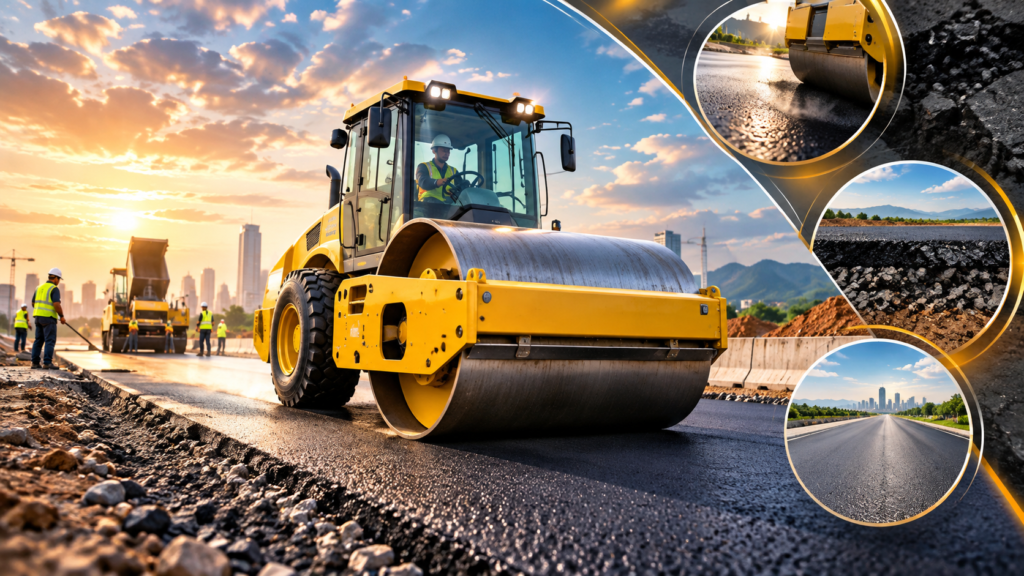
Maximizing Efficiency: How to Use a Single Drum Roller Effectively
Talk to any earthwork superintendent who has been running dirt crews for twenty years, and they will tell you the same thing: you can have the sharpest grade checker and the fastest scraper team on the job, but if your compaction numbers come back soft, everything stops dead in its tracks. Base failure isn’t just an engineering headache; it eats profit margins, tears up haul schedules, and ruins reputations faster than almost anything else on a site. That is precisely where the single drum roller earns its keep every morning.
If you are handling site preparation, building deep embankments, or putting down thick structural lifts of granular base, having a reliable single drum roller on the pad is non-negotiable. Over at rollercompactor.net, we spend our days breaking down densification and granulation processes for crews out in the dirt, and we see the same pattern play out repeatedly.
Getting maximum efficiency out of a single drum roller is not just about hopping in the cab, firing up the engine, and driving back and forth until the dust clears. It takes an understanding of drum harmonics, soil moisture balance, forward travel speed, and how rear tire traction works with front drum static weight.
Run correctly, this rig locks in proctor density in fewer passes than almost anything else on tracks or rubber tires. Run carelessly, and you end up shearing your soil, building a washboard surface, and burning expensive diesel for zero density gains.
Understanding the Mechanics Behind a Single Drum Roller
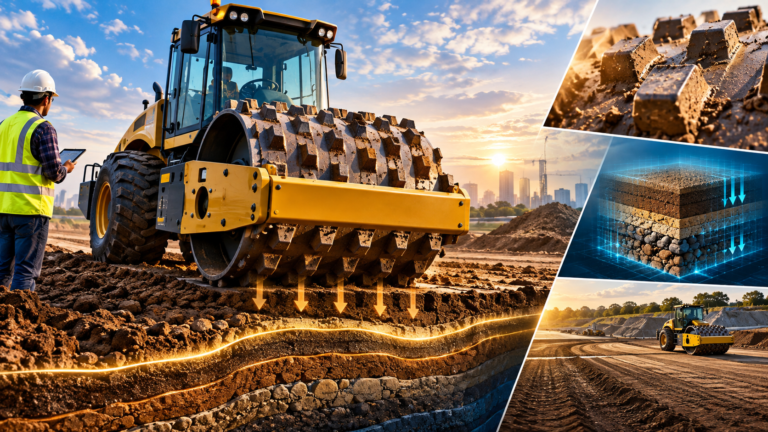
To pull real production numbers out of a single drum roller, you need to understand what is happening beneath the frame while you ride the controls. The machine is deliberately unbalanced from an engineering standpoint, and that design serves a clear purpose.
Up front sits a massive, heavy-gauge steel drum carrying the bulk of the machine’s deadweight; in the rear, you have a pair of wide, deep-tread pneumatic drive tires mounted directly behind the central articulation joint.
This setup concentrates the static linear load right onto that front steel drum, while the rear rubber tires provide the traction needed to push through loose, uncompacted fills, climb 30% haul road grades, and turn without tearing up the newly compacted layer behind you.
Inside that front drum sits an eccentric shaft assembly driven by a dedicated hydraulic motor. When you hit the vibratory switch on your joystick, those internal eccentric weights spin at thousands of revolutions per minute, producing high-amplitude centrifugal energy.
That mechanical vibration does something static weight alone could never pull off: it momentarily floats the granular soil particles, breaks surface friction between individual rocks and sand grains, and allows gravity plus downward drum momentum to drop those particles together into a tightly locked, air-free matrix.
- Front-Biased Weight Bias: The machine’s center of gravity is engineered toward the front axle, putting the heaviest static footprint directly on the contact strip of the steel drum where compaction occurs.
- High-Torque Pneumatic Drive: The wide rear drive tires give the machine the raw grip it needs to push through loose aggregate, sand berms, and wet cut sections without spinning out or high-centering.
- Dual-Amplitude Vibratory Pods: Hydraulically driven eccentric weights inside the drum allow operators to toggle between deep-penetration vibration for thick lifts and lower-amplitude vibration for setting the top surface.
Where a Single Drum Roller Excels on the Job Site
Every piece of compaction equipment in your fleet has a sweet spot, and bringing the wrong rig to a specific material type is the easiest way to lose money on equipment hours. The single drum roller is built specifically for raw earthwork, granular subbases, and non-cohesive fills.
When you are working with materials that lack natural cohesion—such as bank-run gravel, coarse sand, crushed stone base, river rock blends, and blasted shot rock—a single drum roller outclasses everything else. Because these granular materials rely entirely on internal friction and interlocking particle edges for structural stability, they need that heavy combination of high-impact vibratory force and focused downward deadweight to shake the fines into the voids between larger rock fragments.
You will find single drum roller units anchoring roadway subgrade construction, large warehouse structural pads, airport runways, dam embankments, and commercial parking sub-bases. While a smaller 3-ton to 5-ton single drum roller can handle trench backfill, municipal utility cuts, and narrow residential streets with ease, the 10-ton to 20-ton workhorses are the standard when you need to stabilize massive fills where deep soil densification is the only thing standing between a solid foundation and total structural settlement down the road.
- Granular Base and Subbase Courses: Delivers rapid consolidation across loose bank-run gravel, crushed limestone, decomposed granite, and pit-run sand fills that require strong aggregate interlock.
- High-Volume Earthmoving Foundations: Essential for mass grading projects, industrial building pads, and highway embankments where specifications call for deep lifts and uniform proctor density.
- Rough-Terrain Subgrade Prep: The combination of an articulated oscillating chassis and high-flotation rear tires allows the roller to walk over uneven, freshly dumped scraper spoils without bogging down.
Choosing Your Machine: Single Drum Roller vs. Double Drum Roller
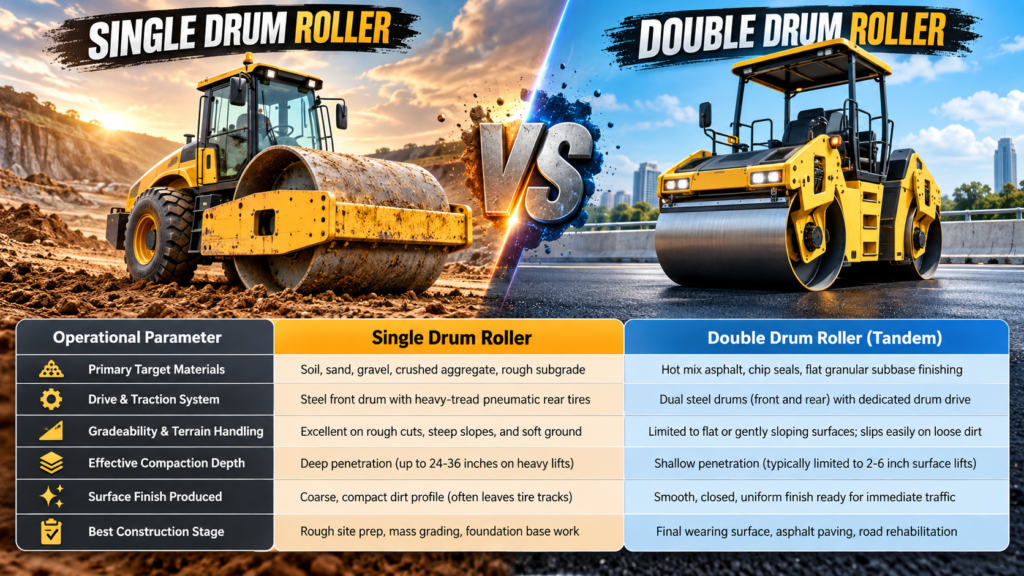
Crews new to site preparation often ask why they cannot simply buy one roller model to tackle both the raw dirt phase and the final paving job. The answer lies in the mechanical differences between a single drum roller and a double drum roller (often referred to on site as a tandem roller).
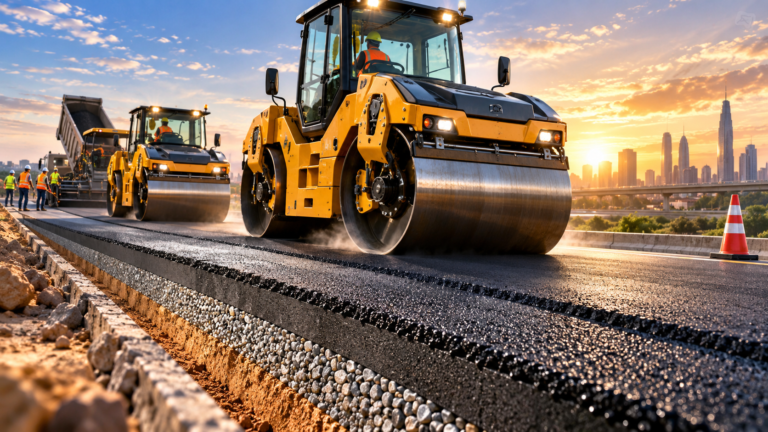
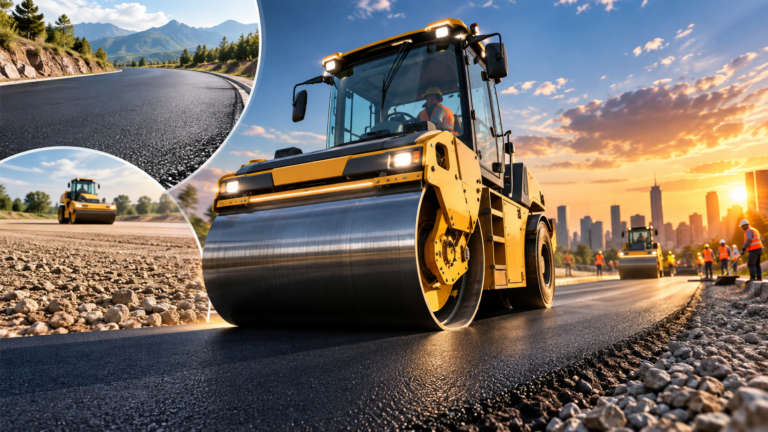
A double drum roller features two polished steel drums—one in the front, one in the back—with zero rubber tires touching the ground. This dual-drum setup is purpose-built for asphalt paving and smooth surface prep; it compresses hot mix asphalt evenly on both passes without leaving tire tread impressions or rut marks on your finished wearing course.
However, take a double drum machine off the pavement and drop it onto loose dirt or a sandy slope, and those slick steel drums will spin out immediately. A single drum roller trades that rear smoothing drum for deep-lug pneumatic tires, giving it the aggressive grip required to claw through muddy haul roads, climb steep fills, and pack raw, unshaped aggregate. The table below outlines how these two pieces of equipment compare across key job parameters:
Table: Single Drum Roller Vs Double Drum Roller
| Operational Parameter | Single Drum Roller | Double Drum Roller (Tandem) |
| Primary Target Materials | Soil, sand, gravel, crushed aggregate, rough subgrade | Hot mix asphalt, chip seals, flat granular subbase finishing |
| Drive & Traction System | Steel front drum with heavy-tread pneumatic rear tires | Dual steel drums (front and rear) with dedicated drum drive |
| Gradeability & Terrain Handling | Excellent on rough cuts, steep slopes, and soft ground | Limited to flat or gently sloping surfaces; slips easily on loose dirt |
| Effective Compaction Depth | Deep penetration (up to 24-36 inches on heavy lifts) | Shallow penetration (typically limited to 2-6 inch surface lifts) |
| Surface Finish Produced | Coarse, compact dirt profile (often leaves tire tracks) | Smooth, closed, uniform finish ready for immediate traffic |
| Best Construction Stage | Rough site prep, mass grading, foundation base work | Final wearing surface, asphalt paving, road rehabilitation |
- Traction Advantage: The rear pneumatic tires on a single drum roller deliver high traction on unstable ground, allowing it to navigate rough terrain where a double drum roller would spin out.
- Lift Thickness Capability: A heavy single drum roller can consolidate much deeper material layers in a single run due to its higher static drum load and larger vibratory drum diameter.
- Application Separation: Single drum units dominate the preliminary earthwork and subgrade stabilization stages, whereas tandem rollers should be reserved for asphalt placement and final surface rolling.
How to Run a Single Drum Roller for Maximum Efficiency
If you want your passes to count and your fuel burn to stay low, you must run your single drum roller with deliberate discipline. The most common mistake new operators make is gunning the throttle and driving across the fill at highway speeds.
High-amplitude vibration requires time to transmit its energy down through the soil column; if you roll too fast, the drum simply skips over the high spots, leaving soft spots and an uneven washboard surface behind you. Keep your forward rolling speed steady, ideally between 1.5 to 2.5 miles per hour. Always map out your pattern with a consistent 6 to 12-inch overlap between adjacent passes so you do not leave uncompacted seams between lanes.
When starting or reversing your travel direction, always kick the vibratory toggle off a few feet before stopping, bring the machine to a smooth halt, reverse your direction, and only re-engage the vibration once you are rolling again. If you stop the machine while the drum is actively vibrating, you will dig a trench into your fill, create a soft shear zone, and damage the subbase you are trying to tighten up.
Match your amplitude settings directly to the material: keep it on high amplitude for initial breakdown passes through raw rock or thick sand, then drop it to low amplitude for your final two passes to knock down the drum marks and lock the surface tight.
- Pace Your Ground Speed: Keep the machine rolling between 1.5 and 2.5 mph so the drum’s vibratory impacts overlap closely, preventing untreated soil gaps beneath the surface.
- Manage Vibration Transitions: Never let the drum vibrate while the roller is sitting stationary; turn off the vibration before coming to a stop, and engage it only after forward or reverse momentum has begun.
- Maintain Pass Overlaps: Always lap each successive run by at least 6 to 12 inches over the previous compacted path to ensure uniform density without weak longitudinal seams.
Soil Moisture, Lift Depth, and Rolling Strategies
You can run the biggest single drum roller on the market across a job site all day long, but if your soil moisture is off, you will never pass a sand-cone or nuclear gauge density test. Soil particles need just enough moisture to act as a lubricant so they can slide past one another and pack tightly into the void spaces.
If your fill is bone dry, the dirt will simply push around, turn to dust, and fight the compaction effort. Conversely, if your material is soaking wet past its optimum moisture content, the pore spaces fill with trapped water. Because water cannot be compressed, running a heavy single drum roller over wet soil causes the ground to pump, rut, and shear beneath the drum like a sponge. Keep your lift thicknesses realistic.
As a general rule of thumb for single drum roller operations, your compacted lift thickness should never exceed the depth that your drum can effectively vibrate through—typically 6 to 8 inches for lighter 5-ton rollers, and 12 to 18 inches for 12-ton machines. If you try to roll a 24-inch lift with a mid-size roller, you will compact the top 6 inches into a hard crust while the bottom remains loose and unstable, guaranteeing foundation failure later when the structure settles under real-world loads.
- Hit Optimum Moisture: Check that your fill sits within 1% to 2% of optimum moisture content; bring in a water truck if the ground is dry, or disc and aerate the soil if it is wet and pumping.
- Respect Lift Depth Limits: Keep your loose lift thicknesses matched to machine tonnage so the vibratory shockwaves penetrate through to the bottom layer rather than creating a false surface crust.
- Watch for Material Shearing: If the soil begins cracking or bowing in waves ahead of the steel drum, the soil is either oversaturated or your amplitude is set too high for that material type.
Daily Walkarounds and Maintenance Routines
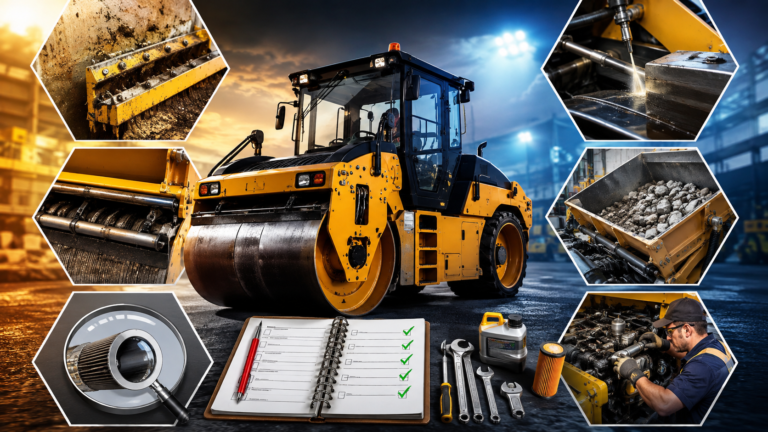
A single drum roller operates in rough, dusty, vibration-heavy environments, which makes proactive maintenance critical to preventing unexpected downtime. As we regularly emphasize in our maintenance resources at rollercompactor.net, your daily pre-shift walkaround is what keeps this equipment running reliably.
Start your morning right at the front drum: inspect the drum scraper blades to make sure they are clear of dried clay, rocks, and mud buildup. If those scraper bars are bent, worn, or packed with hardened dirt, debris will wrap around the drum, scratch the steel face, cause drum hopping, and create uneven compaction lines.
Next, look at the heavy rubber shock mounts (isolators) that separate the vibrating drum frame from the main chassis. If any of those rubber isolators are cracked, oil-soaked, or missing mounting hardware, the vibratory energy will bypass the dirt and shake the cab, engine, and hydraulic lines to pieces instead.
Check your rear tire pressures religiously; if one tire is running 10 PSI lower than the other, the machine will lean slightly, resulting in uneven drum contact and inconsistent density across your rolling width. Finally, check your hydraulic oil levels and air filtration assemblies daily; running vibratory hydraulics with low fluid or dirty filters will toast your drive motors and cost thousands in downtime repairs.
- Inspect Drum Scraper Clearances: Clean off hardened mud and adjust the scraper bars to maintain the manufacturer-recommended gap across the entire width of the drum.
- Evaluate Rubber Isolators: Carefully examine the vibration-dampening mounts between the drum and the chassis for signs of dry rot, cracking, oil saturation, or loose mounting bolts.
- Balance Rear Tire Pressures: Keep both rear drive tires inflated to identical, factory-specified pressures to prevent machine tilting and uneven linear drum loading on the ground.
Intelligent Compaction and Modern Field Tech
The single drum roller is undergoing an impressive technical evolution, moving away from old-school guesswork and toward automated precision. For decades, operators simply ran four or five passes based on feel, parked the rig, and waited around for the third-party testing technician to show up with a nuclear density gauge to tell them whether the base passed inspection.
Today, modern single drum roller models are frequently ordered with or retrofitted for Intelligent Compaction (IC) systems. These setups link onboard accelerometers inside the drum with high-precision GNSS/GPS tracking and cab-mounted digital displays.
As the roller travels across the fill, the system reads how the ground responds to each drum impact, measures the soil’s dynamic stiffness in real time, and paints a color-coded map on the operator’s touchscreen. If a section is under-compacted, the screen shows blue or red; as density hits spec, it shifts to green.
This real-time feedback completely eliminates redundant passes, slashes project fuel burn, catches soft spots before they get buried under multiple lifts, and logs a comprehensive digital compaction record for project owners and structural engineers.
- Integrated Stiffness Sensors: Drum accelerometers measure real-time soil response, giving the operator instant cab feedback on relative ground density.
- GPS Pass Mapping: Satellite tracking keeps an accurate count of passes across every square yard, preventing missed strip seams and unnecessary fuel-wasting over-compaction.
- Digital Quality Assurance: Telematics software compiles continuous stiffness and temperature maps, producing verifiable project reports for regulatory compliance and engineering sign-offs.
Frequently Asked Questions from the Field of Single Drum Roller
What is a single drum roller used for on a construction site?
A single drum roller is used primarily for heavy soil, sand, gravel, and crushed stone compaction during site preparation and earthmoving phases. Its design—combining a heavy front vibratory steel drum with aggressive rear rubber tires—makes it ideal for establishing solid foundations, building roadway subgrades, compacting utility backfills, and preparing industrial pads where deep densification of non-cohesive materials is required.
How does a single drum roller differ from a double drum roller?
The main difference is the wheel configuration and target material. A single drum roller features one front steel drum and two rear rubber tires, delivering high traction and deep vibratory penetration on rough, loose dirt and uneven grades. A double drum roller utilizes two smooth steel drums without rubber tires, making it specialized for smoothing flat surfaces, laying hot mix asphalt, and final surface finishing without leaving tread marks.
What is the difference between static rolling and vibratory rolling?
Static rolling relies solely on the machine’s gross operating weight to press down on the material, which works well on thin surface layers and cohesive materials like pure clay. Vibratory rolling utilizes internal eccentric weights spinning inside the drum to create high-frequency impact waves, temporarily breaking the friction between granular particles so they shake together into a much denser matrix.
How many passes does a single drum roller typically need to achieve density?
Most well-graded granular materials reach targeted proctor density within 4 to 6 passes when the single drum roller is operated at the correct speed (1.5 to 2.5 mph) and the material sits at optimum moisture. Rolling beyond 6 passes often produces diminishing returns and can even cause material shearing, aggregate fracturing, and loss of density unless you are working unusually thick lifts with an extra-heavy machine.
Can you run a single drum roller over hot asphalt?
While you could technically roll a base layer of asphalt in an emergency, it is strongly discouraged for finished paving work. The heavy rear pneumatic drive tires will leave deep ruts, tread marks, and indentations in the soft asphalt mat that are difficult or impossible to roll out, and the machine lacks the dual water-spray systems needed to keep hot mix from sticking to the tires.
Why is soil moisture so critical when using a single drum roller?
Moisture serves as a natural lubricant that lets rock and sand grains slide tightly together under the drum’s vibratory impacts. If the ground is too dry, internal particle friction prevents tight compaction; if it is too wet, incompressible water fills the void spaces, causing the soil to churn, pump, and displace under the drum instead of consolidating.
How do I choose between high and low amplitude on the roller?
Use high amplitude for your initial breakdown passes, deep structural lifts, and coarse, chunky materials like crushed rock or large-grain gravel that require maximum vibratory shock to seat properly. Switch to low amplitude for thin lifts, fine sands, passes close to sensitive existing underground utilities, or your final finish runs where you want to close up the surface without shaking the subbase apart.