Why Roller Compactors with Spikes Are Changing Soil Stabilization Projects
Anybody who has ever spent time on a heavy construction site knows that your project is only as good as the dirt underneath it. Whether you are paving a brand-new stretch of interstate, putting up a massive commercial warehouse, or building a water-tight earthen dam, the ground dictates your success which can be fulfilled with the best roller compactors with spikes.
For a long time, the industry just threw standard smooth drum rollers at the problem, hoping sheer weight and heavy vibration would do the trick. But let’s be honest—when you hit heavy clay, sticky silt, or sloppy mud, smooth drums just don’t cut it. They trap air underneath the surface, bridge right over the low soft spots, and leave you with a foundation just waiting to settle unevenly and cause headaches down the road.
That is exactly why the dirt-moving world has pivoted hard toward roller compactors with spikes. Often called padfoot or sheepsfoot rollers in the trade, these machines don’t just iron the dirt flat. They actively punch into the soil matrix, kneading it and forcing it to lock together, giving you a base that actually stays put for the long haul.
- Punches through the surface to compact dirt from the bottom of the lift upward, making sure you don’t end up with hidden soft spots.
- Stops the annoying bridging effect where smooth drums just ride over the high bumps and ignore the loose dirt in the dips.
- Massively pumps up the actual load-bearing strength of the ground, which keeps the site engineers happy and stops concrete foundations from cracking years later.
The Mechanical Science Behind the Spikes
If you want to understand why these machines work so well, you just have to look at the simple math of surface area and pressure. A standard flat drum spreads its operating weight across the entire width of the heavy machine. That is great for rolling hot asphalt, but it is terrible for punching through tough, uncooperative earth.
Roller compactors with spikes change the equation entirely. By concentrating all that massive weight onto the tips of hardened steel lugs, you get a ridiculous spike in ground pressure. Think of it like someone stepping on your foot with a stiletto heel versus a flat sneaker—the concentrated pressure simply does a lot more damage.
In this case, it does exactly what we want to the dirt. As the steel drum rolls, these heavy-duty spikes enter and exit the ground in a continuous, aggressive kneading motion. It works a lot like kneading thick bread dough. The spikes forcefully mix the soil layers, pushing the dirt particles together and distributing the natural moisture evenly. Plus, because these individual spikes are cast from serious, wear-resistant steel alloys, they can take an absolute beating in rocky, abrasive conditions without wearing down to useless nubs in the middle of a job.
- Uses concentrated point pressure to force extreme weight into tiny contact areas, driving deep into the most stubborn ground.
- Creates a dynamic kneading motion that mixes wet and dry soil particles together for a much tighter, more permanent bind.
- Built with hardened steel alloys so you aren’t constantly swapping out worn-out spikes after working a tough, rocky site.
Breaking Down Clods and Hitting Target Density
Dealing with massive, bowling-ball-sized clods of clay is a complete nightmare when you are trying to hit your strict compaction numbers for the site inspector. If you just roll over them with a smooth drum, you usually just push the clod into the ground whole, leaving massive air pockets all around it. That is a void ratio disaster just waiting to happen.
Roller compactors with spikes handle this issue by literally shredding those clods to pieces. The extreme point pressure shatters the big clumps into workable, fine dirt. As the metal spikes drive down, they physically squeeze out the trapped air and excess water, packing the soil particles tightly against one another. This is exactly how you drop your void ratio and hit those dense specs the engineers are looking for.
The best part about this setup is that it gives you true bottom-up compaction. The spikes punch completely through the lift of dirt you just laid down, compacting the lowest part first and working their way up as the dirt tightens around the drum. This means you never end up with a hard crust on top hiding soft, garbage dirt underneath.
- Shatters big, annoying clay clumps into usable material instead of just burying them whole to cause foundation problems later.
- Actively squeezes out hidden air pockets and extra water, forcing the dirt particles to lock together tightly.
- Compacts the soil lift from the absolute bottom to the very top, meaning you never fail a density test due to a hidden soft under-layer.
Fighting Through Bad Weather and Ugly Terrain
Weather delays are the easiest way to blow your project budget, especially when you are doing mass grading and a surprise rainstorm rolls through. If you try to put a standard smooth drum on wet clay, you are going to spend the entire afternoon watching a 15-ton machine spin its wheels in the mud or slide sideways down a slope.
Roller compactors with spikes give you a massive operational advantage here. You can think of the spikes on the drum just like the heavy-duty metal cleats on a pair of football boots. They bite deeply into the mud, giving the machine the grip it needs to actually climb steep embankments and power through nasty, slippery trenches without sliding totally out of control. It keeps your heavy equipment operators safe and keeps the dirt moving on schedule.
On top of the traction, these spiked machines actually help you dry out the job site faster. When the spikes punch thousands of holes in the wet ground, they open up the soil, letting the wind and the sun get inside to evaporate the moisture. Instead of waiting a week for the site to dry out naturally, you can run a spiked roller over it a few times and get back to real work days earlier.
- Acts just like metal cleats on a muddy field, biting into the dirt so the machine can move forward without spinning out.
- Keeps operators out of harm’s way by preventing heavy equipment from sliding sideways on steep hills or freshly cut embankments.
- Punches thousands of holes in wet soil, opening it up to the air and sun so your job site dries out a heck of a lot faster.
The Showdown: Spiked Drums vs. Smooth Drums
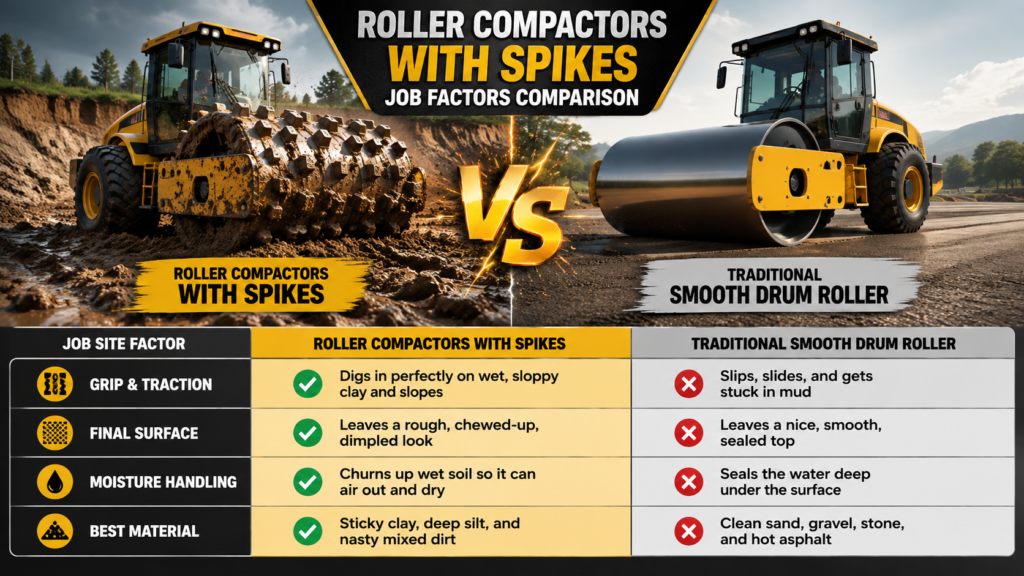
We see this exact debate in the equipment rental yard all the time: do you take the smooth drum or grab a spiked machine? The answer entirely depends on the dirt you are fighting that day. If you put a smooth drum on wet clay, it just creates a shiny seal on the top layer. It traps all the moisture inside, and the ground will just pump and flex every time a heavy truck drives over it. A spiked roller destroys that crust. It rips it wide open, mixes the dirt, and forces it to settle properly. Because the spikes hit the ground with so much concentrated force, you almost always reach your required compaction density in way fewer passes.
Fewer passes mean less diesel burned, fewer hours putting wear on the machine, and lower overall labor costs for the week. Smooth drums are still the undisputed kings of asphalt, sand, and clean gravel. But if the dirt sticks to your work boots, you need the spikes to get the job done right.
Table: Roller Compactors with Spikes Job Factors
| Job Site Factor | Roller Compactors with Spikes | Traditional Smooth Drum Roller |
| Grip & Traction | Digs in perfectly on wet, sloppy clay and slopes | Slips, slides, and gets stuck in mud |
| Final Surface | Leaves a rough, chewed-up, dimpled look | Leaves a nice, smooth, sealed top |
| Moisture Handling | Churns up wet soil so it can air out and dry | Seals the water deep under the surface |
| Best Material | Sticky clay, deep silt, and nasty mixed dirt | Clean sand, gravel, stone, and hot asphalt |
- Cuts down the number of times you have to drive over the same spot, which saves you a fortune in fuel and operator time.
- Rips open the sealed crust on the dirt, which stops water from getting trapped where it can ruin your hard work.
- Serves as the only real choice for cohesive dirt, leaving the smooth drums to do what they do best on road base and paving jobs.
Where These Machines Are Actually Being Used Today
You don’t have to look far to see roller compactors with spikes making a massive difference on modern job sites. If you drive past a major highway expansion, you will definitely see them building up the subgrade, making sure the earth can handle thousands of heavy semi-trucks pounding on it every single day without caving in.
They are also completely non-negotiable when crews are building retention ponds, levees, or big earthen dams. In those jobs, you need the clay to be 100% waterproof, and the aggressive kneading action of a sheepsfoot or padfoot roller is the absolute only way to get the dirt tight enough to stop water from leaking through. We are also seeing them constantly in commercial and residential land development.
When you are pouring a massive concrete slab for a warehouse or a new neighborhood block, that ground cannot shift even a fraction of an inch, or the foundation eventually cracks. Pounding the dirt with spiked rollers ensures the earth under the building is basically as hard as concrete before the actual concrete even shows up in the trucks.
- Locks down the deep subgrade on big highway jobs so the roads don’t buckle, sink, and wave after a year of heavy truck traffic.
- Packs clay so tightly that it actually becomes waterproof, which is exactly the standard you need for safe dams and levees.
- Preps commercial building pads so tightly that developers never have to worry about shifting ground cracking their concrete slabs later.
FAQs About Roller Compactors with Spikes
When folks are looking into upgrading their equipment fleet or renting out a roller for a tough job, we hear the exact same questions pop up time and time again. Understanding the nitty-gritty of how this specific equipment operates can save you from renting the wrong machine and burning days of progress. Down below, we have tackled the top seven things people are actively searching for when it comes to spiked soil compaction. Keeping these quick tips in your back pocket will definitely help you run a smoother, safer, and much more profitable dirt operation.
- Helps you figure out exactly when you should spend the money on a spiked roller and when you should skip it.
- Breaks down the old-school arguments about classic sheepsfoot rollers versus the newer, high-speed vibratory padfoot machines.
- Gives you straightforward advice on keeping the machines running smoothly so you don’t get hit with massive repair bills.
- What is a roller compactor with spikes mainly used for?
In plain English, they are built to smash down cohesive soils like thick clay and heavy silt. You see them on jobs where deep ground stability is life or death—think highway bases, big commercial building pads, and landfill liners where the dirt absolutely has to hold a ton of weight without sinking or shifting.
- What distinguishes a spiked roller (padfoot) from a sheepsfoot roller?
People use the names interchangeably on the job site, but they are different beasts. An old-school sheepsfoot has long, skinny, club-like metal feet and usually relies purely on heavy static weight, making it great for super deep, wet clay. A modern padfoot has shorter, tapered block pads and usually vibrates. Padfoots run a lot faster, handle mixed dirt better, and get the job done with fewer passes.
- Can a smooth drum be effective on cohesive clay soil?
Honestly, no. If you run a smooth drum on wet clay, you are going to have a really bad time. It just bridges over the dips and seals the top layer of dirt, leaving the soil underneath loose, wet, and full of air. Give it a few months, and whatever you build on top of it is going to start sinking or cracking.
- Is it okay to use a roller compactor with spikes on asphalt?
Absolutely never do this. The metal spikes are made to violently tear up and punch into hard dirt. If you drive one onto fresh hot asphalt, you will completely ruin the pavement in about three seconds. Keep the spikes in the mud, and always use a smooth drum for the blacktop.
- Why is the “kneading” effect so vital in soil compaction?
Dirt isn’t just dirt; it has air and water trapped inside of it. The kneading action physically works the soil like bread dough, breaking up hard lumps and forcing the dirt particles to stick together. It squeezes the trapped air out, which is the only real way to get the dirt dense enough to pass a strict engineer’s inspection.
- How do spikes contribute to better traction on challenging terrains?
Think of the spikes just like the big metal cleats on a pair of football shoes. Instead of a smooth steel drum spinning out in the mud, the spikes bite deeply into the ground. This gives the heavy machine the grip it needs to climb steep hills and push through nasty muck without sliding sideways.
- What are the maintenance requirements for spike road rollers?
The biggest thing is keeping them clean. You have to scrape the thick mud and rocks off the cleaner bars daily, or the drum will jam up and stop rolling. Besides that, you need to check the individual spikes for heavy wear or cracks, and make sure the vibratory system and hydraulic joints are pumped full of grease so nothing seizes up while you are working.