Wheel Loader Quick Coupler Systems: Improvise Site Performance
Maximizing heavy machinery output is the difference between a profitable venture and an expensive operational delay for a construction project. On high-stakes job sites wheel loaders are often relied upon as the ultimate utility players with wheel loader quick coupler systems can make material movement, site preparation and excavation easy.
However, the real material-handling capacity of these heavy-duty machines is limited by the physical effort and hours of labor required to manually change attachments by operators. This is where modern engineering comes to the rescue with a game changing solution.
The key to reducing cycle times, protecting hydraulic infrastructure and increasing machine versatility lies in understanding how to improve site performance using wheel loader quick coupler systems. Operators can replace outdated pin-on configurations with an intuitive mechanical or hydraulic quick coupler interface, transforming a single wheel loader into a versatile, multi-purpose workhorse.
The ability to go beyond traditional pin-on configurations is a high-value opportunity to eliminate operational bottlenecks common in today’s earthmoving operations. We have created the ultimate operational roadmap to help earthmovers, civil engineering contractors and fleet managers maximise their daily machine use.
The sections below discuss the major effects that quick coupler systems have on job site speed, equipment life and job site safety procedures.
Top Features of Wheel Loader Quick Coupler Systems Efficiency
1. Minimize Downtime When Changing Attachments
The most immediate benefit to adding a high-performance quick coupler system to your heavy equipment fleet is the near elimination of attachment changeover downtime. In standard setups, swapping a general-purpose bucket for a set of pallet forks or heavy-duty material handling arm takes several crew members, sledge hammers and brute physical force. This labor-intensive process can easily waste 20 to 30 minutes of active production time with each and every attachment swap.
You learn how to improve site performance with quick coupler systems on wheel loaders and realize that your changeover time goes from half an hour to seconds. The modern hydraulic quick coupler allows the machine operator to safely disconnect one work tool and securely lock onto another without ever stepping foot outside the climate-controlled cab. This dramatic reduction in machine downtime and hand labor totally changes the potential daily output of your earthmoving and loading operations.
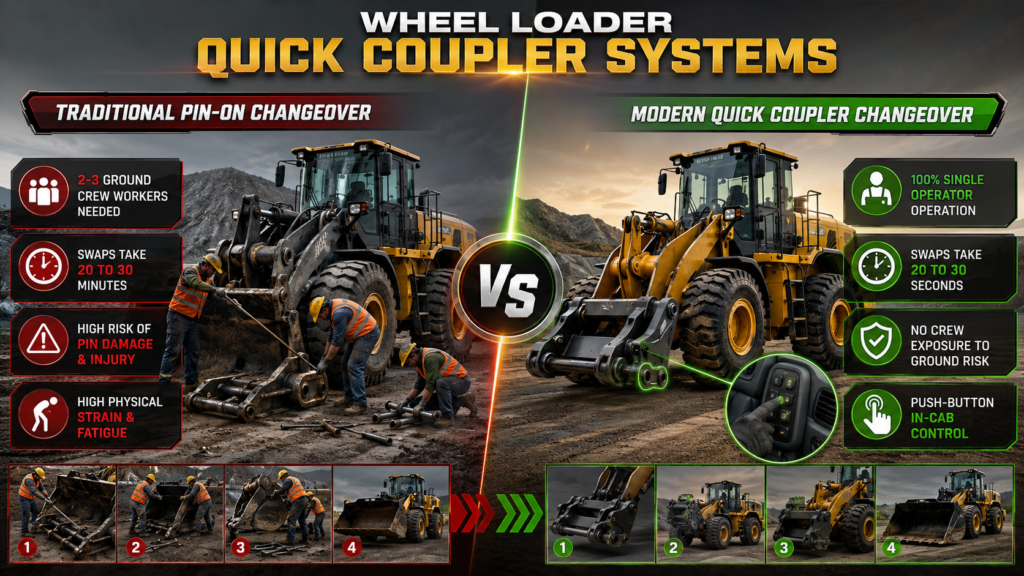
Table: Wheel Loader Quick Coupler Systems
| Traditional Pin-On Changeover | Modern Quick Coupler Changeover |
| • 2-3 ground crew workers needed | • 100% single operator operation |
| • Swaps take 20 to 30 minutes | • Swaps take 20 to 30 seconds |
| • High risk of pin damage & injury | • No crew exposure to ground risk |
| • High physical strain & fatigue | • Push-button in-cab control |
- Huge Secondary Labor Reductions: Gets rid of the historic need for two or three ground laborers to stand by with tools just to help swap basic mechanical components.
- Fast Changeover Sequences: enables the same wheel loader to switch from stockpiling aggregates to loading flatbed trucks with palletized goods within the same production hour.
- Reduced Unproductive Fuel Burn: Reduces the long periods of engine idling that naturally occur while ground crews struggle to manually align structural pins on uneven construction terrain.
2. Fleet Versatility & Machine Utilization Maximization
Investing in a fleet of heavy machines that are all single purpose costs a great deal of capital, something that modern construction companies can no longer afford. Maximizing your return on investment is all about squeezing the most multi-tasking performance you can from every machine you own or rent.
With the addition of a universal quick coupler system, a standard wheel loader is transformed from a basic loading machine to a highly versatile asset that can manage diverse job site duties.
The correct attachment mix allows your wheel loader fleet to take on tasks typically assigned to specialist support units such as telehandlers, small excavators or rough terrain forklifts. According to industry engineering analysis, a high-quality coupler interface can extend the operational scope of a single wheel loader to dozens of specialized attachments.
This full-service flexibility translates to lower mobilization costs and a smaller equipment footprint on a crowded urban job site.
- Wide Compatibility for Attachments: Connects easily to heavy-duty material handling arms, multi-purpose grapples, specialty snow plows, concrete block handlers and custom screening buckets.
- Cross-Fleet Tool Sharing: This allows multiple wheel loaders in similar weight classes to share a central pool of specialized work tools, thereby reducing total tool purchase costs.
- Reduces Redundant Machinery: Takes the need to transport, fuel and maintain secondary support machines on site saving thousands of dollars in monthly equipment overhead.
3. Enhanced Center of Gravity and Material Retention Ability
One of the common concerns equipment operators have is that the addition of a quick coupler system adds an unwanted forward physical offset that can reduce the net tipping load capacity of the loader.
Luckily, this story has been completely rewritten by advanced technological innovations. Innovative designs such as integrated low-profile wedge couplers bring the attachment much closer to the wheel loader’s main lift arms.
This has the effect of moving the combined center of gravity inward towards the front axle of the loader by bringing the attachment closer to the machine frame. It’s a clever piece of structural engineering that gives you the snappy performance profile of a permanent pin-on connection but still offers the flexibility of a quick-change system.
Overall lifting capacity is increased, machine bounce on rough terrain is decreased, and material retention during high-speed load-and-carry cycles is increased, improving the resulting physical stability.
- Reduces Tool Offset Displacements: Advanced wedge-locking systems seat the attachment close to the frame, eliminating the loss of breakout force often seen with older coupler styles.
- Improved High Speed Stability: By positioning the payload closer to the front axle, tipping hazards and machine rocking are reduced while traveling over uneven, rocky haul roads.
- Better Breakout Force Distribution: Hydraulic crowd force comes directly from the loader arms into the pile, resulting in maximum bucket yields each pass.
4. Minimizing Structural Wear and Degradation of Attachments
The longer it takes to change the attachment, the more operators will tend to develop a bad habit of using the wrong tool for the job, just for convenience. For example, an operator could use a typical aggregate bucket to push heavy debris with its corner, pull down a structural barrier or move heavy concrete pipes.
Using the wrong tool for the job puts uneven, twisting stress on the loader arms and speeds up structural cracking on the attachment itself.
We eliminate the physical and psychological friction that breeds this abuse of equipment by implementing a quick-coupling solution. It takes less than a minute to change attachments, which increases the motivation of operators to use the exact tool required for the job at hand.
This forward-looking operational change greatly reduces structural wear, prevents premature cavitation of the hydraulic pump and preserves the long-term resale value of your machine fleet.
- Prevent tool abuse: Operators use specialized tools for the tasks they were designed for, rather than forcing a standard bucket to do work it was not built to do.
- Rattle-Free Locking Mechanisms: State-of-the-art hydraulic wedging technology applies constant automated pressure to eliminate slack and play between the coupler ears and the attachment pins.
- Less Structural Vibration: The high-impact metal-on-metal slamming that destroys loader arm bushings is eliminated by removing the loose mechanical play of low-grade couplers.
5. Increasing Site Safety and Reducing Exposure of Ground Crew
The safety of modern construction sites relies largely on keeping the ground crew away from moving heavy equipment. Conventional manual attachment swaps are a high-risk scenario with ground crew members positioned directly between loader arms and heavy steel attachments. Manual changeovers pose an extreme risk of pinched fingers, crushing injuries from falling parts, or accidents due to poor visibility for the operator.
Looking at ways to improve site performance with quick coupler systems on wheel loaders, safety improvements are a major benefit. Hydraulic quick couplers are a completely bombproof connection with redundant mechanical locking circuits, integral check valves and positive visual indication devices.
The entire engagement process is initiated and completed from within the cab, with zero exposure of ground crew to active work zones whatsoever.
- Dual Hydraulic Secondary Safety Locks: Incorporates mechanical safety pins or hydraulic check valves that prevent the lock from becoming disengaged in the event of an unanticipated hydraulic hose failure.
- Clear Visibility Signaling Indicators: Has easy to see physical indicators or electronic in-cab sensors that clearly indicate to the operator that the locking wedges are fully extended and secured.
- Zero Ground Worker Exposure: Keeps support workers completely clear of heavy lifting components and crush zones, dramatically reducing recordable job site injury rates.
6. Proactive Maintenance of Wheel Loader Quick Coupler Systems Top Performance
To keep your quick coupler system running at peak productivity, it is imperative that you follow a systematic preventative maintenance program. Couplers, like any heavy duty hydraulic or mechanical component, are constantly exposed to abrasive dust, moisture and high impact working forces.
If basic maintenance is neglected, mechanical binding, fluid leakage or premature wear of the locking wedges can occur.
A few minutes of routine inspection will keep your coupler operating at peak efficiency and help you avoid unexpected breakdowns on the job. A simple, structured maintenance checklist keeps the coupler interface clean, tightly locked and ready for a rapid change of attachments.
- Routine Cleanout of Debris: After each shift, clean out the cavities of the locking wedges to remove packed dirt, mud and rocks to achieve full structural engagement.
- Focused Lubrication Procedures: Apply premium grease to the main grease points and sliding lock pins every day to minimize friction and prevent component sticking.
- Hydraulic Hose Wear Checks: Scuffing, weather cracking, or wet fittings in auxiliary hydraulic lines can cause unexpected fluid pressure loss. Check daily to prevent this.
FAQs: How Quick Coupler Systems on Wheel Loaders Improve Site Performance
What is the primary difference between a hydraulic and a mechanical quick coupler on wheel loaders?
The basic difference lies in ease of operation, safety, and speed. The wheel loader is equipped with a hydraulic quick coupler that connects to the auxiliary hydraulic system, so the operator can lock and unlock attachments instantly from the cab without any manual labor. In contrast, a mechanical quick coupler requires the operator to leave the machine and physically pull a lever, turn a screw mechanism or insert a physical pin to make the attachment secure. Mechanical models are less expensive initially but hydraulic models are much more productive and safe on site.
Do quick couplers negatively impact the lifting capacity or breakout force of a wheel loader?
Traditional or poorly designed quick couplers will reduce lifting capacity to a degree as they add dead weight and extend the attachment further forward, increasing the load center. Modern premium systems such as the high-tech wedge and low profile systems available on rollercompactor.net are designed to reduce this offset. By keeping the attachment very close to the loader arms they keep the center of gravity of the machine tight, matching original factory pin-on performance with unmatched tool versatility.
Is the quick coupler on a wheel loader universal for all makes of equipment?
Quick couplers are not interchangeable for all brands but there are very standardized industry patterns. The most popular configurations are the classic ISO interface used by many global brands and proprietary high-performance wedge designs specific to each manufacturer. Check the hook dimensions, auxiliary hydraulic flow settings and locking pin positions of the attachment to ensure they match the coupler model on your loader.
How frequently should a wheel loader quick coupler system be greased and maintained?
To maintain the integrity of the quick coupler and avoid any unexpected mechanical sticking, the key grease points need to be greased every 10 hours of operation or at least once a working day. Operators should also do a quick visual check at the beginning of every shift for leaks of hydraulic fluid, hose routing for abrasions, and to remove any packed mud or rocks from the locking pins to ensure a perfect mechanical lock.
Can I use standard quick couplers with hydraulic attachments such as breakers or grapples?
Yes, powered hydraulic attachments can be successfully operated but you must ensure that your loader is equipped with a compatible auxiliary hydraulic circuit. The wheel loader quick coupler system should be used in conjunction with quick-connect hydraulic couplers on high-demand tools such as rock breakers, multi-purpose grapples or industrial sweepers. They connect the pressure lines of the machine to the tool. The operator must always check that the auxiliary flow rates and pressure settings of the loader are adequate for the attachment.
What safety features are built into a quick coupler to prevent it from falling off accidentally?
High-quality modern quick couplers incorporate multiple layers of redundant safety engineering to prevent accidental tool drop incidents. These safety mechanisms include pilot-operated hydraulic check valves that trap fluid pressure within the locking cylinders, heavy-duty physical springs that hold locking wedges in place during pressure losses, and highly visible indicator pins that allow operators to confirm a secure, positive lock directly from the cab.
How can I tell if my wheel loader attachments are compatible with a new coupler installation?
Compatibility is verified by comparing the physical interface geometry and matching the specific structural hook-and-pin spacing of your existing tool inventory. If you have an assortment of older, traditional pin-on buckets, they can easily be converted for use with a new quick coupler system by welding a standardized adapter plate or coupler hook bracket onto the back of the existing attachment frame.