Drum Roller Compactor 2026 Buyer’s Guide: Sizes, Specs & Efficiency Tips
The heavy machinery sector is undergoing major changes, and in 2026, elements such as precision, fuel saving, and “smart” functioning are at their peak. If you are an experienced contractor or a first-time buyer, other than machine weight, the advanced technology features along with site requirements will be major factors for you to buy a drum roller compactor.
Drum Roller Compactor 2026 Buyer’s Guide:
We at rollercompactor.net also believe that the quality of compaction plays an integral role in any durable infrastructure project – a superhighway, or a small drive-way for the neighbors.
Our 2026 guide to the norms help you understand the modern drum roller specs, so you can make an excellent purchase decision, enjoy the greatest ROI, and build the most durable infrastructural components.”
Drum Roller Compactor in 2026:
The compaction equipment market in 2026 is dominated by hybrid and electric models and at the same time there are Intelligent Compaction Systems (ICS) which can give operators real-time data about whether the compaction is satisfactory.
Whether single drum, double drum or padfoot–each type of roller offers certain advantages and influences the cost and quality performance of the project. Thanks to the high-tech vibration and AI controls that are now commonplace, the number of passes needed can be reduced by up to 25%, which greatly decreases fuel and labor costs.
We’ve put together this buyer’s guide to help you understand these changes and decide on the product that will serve your purposes both in power and intelligence.”
Knowing Drum Roller Compactor Types and Their Usage in 2026
Proper buying of a roller demands first of all that you figure out what the major types sold nowadays are. Every type is built for certain soil character and project size and if you select one that is not right for these, you risk under-compaction and destruction of the materials.
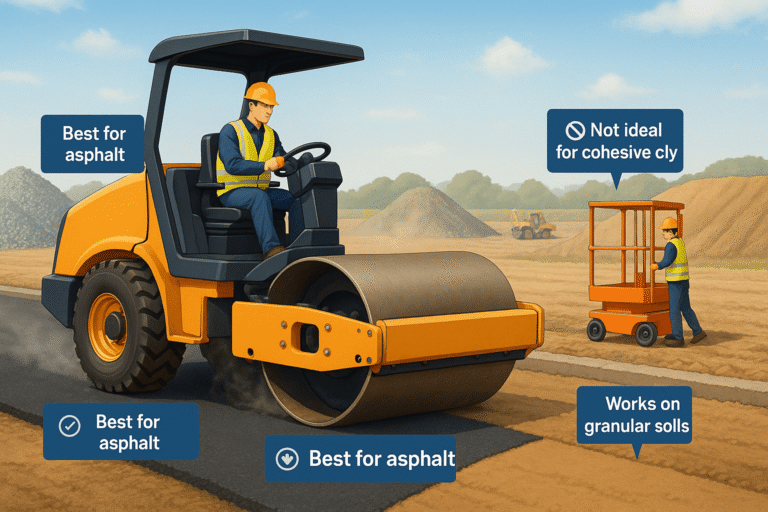
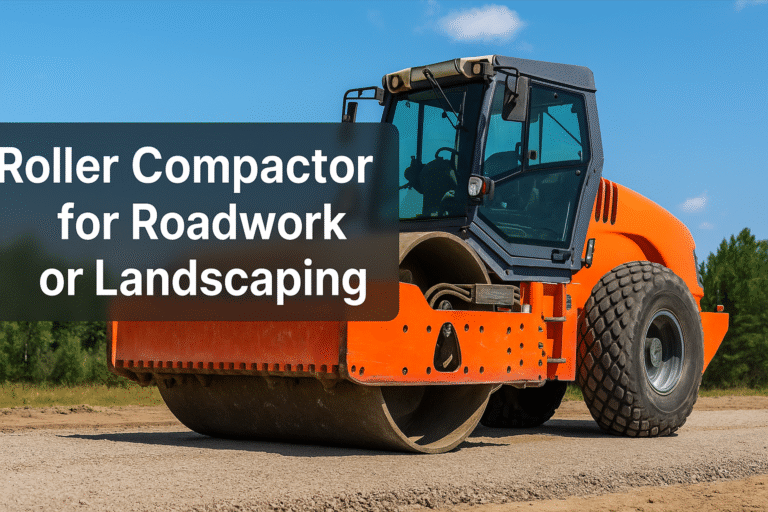
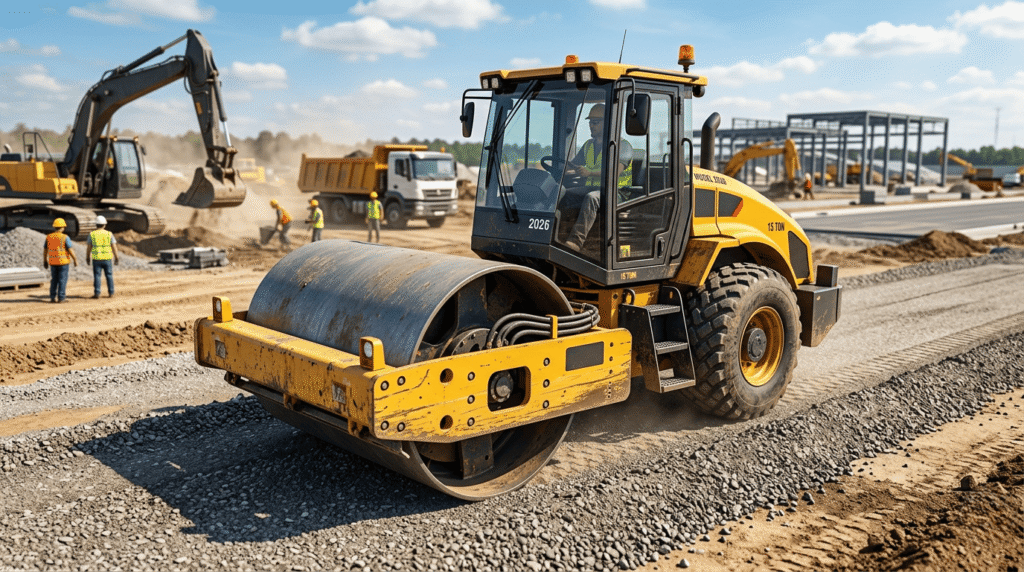
- Single Drum Rollers: These are primarily used for compacting soils and sub-bases, and at the front of the machine there is a wide steel drum while the rear is fitted with heavy-dut y tires for traction on uneven terrains.
- Double Drum (Tandem) Rollers: Used especially on asphalt and finishing work, these machines have two steel drums running one behind the other so that a very even and smooth surface can be obtained without the “kneading” effect of tires.
- Padfoot (Sheepsfoot) Rollers: These drums have “lugs” or “bumps” which are penetrating deeply into the soil to compact it and get density from the bottom level up.
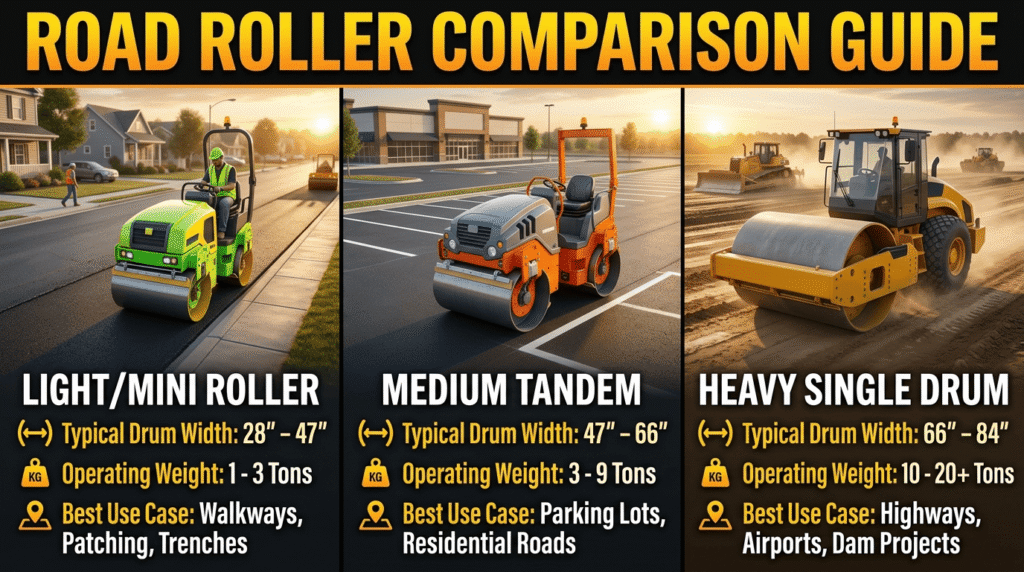
Main Specifications: Weight, Width and Vibration
The operating weight and drum width are the main bases for us to classify drum roller compactors in 2026 as they have a direct influence on the “lift thickness” (depth of material) the machine can compact effectively.
| Roller Category | Typical Drum Width | Operating Weight | Best Use Case |
| Light/Mini Roller | 28″ – 47″ | 1 – 3 Tons | Walkways, Patching, Trenches |
| Medium Tandem | 47″ – 66″ | 3 – 9 Tons | Parking Lots, Residential Roads |
| Heavy Single Drum | 66″ – 84″ | 10 – 20+ Tons | Highways, Airports, Dam Projects |
- Compaction Force (kN): This is the kilonewtons delivered by the drum “hit”; to work on thick lifts and hard materials you will have to go for higher kN ratings.
- The Frequency and Amplitude: Machines with capability to adjust vibration levels should be considered since the application is not always constant hight frequency (vibration/minute) is used for thin asphalt while high amplitude (motion of the drum) is required for deep soils.
- Static vs. Vibratory: Static means that the force is simply the weight of the roller whereas the vibratory types have internally rotating weights which create dynamic forces and make it possible to reach 30% more efficiency in modern 2026 projects.
The Rise of Intelligent Compaction and Efficiency Tips
Efficiency today implies reliance on data. The best contractors are eliminating the concept of “guesswork” and embracing systems that illustrate real-time compaction progression. This helps to avert “over-compaction,” a state which causes the breakdown of aggregates and ultimately results in weakening of the foundation.
- Adopt Real-Time Data Mapping: Rollers fitted with GPS and capacity measuring sensors find the user a color-coded density map for the whole territory and guaranteeing no area left uncompressed or undercompressed.
- Optimize Pass Patterns: Sticking to a uniform working speed of 2-4 mph will most likely save time plus material since the roller overlaps about 6 inches with each pass ensuring no “weak spots” in the compacted material.
- Monitor Moisture Content: Even the best compactor is powerless against dry or overly wet soil; hence soil moisture must always be at or near the “Optimum Moisture Content” (OMC) if minimum passes are desired for a given density level.
Maintenance and Longevity in 2026
A drum roller compactor is certainly no small amount of money and its working life depends largely on maintenance of its vibration and hydraulic systems. Today, numerous brands have adopted predictive diagnostics which can show you the potential problem before it leads to downtime.
- Daily Drum Scraper Checks: Verify that drum scrapers are set correctly to remove material sticking to the drum; otherwise, the dirt on drum will lead to imperfections on the mat and uneven compaction.
- Hydraulic System Maintenance: With today’s vibratory rollers working at very high pressures, the hydraulic oil must be replaced every 1,000 to 2,000 hours to avoid “internal bleeding” of power.
- Shock Mount Replacements: These rubber mounts isolate the drum vibrating from destroying the frame of the machine as well as the operator’s comfort; replace any with visible cracks or tears at once.
Choosing Between Electric and Diesel
2026 is certainly a year of change for power sources. Although diesel is likely to continue to dominate heavy-duty, long-duration works, electric drum roller compactors have found their niche for urban, indoor works where no emissions and low noise matter the most.
- Diesel Rollers: Good for highway projects in the remote areas where there is no charging facility and for maximum torque that is needed for 10-12 hour shifts.
- Electric Rollers: Most suitable for “Green Zone” projects, hospitals, and residential neighborhoods where noise restrictions are severe; besides, operating costs are on average 20% lower since there are fewer moving parts.
- Hybrid Solutions: Its diesel engine charges the onboard batteries providing the range of the diesel and the efficiency and low-end torque of the electric motor.
Safety Features and Operator Comfort
Operator fatigue causes many accidents and delays on projects. For the 2026 buyer’s guide, the focus is on equipment with ergonomically designed cabins, better comfortable seats and windows for wider visibility especially for double drum roller compactors where the operator needs to clearly see to the “edge”/ “front step” of the drums.
- 360-Degree Visibility: Features like “sloped hood” and camera systems that eliminate blind spots around the rear tires and drum edges give a complete view to the user.
- ROPS/FOPS Certification: Really the cabin or canopy should be certified for Roll-Over and Falling-Object Protection for the safety needs of 2026.
- Climate Control and Vibration Isolation: These days, “floating cabins” can be found even in mid-range models allowing the operator to work without fatigue and still be highly productive unlike older models.
FAQs – Drum Roller Compactors
Name one major difference between a smooth drum and a padfoot roller?
A smooth drum roller is made for use on loose soils such as sand and gravel and aims at leaving a level surface. On the other hand, a padfoot roller (also known as sheepsfoot) has lots of “lugs” on the drum which reach down into clay soils and so compact from the bottom up thereby securing structural stability in-depth.
What factors should influence the choice of drum width for a project?
The drum width should be based on site constraints. For highways, an 84-inch drum is the default option so that more ground is covered. However, for residential driveways or when working in tight urban locations, the smaller 47-inch or “mini” rollers are preferable since they can maneuver easily without damaging the curbs.
What is “Intelligent Compaction” (IC)?
Intelligent Compaction is a kind of earthwork compaction machinery that uses GPS and onboard sensors to measure the soil’s stiffness. The operator is presented with a digital map that highlights locations of the construction site that have achieved the desired level of compaction, thereby avoiding any duplication of work and resulting in an even quality of the finished product.
Would a single drum roller be suitable for asphalt paving?
Most likely not since the rubber tires of single drum roller compactors located at the back would leave marks and could even “knead” the asphalt thereby resulting in an uneven finish. When it comes to asphalt, a double drum (tandem) roller or a pneumatic tire roller would be the preferred option for getting a smooth mat.
How often is maintenance recommended on a vibratory roller?
A quick daily inspection is necessary to check fluid levels, make sure the drum scraper is working, etc. Besides, there are some planned maintenance activities that the engine oil is changed every 250 hours and hydraulic oil and vibration system are serviced every 1,000-2,000 hours. It is best to check the latest 2026 model’s manual for exact timelines.
Do electric drum roller compactors have enough power for heavy soil compaction?
Electric motors deliver excellent and high “instant torque” which is best suited for the activation of the vibration system. Although such equipment are presently limited by battery life when it comes to 24/7 operations, they can still produce the same compaction forces as their diesel counterparts for a typical 8-hour shift.
Why is it considered to be a bad thing when the soil is over-compacted?
When you “over-compact”, you can break down the aggregate or the rock within the soil or asphalt into very fine particles. This completely destroys the “interlocking” property of the material and as a result a surface is formed which is not only weaker, but also more susceptible to cracking and erosion over time.