The Best 7 Uses for Spiked Roller Compactors in Roadwork and Ground Preparation
In the modern age of building infrastructure, the quality of the ground beneath our highways and building foundations is what keeps them stable. To get that stability, you need more than just big machines; you also need tools made for certain types of soil. The Spiked Roller Compactor, also known as a padfoot or sheepsfoot roller, has become a game-changer among these.
These spiked machines don’t just flatten the surface like traditional smooth-drum rollers do. Instead, they “knead” the soil to get rid of every air pocket. If you want to make sure that your structure lasts for a long time, you need to know the Top Applications of Spiked Roller Compactors in Roadwork and Ground Preparation. This is true whether you are working on a big highway project or getting ready to landscape your home.
Best 7 Uses of Spiked Roller Compactor:
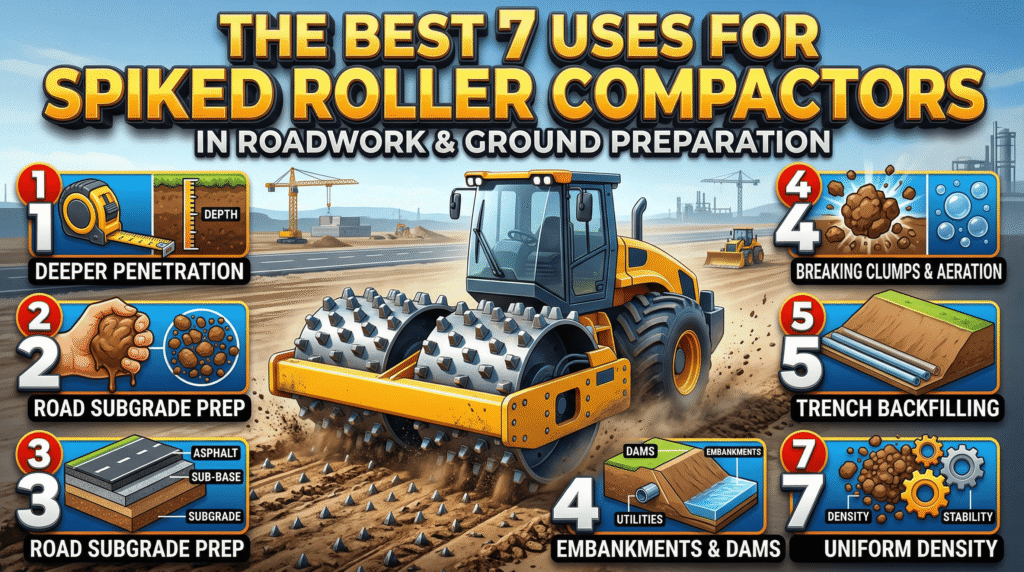
1. Learning how to compact cohesive soil in road bases
The main and maybe most important use of a Spiked Roller Compactor is to compact soils that stick together, like clay and silt. Because clay particles tend to stick together, making a bridge that resists surface pressure, traditional rollers often have trouble with these materials.
The spikes on the drum break through these tough layers, breaking down the soil’s internal structure and pushing the particles together from the bottom up. In the early stages of building a road, this step is very important because the sub-base needs to be perfectly dense so that it doesn’t sink or “rut” under heavy traffic.
- Deep Penetration: The spikes put the full weight of the machine on small contact points, which lets the force go deeper into the soil than a flat drum.
- Kneading Effect: The spikes move in and out of the ground, which changes the arrangement of soil particles. This is similar to kneading dough, which is the only way to make wet clay denser.
- Managing moisture: The spikes help release trapped moisture by breaking up clumps. This lets the soil get to its ideal moisture level for maximum density.
2. Important Ground Preparation for Heavy Infrastructure
Before a single brick is laid or a ton of concrete is poured for a big building, the ground must be carefully prepared. When it comes to getting building pads and industrial foundations ready, Spiked Roller Compactors are the best choice.
These machines make sure that the “lift” (the layer of soil being compacted) is the same depth all the way through. If the bottom of a soil layer stays loose while the top gets hard, the building will eventually settle unevenly, which will cause huge structural cracks. A Spiked Roller Compactor makes sure that the foundation is just as strong as the buildings it supports.
- Getting rid of air pockets: The spikes on the drum make sure that air pockets, which can cause things to move over time, are completely gone.
- Layered Stability: These rollers are perfect for “lifts” that are up to 12 inches thick, making sure that the whole vertical profile of the soil is compressed.
- High Load-Bearing Capacity: By increasing the density of the soil with targeted spike pressure, the ground can hold much heavier industrial loads.
Comparison: Spiked and Smooth Drum Rollers
| Feature | Spiked Roller Compactor | Smooth Drum Roller |
| Primary Soil Type | Cohesive (Clay, Silt) | Granular (Sand, Gravel) |
| Action | Kneading & Penetration | Static Pressure & Vibration |
| Finish | Rough, textured surface | Smooth, even finish |
| Best For | Sub-grade and base layers | Final asphalt or top-level soil |
3. Landscaping and clearing large areas of land
Spiked Roller Compactors have two uses in landscaping and site development: they compact and aerate the ground. When you clear a site of thick plants, the soil is often left in a messy, clumped state.
The spiked drum does a good job of breaking up these organic “clods” and making a flat, dense surface for more building. Also, these rollers are used in big park projects or building golf courses to make sure the ground is stable enough for heavy maintenance equipment without losing its ability to drain water.
- Texturing the surface: The spikes leave a patterned surface that makes it easier for the next layers of topsoil or sod to “grip.”
- Breaking Up Vegetation Clumps: The spikes break up the material in places with a lot of roots or organic matter to make the soil mix more even.
- Better aeration: The spikes keep the top layer from becoming a “crust” while compacting the deeper layers, which lets water flow through better.
4. Backfilling trenches and keeping pipelines stable
One of the hardest parts of utility work is making sure that trenches that have been filled in don’t sink over time. When you bury pipes for water, gas, or fiber optics, the soil that fills the trench must be compacted to match the earth that hasn’t been disturbed.
A Spiked Roller Compactor, especially one that you walk behind or mount on an excavator, is the best tool for the job because trenches are usually narrow and have wet soil. It stops the “settlement” that happens when utility lines are put in and causes dips in the road.
- Vertical Compaction: The spikes keep the soil tightly packed against the sides of the trench, which keeps the backfill in place.
- Ability to move in tight spaces: Smaller spiked rollers can work in narrow excavations where bigger machines can’t.
- Avoiding Damage to Pipes: The kneading action gives the pipes a solid support without the high-frequency vibrations that could harm delicate utility materials.
5. Stabilizing the slope and embankment
When you work on an incline, you face a unique set of problems, the most important of which are traction and stability. When it rains, a smooth roller can slip on a slope, which is dangerous and doesn’t do a good job of compacting the soil.
The spikes on a Spiked Roller Compactor work like “cleats,” digging into the slope to give you better traction in these situations. This makes them necessary for building highway embankments, dam walls, and levees where the soil needs to be packed down on a steep slope.
- Mechanical Keying: The spikes make a mechanical bond between layers of soil on a slope, which keeps the layers from sliding against each other.
- Better Traction: The pads that stick out make sure the machine can safely go up and down hills, even when it’s wet or slippery.
- Uniform Density on Inclines: This keeps the “face” of an embankment as dense as the flat ground, which stops erosion and landslides.
6. Effectiveness of Landfill and Waste Management
The waste management industry relies heavily on Spiked Roller Compactors, even though roadwork is the main focus. The goal of a landfill is to crush trash and pack it down to save as much space as possible.
The heavy, spiked drums are great for ripping open trash bags, smashing things that are hollow, and packing the trash into a tight mass. This makes the landfill last as long as possible and makes sure that the “cell” is strong enough for the next layer of waste and soil cover.
- Volume Reduction: The spikes break up and puncture trash better than a flat surface.
- Shredding Action: The spikes help shred plastic and organic waste as the roller moves, which speeds up the process of breaking down waste and settling it.
- Stability for Cover Soil: A well-compacted layer of waste makes a solid base for the “daily cover” of soil, keeping smells and pests away.
7. Repairing dirt paths and maintaining roads in all kinds of weather
The Spiked Roller Compactor is the best tool for maintaining roads in rural areas and temporary construction sites. These roads often have “soft spots” where water collects.
Operators can “chew up” the damaged surface and re-compact it into a solid, water-resistant path by using a spiked roller. This is very helpful in the spring when the ground is thawing and regular rollers would just get stuck in the mud.
- Fixing the Surface: The spikes break up the “pothole” areas and move the material around so that it is level again.
- Performance in Wet Weather: Spiked rollers can work in muddy conditions that would stop other equipment from working because they don’t need a smooth surface to grip.
- Dirt roads that last a long time: Properly compacting with spikes makes a “crust-like” stability that keeps rain and wind from eroding them.
FAQs: About Spiked Roller Compactors
What is the main difference between a roller with spikes and a roller with a smooth drum?
A smooth drum roller uses static weight and vibration to pack down granular materials like sand and asphalt, giving them a smooth finish. A Spiked Roller Compactor has metal “feet” that stick out and knead together soils that stick together, like clay. This makes the base layers go deeper and stay more stable.
Is it possible to use a spiked roller on asphalt?
Not usually. The spikes would rip up the hot asphalt and leave a surface that was rough and uneven. Before the final paving starts, spiked rollers are only meant to prepare the ground for soil, gravel, and the base layer.
What does the name “sheepsfoot” mean for spiked rollers?
The name comes from the time when shepherds would drive their sheep across paths to pack the ground down. The metal spikes on the modern Spiked Roller Compactor act like the small, high-pressure impact of a sheep’s hoof.
How deep can a spiked roller push down on dirt?
A spiked roller can effectively compact “lifts” of soil that are between 6 and 12 inches deep, depending on the weight of the machine and the type of soil. The spikes make sure that the compaction is the same all the way up and down the layer.
Are spiked rollers better for soil that is wet or dry?
Spiked rollers work best in wet, sticky soils like clay because they knead the soil, which helps get rid of trapped air and water. But you can also use them on dry soil, though you may need to add some water to get the right amount of moisture.
Do I need a roller with spikes that vibrate?
Some spiked rollers use static weight, but most modern ones have a vibrating mechanism. A vibratory Spiked Roller Compactor is very effective because it uses both the kneading action of the spikes and the “shaking” force of vibration to settle particles even faster.
Is a spiked roller good for landscaping around the house?
Yes, smaller versions or excavator attachments are great for getting large residential lots ready, especially those with heavy clay soil. They make sure that future lawns, driveways, and patios have a solid base that won’t sink or collect water.