The Science of Smooth Drum Compaction: Advanced Techniques for Building Durable Roads and Pavements
Preparing a road surface that resists cracking, rutting, and early degradation starts before the asphalt is placed. Smooth Drum Compaction is the most important step in road and pavement building. The unrelenting strains of current traffic and environmental factors will destroy even the greatest materials and paving patterns without proper density. For granular subbases, crushed rock layers, and most asphalt mats, the smooth drum roller is the norm.
Exploring the Basic Mechanical Principle of Smooth Drum Compaction
Single- or double-drum (tandem) smooth drum rollers achieve material density by the combination of static weight and dynamic vibration. Static compaction involves the use of the machine’s bulk to push and rearrange particles. Dynamic compaction is the factor that dramatically raises the effectiveness and the result of the impact.
The flat surface of the drum limits point pressure, which makes the drum very good for uniform compression of fine-grain materials, granular layers, and asphalt pavement surface layers without the separation of fractions or crushing of the aggregate. In addition, the smooth drum’s versatility as a primary breakdown compactor for granular bases and a finishing tool for the final asphalt lift makes it the indispensable road construction equipment.
Compaction effort is increased with the help of the dynamic vibration. With each revolution the material is pushed down by the centrifugal force resulting from the eccentric weights in the drum. The enormous kinetic energy very briefly frees the material particles from the frictions that hold them in a tight stable structure and thus allows them to move to an even tighter one than can be done by static weight alone.
Consequently, there is a very large reduction in air spaces which increases density, load-bearing capacity, and permeability, thus giving the material better protection against water damage and the freeze-thaw cycle. Smooth drum operation is based on the understanding and control of static weight and centrifugal vibration.
- Static Compaction: Uses only roller’s weight (carrying area defined as static linear load) to press and consolidate material down.
- Vibratory Compaction: Quickly oscillating the drum gives a dynamic force and thus particle lubrication and tighter interlock are resulting factors.
- Material Specificity: Smooth drum works well on non-cohesive materials such as sand, gravel, and crushed stone, and also provides the required smooth finish for asphalt.
Strategic Application: Material Selection and Lift Thickness
Correctly chosen machine and mode for the material to be compressed are indispensable for smooth drum compaction. For deep compaction of cohesive soils such as clays padfoot drums are used while for deep subbase layers down to the thin wearing course of asphalt smooth drums are utilized.
Using the proper method the operator adjusts the roller settings or changes the roller depending on lift thickness and material stiffness. On a thick granular foundation (8 to 12 inches) a vibratory smooth drum operates at full dynamic capability, while the use of a static mode on hot asphalt results in minimizing damage and creating an ideal finish.
Compaction of base course (crushed aggregate or stabilized base) is mostly done with a smooth drum vibratory roller. A tight, linked framework is what we aim for. The smooth drum acts as the breakdown roller (initial pass with vibration), intermediate roller (additional passes with decreased amplitude), and occasionally finish roller (static only) when rolling hot mix asphalt (HMA).
Smooth Drum Compaction Capabilities:
Modern smooth drum rollers have the capability to switch between high and low amplitude and dynamic or static mode thus making them possible in all road building stages. An expert compaction approach is capable of changing the compact effort instantly.
- The machine’s power usually determines the optimal lift thickness for vibratory smooth drum compaction to be between 8 and 12 inches for granular soils.
- When working on asphalt, one should always start rolling when the temperature of the HMA is at its highest allowable limit, which is generally more than 175°C (350°F) for breakdown.
- For the last finishing passes on the asphalt, the use of vibration should be discontinued so that surface imperfections such as roller marks or small ripples can be avoided.
Mastering the Compaction Parameters: Amplitude, Frequency, and Speed
Amplitudes, frequency, and speed that the operator chooses are pieces of parametric precision on which compaction relies. These factors determine the extent and the uniformity of energy that is delivered to the material. The compactive effort is limited by drum amplitude, which is its maximum vertical displacement.
Dense lifts or stiff, difficult-to-compact materials require high amplitude whereas a low amplitude is suitable for thinner asphalt layers or intermediate passes.
- The number of drum oscillations per minute (vpm) is what determines the speed of the impact.
- Using a high frequency allows for a higher rolling speed to be kept and at the same time the impact spacing to be maintained.
The finishing of an asphalt surface with a smooth, uniform look is to a large extent dependent on the factors of frequency and rolling speed. The recommendations by the industry standards are for 10–12 hits per rolling foot. Over-compaction is not evenly done when the frequency is high and the speed is low.
There is a danger of “rippling” or “washboarding” the pavement if low frequency and high speed are used, thus affecting the ride quality and durability. Skilled operators adjust speed to correspond to frequency and material requirements so that the whole highway undergoes the ideal, uniform energy input for maximum density thereby they leave no square foot unchecked.
- Amplitude (High/Low): High amplitude is for thick layers and deep compaction; low amplitude is for thin layers and surface smoothing.
- Frequency (VPM): The rate of impacts is controlled by this parameter; higher frequency allows for a faster pace while maintaining ideal impact spacing.
- Rolling Speed: Has to be consistent and slow (normally 2–3 mph) to allow for uniform impact spacing and to make shoving of the material impossible.
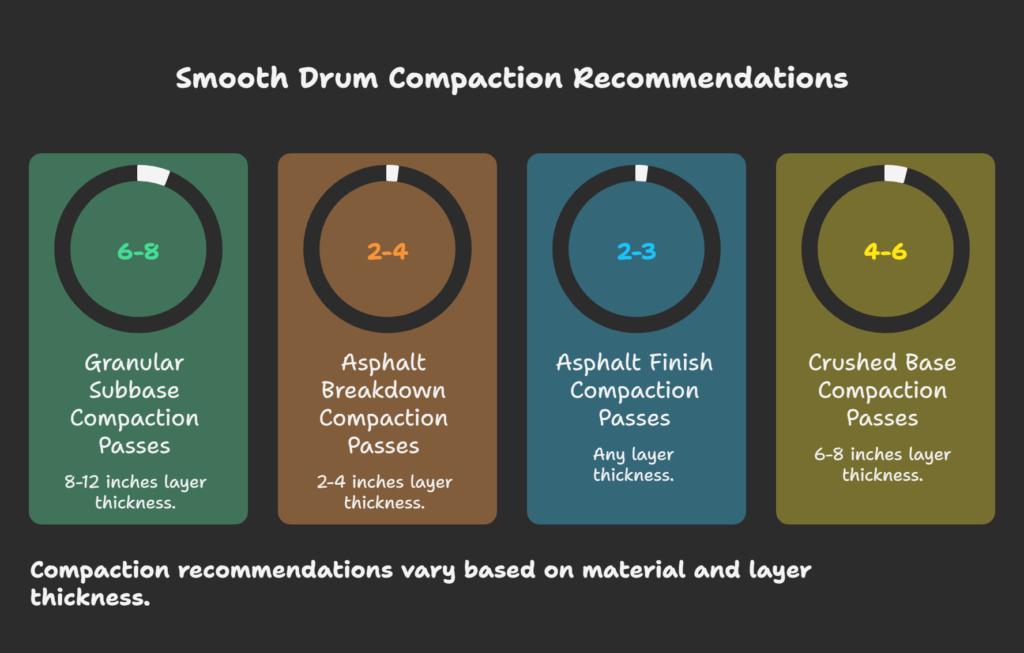
Tabular Format: Smooth Drum Compaction
| Material / Layer | Lift Thickness (Approx.) | Recommended Amplitude | Recommended Frequency | Compaction Passes |
| Granular Subbase | 8 – 12 inches | High | Medium to High | 6 – 8 |
| Asphalt Breakdown | 2 – 4 inches | Medium to High | High | 2 – 4 |
| Asphalt Finish | Any | Static (Zero) | N/A | 2 – 3 |
| Crushed Base | 6 – 8 inches | Medium | Medium | 4 – 6 |
Optimal Rolling Patterns and Pass Overlap
Optimally compacted material requires closely planned rolling patterns and correct parameters. Edge-to-edge mat density, void elimination, and stress point avoidance are the goals. Typically folding the rolling over perpendicular to the paving direction and increasing the overlap are used.
- First asphalt breakdown passes should be done at the low side of the road slope to prevent the lateral displacement of the hot mix or, in the case of a level terrain, a little bit inward from the pavement edge. This tightens the outside stuff in.
- Consistency is maintained through the overlap of the next pass with the one under consideration by 25% to 50% of the drum width. This ensures that each aera of the pavement receives sufficient collisions.
- Stopped and started in the same place might cause dips or bumps, thus operators have to know how to stop and reverse the roller in a small arc toward the center of the mat to roll out any depressions on the next pass.
NEVER stop rolling on hot, new asphalt as this leaves a permanent drum depression that reduces smoothness and durability. Operators keep density and levelness along the route by sticking to a strict pattern and pace.
- Start/Stop Technique: Always stop and reverse in a gradual arc to prevent noticeable start/stop marks and subsequent surface imperfections.
- Overlap Requirement: Ensure consistent 25% to 50% overlap on all vibratory passes to guarantee uniform coverage and density across the width of the lift.
- Joint Compaction: The long joint along the two pavement parts is the place that has to be specially looked at and usually requires a somewhat small overlapping of the cold mat so that the density of the cold mat and the warm mat is the same.
Supercharging Smooth Drum Performance With Intelligent Compaction (IC)
- The smooth drum operation which was largely reliant on the operator’s discretion has been changed dramatically by Intelligent Compaction (IC).
- Rammers with IC technology have an accelerometer-based measuring system, GPS mapping, and infrared temperature sensors for asphalt operations installed.
- The system provides real-time input to operators, thus making compaction a science that is driven by data. A console display shows the operator the coverage, target density (Compaction Meter Value or CMV), and areas where work is still needed.
- This ensures greater quality control and also more freedom for the road builders. The IC units keep real-time track of the number of passes per square meter, thus, an under-compaction (early failure) and over-compaction (aggregate crushing and material weakening) situations are avoided.
The integrated circuit system gets the signal when the asphalt is still in the temperature range that is considered critical and therefore the density requirements are satisfied before the mixture hardens. By employing IC, contractors can furnish project owners with concrete evidence or data showing that the site has been uniformly covered and that the required density levels have been achieved, thus making the process of accountability and quality assurance a great deal easier.
- Real-Time Data: IC systems provide continuous feedback on stiffness/density (CMV) and coverage, thus preventing guesswork and ensuring efficiency.
- Temperature Mapping: In asphalt paving, IC is supporting the roller to remain within the optimum temperature range in order to attain maximum density before the mix cools.
- Documentation: GPS-tagged data creates a comprehensive, auditable record that density requirements have been met everywhere, thus enhancing project transparency.
Operational Longevity and Maintenance Best Practices
Careful maintenance of the smooth drum roller together with operator attention will keep the machine efficient and reliable. Road construction is dirty, noisy, and it requires regular inspections. Operators should make sure that the drum’s surface is clean from any stuck material, especially asphalt or cohesive soils, which may cause uneven compaction and markings.
- A water spray system that is used to prevent the sticking of asphalt should be checked if it is working and whether the tank is full before every shift.
- Smooth drum rollers are equipped with advanced hydraulic and vibratory systems and thus fluid levels and wear and tear should be checked.
- Not maintaining the machine may lead to component failure, thus it costs money and the time projects are delayed.
Rollercompactor.net as one of the leading specialists in this area recommends following the equipment manufacturer’s points for their specialized equipment. Serviced rollers perform at optimal efficiency, reach density goals faster, and lower operating costs thus benefitting project profitability and quality.
- Daily Cleanliness: Make it a regular habit to clean the drums and in particular the scrapers so that no material can build up there, as otherwise the smoothness of the finished surface would be compromised.
- Vibratory System Check: Keep an eye on the hydraulic fluid levels as well as the lines that provide the eccentric weights with the fluid, because this system is the main one for the roller’s primary function.
- Manufacturer Compliance: Follow the manufacturer’s schedule for oil changes, filter replacements, and specific preventative maintenance checks quite closely to maintain machine warranty and performance.
The smooth drum roller is not just a heavy metal cylinder but rather a precision instrument for material consolidation. By combining a thorough knowledge of compaction physics with proper operational techniques—from setting amplitude and frequency to following the right rolling patterns and using the features of Intelligent Compaction—road builders are able to produce pavements that have increased strength, smoothness, and resistance consistently. The commitment to compaction excellence is what the durability of our road systems depends on.
FAQs on Smooth Drum Compaction
What is a smooth drum roller’s main purpose?
Smooth drum rollers improve the density and stability of non-cohesive materials such as sand and gravel, and at the same time, they compress and smooth hot mix asphalt. Weight alone is combined with high-frequency dynamic vibration to eliminate air holes and to tightly bind material particles for a durable foundation.
Material for smooth drum compaction?
Sand, gravel, crushed stone, and well-graded aggregates are the most suitable materials for smooth drum rollers. Significantly, they are the benchmark for the entire process of asphalt pavement compaction from breakdown to surface finishing.
How are static and vibratory smooth drum compaction different?
In static compaction the roller’s weight alone is used to compress the material. The drum’s eccentric weights provide a dynamic centrifugal force that increases compactive effort, penetrates deeper, and temporarily reduces particle friction to achieve higher density faster.
How does rolling speed effect asphalt compaction?
Controlling rolling speed to be in line with vibratory frequency is very important. If the speed is too high the material will not be compacted per foot. Starting slow or unevenly may cause material pushing, rippling, or over-compaction, which is the main reason for the pavement’s smoothness and stability to be negatively affected.
Why is optimum moisture content’ required for granular base compaction?
The optimal moisture content (OMC) of soil or aggregate is the amount of water that results in the maximum dry density for a given compaction effort. Some moisture acts as a lubricant for granular bases, thereby enabling the particles to slide into a tighter configuration and thus maximize smooth drum roller compaction.
For road project rolling passes, how much drum overlap is recommended?
The rolling passes must overlap the drum width by 25% to 50% according to the industry standards. This systematic overlapping room provides each compacted area with enough energy and density without stretching out the uncompressed strips.