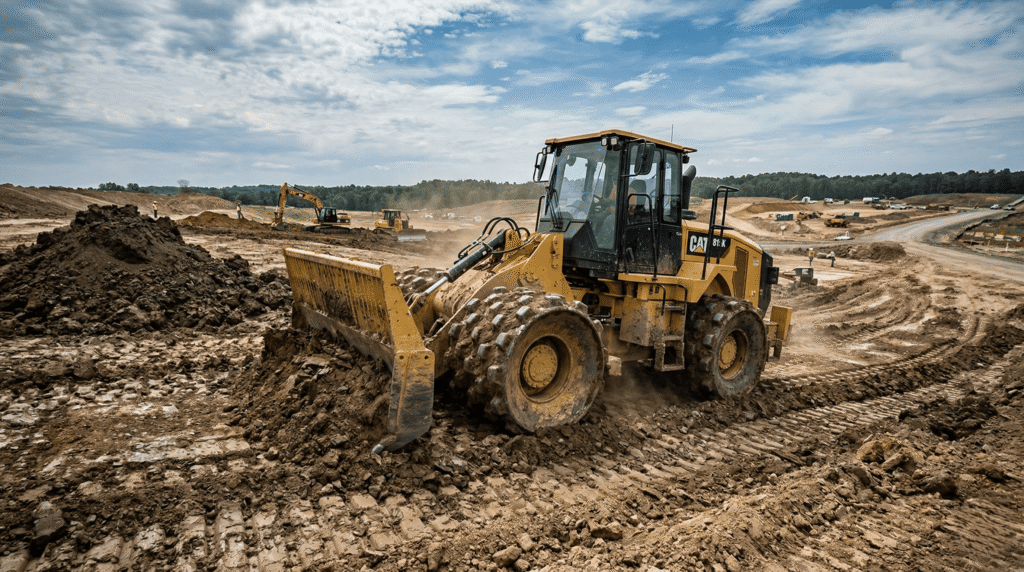
Mastering Soil Compaction: When to Choose a Sheepsfoot Roller
Every good construction project relies, sometimes unconsciously, on soil compaction. Roadways, residential foundations, or dams – the load-bearing capacity of the soil underneath the structure ultimately governs the strength and safety of the construction. Among various heavy machinery, sheepsfoot roller is one of the most effective and highly specialized equipment.
However, the question arises, when to choose a sheepsfoot roller instead of the other types of rollers such as smooth drum or pneumatic ones? Knowing how the kneading motion and high pressure penetration work is essential to perfectly compact soil even in the most complicated situations.
This comprehensive guide will cover the technical as well as operational aspects of sheepsfoot rollers. We will also discuss practical examples where using this roller is essential if one wants to avoid major problems after several years of structure utilization.
What Is a Sheepsfoot Roller?
A sheepsfoot roller that goes by the other names of either padfoot or tamping roller is essentially a compaction machine with a heavy drum. Unlike other rollers that have a plain surface, this drum is equipped with a number of “feet” or lugs made of steel.
The reason for the name of this machine is that it operates similarly to how sheep would compact the soil with their feet when a flock is driven over a path. Whereas the pressure exerted by a smooth drum roller is only on the surface, the kneading action of a sheepsfoot roller penetrates deeply into the soil base layers.
- “Kneading” Action: The pointed lugs/Pads go down deep into the soil and the instep action loosens the bonding of plastic and cohesive materials at the molecular level.
- High Contact Pressure: Since each “foot” or “pad” surface is quite small in extent, very high PSI (pounds per square inch) is applied, thus enabling densification at a depth to take place.
- The “Walk-out” Feature: As the soil densifies, the feet slowly “walk out” of the soil, finally rolling on the top of the surface once the required density has been attained.
Optimal Soil Types for Sheepsfoot Compaction
Focusing most intensely on deciding when to choose a sheepsfoot roller for your project, soil composition should be carefully analyzed. Cohesive or semi-cohesive types of soils are the ones for which such machines have been specially developed as heavier static weight through vibration are insufficient stabilizers only.
Thus, if you are mixing materials that tend to stick together when wet, the sheepsfoot will be your best weapon.
- Heavy Clay: Contrary to the general belief clay is elastic and full of air pockets. The kneading of the sheepsfoot properly crushes the former and aligns particles in this way that strong bonds are formed.
- Silty Soils: Even though silts are granular, the very short distance to the particles assures that the lug deep penetration closely corresponds to that of silt while helping to remove trapped air which a smooth roller may just close over.
- Wet or Muddy Ground: During wet weather, the roller makes holes which enable soils to “breathe” naturally and aerate, thus drying takes place faster and at the same time the lower layers are also compacted.
Key Applications: When to Choose a Sheepsfoot Roller
Sheepsfoot rollers are generally regarded as heavy equipment of a specific purpose especially in the industry. Quite rarely they are used for finishing; on the other hand, they are so fundamental for the base that one can hardly imagine the construction work without them.
The following are examples of their main areas of application:
- Hills and Embankment Construction: For structures and/or water bodies requiring waterproofing, sheepsfoot packing makes it absolutely certain that mortar laminates or seams will not form going neither way.
- Road Subgrade Preparation: It is important that the base of any road is extremely dense and durable so as not only to support the asphalt layer but also to serve as the load-bearing layer itself. Sheepsfoot compaction of the road bedding will eliminate any subsequent settlement which might have been caused by very heavy traffic.
- Landfill and Trench Backfilling: When working in limited or deep-fill situations, the deep reach of the sheepsfoot and the pressure it can bring to bear, enable the waste or utility lines to be encased with firm, non-shifting soil.

Comparison Table: Sheepsfoot Roller vs. Smooth Drum Rollers
| Feature | Sheepsfoot Roller | Smooth Drum Roller |
| Primary Soil Type | Cohesive (Clay, Silt) | Granular (Sand, Gravel) |
| Compaction Style | Kneading & High Pressure | Static Weight & Vibration |
| Compaction Direction | Bottom-Up | Top-Down |
| Surface Finish | Rough/Pitted (Requires Finishing) | Smooth and Level |
| Moisture Handling | Excellent (Helps Aerate Wet Soil) | Poor (May Slip on Wet Clay) |
| Best Used For | Subgrades, Dams, Embankments | Asphalt Paving, Base Layers |
Operational Best Practices for Maximum Density
The knowledge of soil compaction will be on the truly expert level once the operator takes into consideration factors other than merely the physical act of riding the machine. Properties of the sheepsfoot compactor roller depend very much on the way material is prepared and how passes are planned and executed.
- Control Lift Thickness: Never overfill; generally, soil lifts should not exceed 6 to 10 inches. Should the lift be excessively thick, even the heaviest lugs will be ineffective at reaching the bottom.
- Measure Moisture Levels: There is an “Optimum Moisture Content” (OMC) for soil. On the one hand, if clay is overly dry, bonding will fail; on the other hand, if clay is too wet, there will be only mud removal without compaction. The sheepsfoot can be utilized to aerate excessively wet soil until it becomes optimal.
- Overlap Passes: In order to get a uniform density and avoid the occurrence of “soft spots,” each subsequent roll should overlap the previous one by at least 10–20%, gradually covering the gaps between the feet.
Maintenance and Efficiency Tips
It is imperative that your machine is in excellent working order if you want to keep your compaction level at a high standard. The sheepsfoot roller’s particular design necessitates attention that is somewhat different from standard rollers.
- Clean the Cleaner Bars: This is a metal strip equipped with teeth which is located between the rows of feet. Their role is to prevent mud from sticking to the drum, as otherwise, sheepsfoot would become a smooth roller and lose its impact.
- Look for Wear on the Lugs: Due to the nature of the work feet tend to wear out and become rounded. This is why it is very important that the “feet” are checked regularly to ensure penetrating and sharp edges are present.
- Ballasting with Weight: Many sheepsfoot drums have steel shells that are ballasted internally with water or wet sand. By controlling this, machine weight and consequently the machine’s ground pressure can be varied within the allowed range and the compaction adjusted to the target density of the material.
FAQs of Sheepsfoot Roller Mastering Soil Compaction
What is the main advantage of a sheepsfoot roller?
Its feature that is foremost amongst the many advantages is that it can compact cohesive soil like clay not just on the top but from the bottom up through a high-pressure action of kneading. The soil is penetrated greatly so that the air voids inside which bridges a smooth drum operation are more efficiently removed.
Can you use a sheepsfoot roller on sand?
Using a sheepsfoot roller on sand is generally going to be unproductive as the sand is a good example of a granular soil. Here, you can expect the “feet” to do more “tilling” than actually compacting the soil. A smooth drum vibratory roller is the right machine for sandy soil.
How do you know when sheepsfoot compaction is complete?
The time when the sheepsfoot roller “walks out” or “walks off” the soil is the time when the soil is fully compacted. In other words, the machine’s “feet” are no longer dropping deeply into the soil but, instead, they are skating on top of the compacted dirt.
What is the difference between a padfoot and a sheepsfoot roller?
Padfoot and sheepsfoot are similar but with the latter having a greater number of smaller lugs (sometimes shaped like clubs) for deeper penetration, whereas the padfoot has fewer/larger pads and is usually combined with vibrations for mixed soil types.
Why is it called a sheepsfoot roller?
This piece of equipment actually traces its origin back to the times where roads were constructed by simply treading the soil with the feet of sheep that were driven in flocks over the surface and thus the soil got packed by the small but high-pressure hooves of the sheep.
What is the ideal lift thickness for a sheepsfoot roller?
Thickness of 6 to 8 inches (150-200mm) lift in case of most cohesive soil types is adequate. This makes sure the feet are able to fully penetrate and firm up the elevation from bottom to top as well.
Is a vibratory sheepsfoot roller better than a static one?
Which one is better depends on the job at hand but generally speaking, vibratory types are more powerful since they not only produce the kneading action of the “foot” but at the same time, they release a dynamic force which speeds up work and are also better capable of semi-cohesive or mixed soil types.