How the properties of materials affect the roller compaction efficiency in construction?
The stability of the ground underneath is what makes or breaks any construction project, from paving highways to building foundations. By getting rid of air voids, roller compaction efficiency is a mechanical way to make soil, aggregate, or asphalt denser. But the operator’s knowledge of the material being pressed is what makes the machine work well.
Importance of Roller Compaction Efficiency by rollercompactor.net
As highlighted on rollercompactor.net, the interaction between a roller’s weight and a material’s physical properties determines whether a site will remain stable for decades or fail under the first heavy load.
The physics of the “Nip Zone” and the “Slip Region” are just as important as the raw power of a roller compactor. Friction pulls material into the path of the drum when it enters the compaction zone.
If the material properties don’t match the equipment settings, the result is either under-compaction, which causes settling later, or over-compaction, which breaks up aggregates and weakens the structure.
Knowing what soil classification does
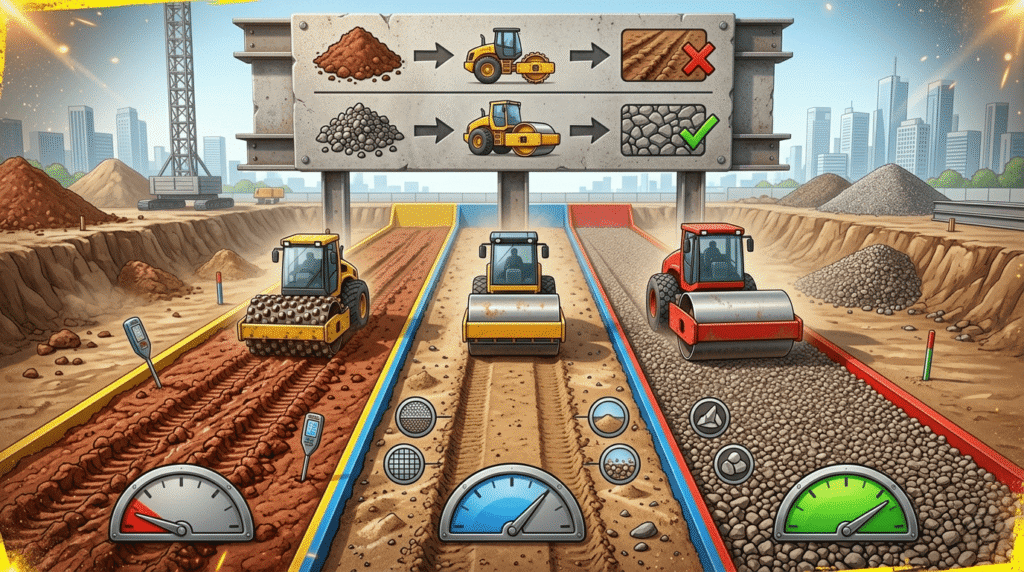
The classification of the soil is the most important thing that affects how deep and effective compaction is. There are two main types of soil: cohesive and granular. Each type needs a different mechanical approach. Clay and silt are examples of cohesive soils. They are made up of tiny particles that stick together, so you have to “knead” or “tamp” them to get rid of air pockets.
- Cohesive Soils: These need padfoot or sheepsfoot rollers with “lugs” that stick out and go deep into the layer.
- Granular Soils: Vibratory rollers work best on materials like sand and gravel because the vibration shakes the particles into a denser arrangement.
- Mixed Soils: These are often found in embankments and need a balance of static weight and controlled vibration to make sure that all particle sizes are taken into account.
The Science of Lubrication and Moisture Content
Water acts as a lubricant during the roller compaction efficiency process, allowing soil particles to slide past one another and lock into a denser configuration. The Optimum Moisture Content (OMC) is the name for this state.
If the soil is too dry, the particles can’t move because of friction. If it is too wet, the water takes up space that should be filled with solid particles, making the base “spongy” and unable to hold weight.
- Lubrication Effect: When the moisture levels are right, the particles in the aggregate don’t rub against each other as much, which makes them easier to “compact.”
- Proctor Testing: Construction teams need to use lab-tested values to find the maximum dry density of the material at the site.
- Weather Impact: High humidity or rain that comes out of nowhere can change a material’s properties right away, so the roller’s speed or vibration frequency needs to be changed right away.
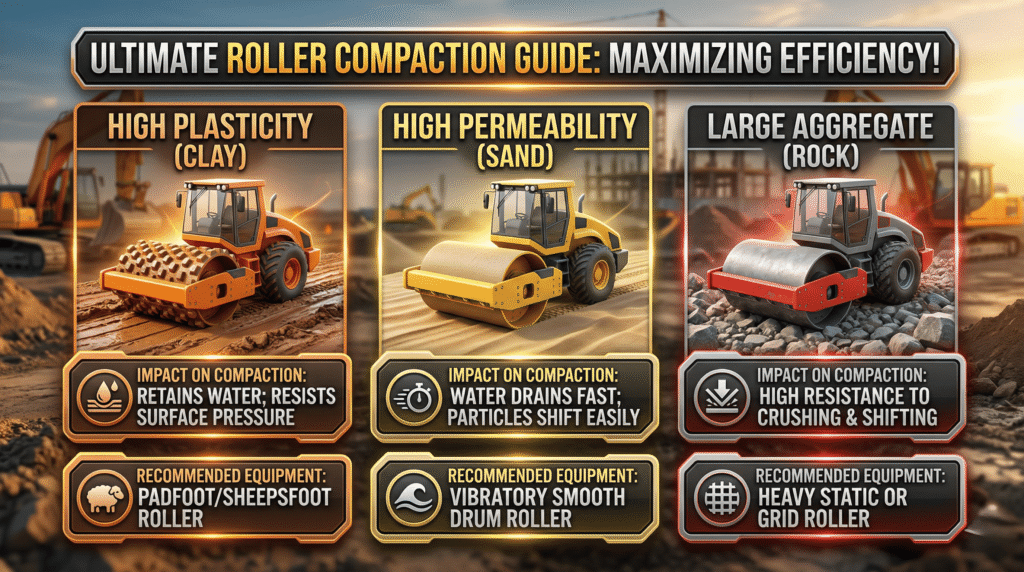
Table: Roller Compaction Efficiency in Construction
| Material Property | Impact on Compaction | Recommended Equipment |
| High Plasticity (Clay) | Retains water; resists surface pressure. | Padfoot/Sheepsfoot Roller |
| High Permeability (Sand) | Water drains fast; particles shift easily. | Vibratory Smooth Drum Roller |
| Large Aggregate (Rock) | High resistance to crushing and shifting. | Heavy Static or Grid Roller |
Impact of Particle Size and Gradation
Gradation is the way that different sizes of particles are spread out in a material. A “well-graded” material has a good mix of big and small particles, with the small ones filling in the spaces between the big ones.
This makes the material denser and better able to hold weight. On the other hand, “poorly graded” or uniform materials are harder to compact because the gaps stay empty.
- Aggregate Interlocking: When materials are graded correctly, they fit together better under the drum, making a strong structure.
- Risk of Crushing: If you vibrate soft aggregates like limestone too much, the stones can break, which changes the gradation and makes the shear strength weaker.
- Lift Thickness: The thickness of the material layer (the “lift”) must match the weight of the roller; if the lift is thicker, the drums must be heavier to reach the bottom layers.
The Effect of Temperature on Asphalt Compaction
When you go from soil to asphalt, the main property of the material changes from moisture to temperature. Asphalt is a visco-elastic material, which means that the temperature at which the roller passes over it determines how well it can be compacted.
The binder gets too hard if the mix cools down too much, and no amount of rolling will make it dense enough to provide roller compaction efficiency.
- Control of Viscosity: The asphalt binder can work as a lubricant for the aggregate at high temperatures.
- Compaction Window: To keep the mix from pushing out or cracking, operators must work within a certain temperature range.
- Final Touches: Here, pneumatic (rubber-tired) rollers are often used because their kneading action seals the surface without crushing the hot aggregate.
Optimizing Machine Settings for Material Resistance
To be efficient, you need to get the target density in the fewest number of passes. To do this, you need to set the roller’s mechanical settings to match the material’s resistance. The drum doesn’t have enough time to put the right amount of pressure on the surface if the machine moves too quickly. If it moves too slowly, it might compact too much and move the material.
- Vibration Amplitude: To make sure the force reaches the bottom, thicker lifts of granular material need a higher amplitude.
- Frequency Settings: Higher frequencies let you go faster while still keeping the right “impact spacing” on the surface.
- Static vs. Dynamic Force: Static pressure is good for finishing, but dynamic (vibratory) force is needed to keep deep layers stable.
Keeping the Interface in good shape
The surface of the drum is where the machine and the material interact. If there is too much material on the drum, it can cause uneven compaction and surface flaws. To keep roller compaction efficiency working during a shift, it’s important to keep the drum clean and the water spray system (especially for asphalt) working.
- Scrapers and Mats: Check scrapers often to make sure they are getting rid of dirt from the drum.
- Water Spray Systems: Make sure the nozzles are clear so that the asphalt doesn’t stick to the steel.
- Fluid Management: Keeping the right amount of hydraulic fluid in the system makes sure that the vibration mechanism always applies the same amount of force to the material.
Frequently Asked Questions About Roller Compaction Efficiency
What is the most important thing that makes soil compact?
The Moisture Content is the most important thing. When soil particles are at their densest possible state, they can move around with the least amount of mechanical effort.
What is the difference between a padfoot roller and a smooth drum for clay?
Clay is a type of soil that sticks together and needs to be “kneaded” to break up clumps and get rid of air pockets. A smooth drum can’t compact from the bottom up like the “feet” on a padfoot roller can.
How many passes do you usually need for the best compaction?
For 95% to 98% density, most construction standards say that 3 to 5 passes are needed. If you go too far, you can “over-compaction,” which breaks up aggregates and makes the base weaker.
Is it possible to compact soil that is too wet?
Not at all. Soil gets “spongy” when it has too much moisture. Water fills the gaps and can’t be compressed, so the soil particles can’t lock together. First, the soil needs to be dried or aerated.
What are the differences between static and vibratory compaction?
Static compaction only uses the weight of the machine. Vibratory compaction uses a spinning weight inside to make quick impacts, which works much better for settling materials like sand and gravel.
Does the speed of the roller change how well it compacts?
Yes, it does. If the roller moves too quickly, it lowers the “dwell time,” which is the amount of pressure put on a certain area. For deep compaction, a steady pace of about 2 to 4 miles per hour is usually best.
How does the thickness of the lift affect the Roller compaction efficiency?
If a “lift” (layer of material) is too thick, the force of roller compaction efficiency may not reach the bottom, leaving a layer of loose material underneath. Most rollers are 6 to 12 inches thick, but heavier rollers can handle thicker lifts.