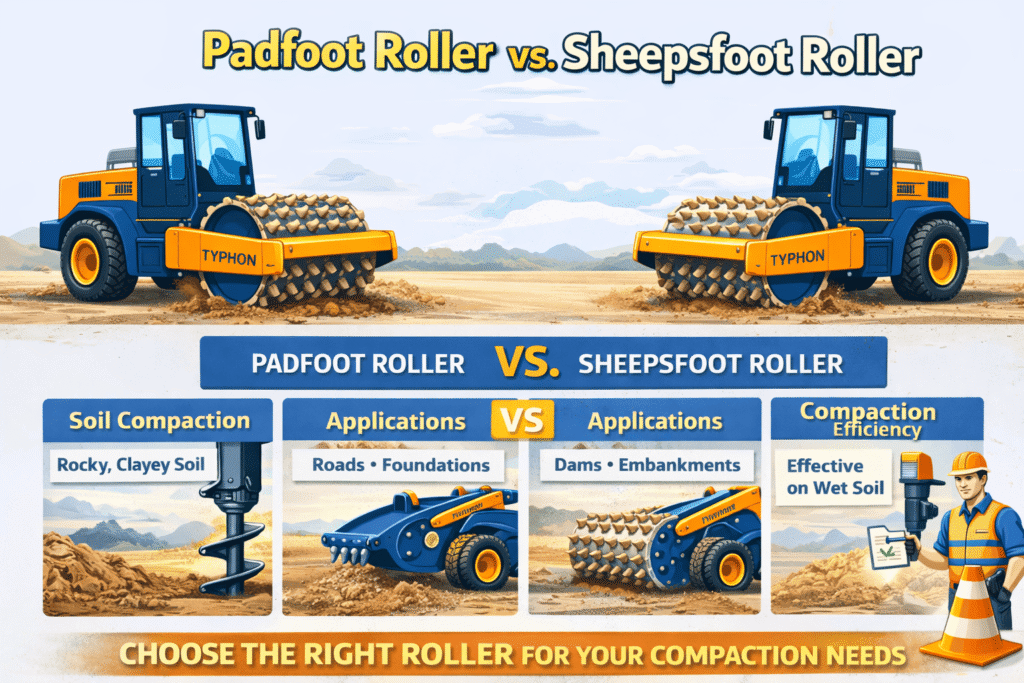
Padfoot Roller vs. Sheepsfoot Roller: The Ultimate Guide to Soil Compaction
When you’re standing on a job site, staring at a massive pile of earth that needs to be stabilized, the equipment choice you make determines whether your foundation stands for decades or sinks in weeks. In the world of heavy civil engineering, two titans dominate the landscape of cohesive soil compaction: the Padfoot Roller and the Sheepsfoot Roller.
While they look strikingly similar to the untrained eye—both featuring “bumpy” drums—they are not interchangeable. Using the wrong one is like trying to use a Phillips head screwdriver on a flathead screw; you might eventually get the job done, but it’ll be messy, inefficient, and potentially damaging.
This comprehensive guide will delve into the mechanics, soil science, and practical aspects of Padfoot vs. Sheepsfoot rollers.
1. Defining the Heavy Hitters
Before diving into the technical nuances, let’s define exactly what we’re dealing with.
What is a Sheepsfoot Roller?
The Sheepsfoot roller is the elder statesman of compaction. Historically, it was inspired by the way actual sheep would pack down paths with their hooves. Modern versions consist of a hollow steel drum fitted with dozens of “feet” or “lugs.”
-
The Key Feature: These lugs are generally smaller in surface area and rectangular or club-shaped.
-
The Mechanism: It works through static pressure and kneading. Because the feet are small, they exert high pressure per square inch, penetrating the soil deeply.
What is a Padfoot Roller?
The Padfoot roller (often called a “tamping foot” roller) is essentially the high-tech evolution of the Sheepsfoot. While it also has lugs, the “pads” are larger, often tapered, and have a broader surface area.
- The Key Feature: Most modern Padfoot rollers are vibratory.
- The Mechanism: It combines the kneading action of the pads with high-frequency vibration, allowing it to handle a wider variety of soil moisture levels.
2. The Science of Compaction: How They Work
To see why you’d choose one over the other, we must examine their interaction with the earth.
Static Kneading (Sheepsfoot)
A sheepsfoot roller compacts from the bottom up. As the drum rolls, the lugs penetrate the loose lift of soil. The pressure at the tip of the foot compresses the soil at the bottom of the layer first. As the soil becomes denser, the feet “walk out” of the lift, eventually rolling on top of the compacted surface.
Vibratory Impact (Padfoot)
A Padfoot roller works from the top down and bottom up simultaneously. The larger pads provide a kneading effect, but the internal eccentric weights (the vibration) send shockwaves through the soil. This mechanism rearranges the soil particles, forcing out air and water more aggressively than static weight alone.
3. Soil Compatibility: Which Dirt Wins?
Soil type is the #1 deciding factor in the Padfoot vs. Sheepsfoot debate.
| Soil Type | Best Choice | Why? |
| Heavy Clay | Sheepsfoot | It requires high-pressure kneading to break down the molecular bonds of plastic clay. |
| Silty Clay / Wet Silt | Padfoot | The vibration helps move water and air out of the silt more efficiently. |
| Sandy / Cohesive Mix | Padfoot | Pure sheepsfoot rollers struggle with sand; the padfoot’s vibration handles mixed soils better. |
| Very Wet Soil | Sheepsfoot | The deep penetration allows it to aerate the soil slightly, helping it dry while compacting. |
4. Deep Dive: The Sheepsfoot Roller

Advantages
- High Contact Pressure: Because the surface area of each “foot” is tiny, the $PSI$ (pounds per square inch) is massive. This is essential for stiff, “fat” clays that resist compaction.
- Aeration: In wet conditions, the sheepsfoot creates holes that allow moisture to evaporate from the lower levels of the lift.
- Bonding Layers: By leaving a “dimpled” surface, it creates a better mechanical bond between the current lift and the next layer of soil being poured on top.
Disadvantages
- Slow Speed: These are not built for a race. To get proper compaction without “plowing” the soil, you have to move slowly.
- Top-Level Fluff: They often leave the very top inch or two of soil loose (the “fluff layer”), which may require a smooth-drum roller to finish off if you need a sealed surface.
5. Deep Dive: The Padfoot Roller

Advantages
- Versatility: Thanks to the vibratory system, a padfoot can handle a broader range of Type B and Type C soils.
- Speed and Efficiency: Because of the vibration, you can usually achieve the required density in fewer passes than a static sheepsfoot.
- Tapered Design: Padfoot lugs are often tapered so they can enter and exit the soil without tearing it up as much as a straight-lugged Sheepsfoot might.
Disadvantages
- Vibration Limitations: The use of vibration is not always beneficial. In extremely wet, sensitive clays, vibration can actually turn the soil to jelly (liquefaction), making it impossible to compact.
- Cost: Vibratory rollers are generally more expensive to rent, purchase, and maintain due to the complex hydraulic and eccentric systems.
6. Key Differences at a Glance
If you’re skimming for the “too long; didn’t read” version, here it is:
- Surface Area: Sheepsfoot has small, concentrated feet; Padfoot has larger, broader pads.
- Compaction Method: Sheepsfoot is static/kneading; padfoot is vibratory/kneading.
- Soil Depth: Sheepsfoot is superior for deep, thick lifts of heavy clay. Padfoot is better for thinner lifts of varied soil types.
- The “Walk Out” Factor: You know a sheepfoot is done when it “walks out” (stays on top). A Padfoot relies more on a density meter or a “thump” test.
7. Operational Best Practices
Regardless of which machine you choose, the operator’s skill is the X-factor. Here are three tips for maximizing performance:
1. Watch Your Lift Thickness
It’s tempting to dump 12 inches of dirt and hope for the best. However, even the heaviest Sheepsfoot struggles if the lift is too thick. Stick to 6-inch to 8-inch lifts for guaranteed density.
2. Moisture is Everything
Soil has an Optimum Moisture Content (OMC).
- If it’s too dry, the particles won’t slide into place.
- If it’s too wet, you’re just moving mud around.
A sheepsfoot is better at handling over-optimum (wet) clay because it breaks the surface and lets it breathe.
3. Overlap Your Passes
To ensure there are no soft spots, the roller should overlap its previous path by at least 10–20%. This guarantees that a subsequent pass eventually covers the spaces between the feet/pads.
8. When to Switch to a Smooth Drum?
Neither the Padfoot nor the Sheepsfoot is a finishing tool. Once you’ve reached your target density, you’ll usually see a dimpled or pockmarked surface.
If you are preparing a subgrade for paving or a concrete slab, you must follow up with a smooth drum vibratory roller. This seals the surface, prevents rainwater from pooling in the lug holes, and creates the flat plane required for construction.
9. Maintenance Considerations
Choosing between these two also involves looking at your shop’s capabilities.
- Sheepsfoot Maintenance: Primarily focused on the cleaner bars. These are the metal teeth that sit between the rows of feet to scrape off mud. If these break, the drum turns into a giant smooth ball of mud, and compaction stops.
- Padfoot Maintenance: More intensive. You have to monitor hydraulic fluid for the vibratory motor, check the rubber isolators (which prevent the machine’s frame from shaking apart), and ensure the eccentric weights are balanced.
10. The Final Verdict: Which One Do You Need?
Choose a sheep’s foot roller if:
- You are working on a massive dam, levee, or pond liner.
- The soil is 100% heavy, sticky clay.
- You need to compact very thick layers of soil.
- You are working in a climate where you need the soil to dry out as you work.
Choose a Padfoot Roller if:
- You are working on a highway subgrade or a residential building pad.
- The soil is a mix of silt, clay, and some gravel.
- You need to get the job done quickly with fewer passes.
- You want a machine that can handle a wider variety of job sites.
Conclusion
In the battle of Padfoot vs. Sheepsfoot, there is no objective winner—only the right tool for the specific dirt under your feet. The Sheepsfoot remains the king of raw, unadulterated clay, while the Padfoot is the versatile workhorse of the modern construction site.
Understanding the physics of how these feet interact with soil moisture and particle size won’t just save you time; it will save you from the nightmare of a failed compaction test.
Pro Tip: When in doubt, perform a test strip. Run 5 passes with each and have a technician check the density. The dirt never lies.