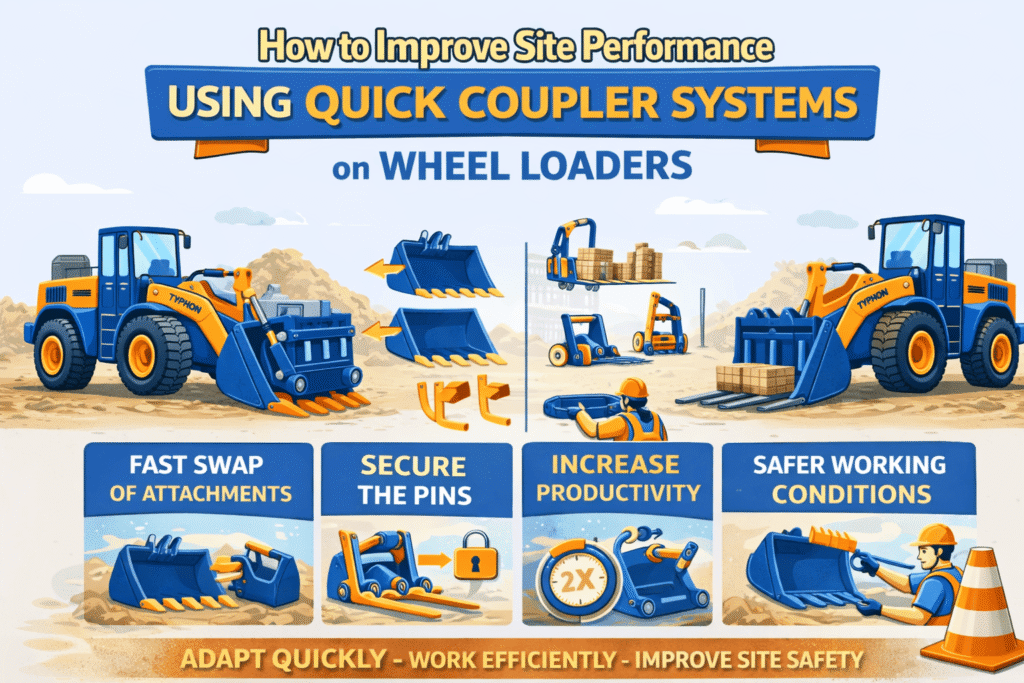
How to use Quick Coupler Systems on Wheel Loaders for Site Performance Improvement
In the era of the highly competitive construction and earthmoving industry, it is site performance that essentially decides whether the project will make a profit or struggle with overhead. The biggest change in today’s technology that has led to the maximum utility of the heavy machinery is probably the advanced attachment interfaces which includes Quick Coupler System on Wheel Loaders.
For the owners and the operators of the machines who are visiting rollercompactor.net, it is important to grasp the mechanical benefits of these attachment systems. The professionals in the business who install a top-notch Quick Coupler System on Wheel Loaders can utilize their machine not as a single-purpose one but as a multi-tasking and versatile powerhouse that would have the least idle time and the highest output.
The changeover from brick-and-mortar pin-on attachments to up-to-date coupler systems is more than just a matter of convenience – it is a real performance upgrade from a strategic point of view.
Among the pressured environment where soil compaction, material handling, and site preparation operations are competing simultaneously for achieving the highest degree efficiency, the simple characteristic of the tool change time reduced to under a minute can be considered a revolutionary thing.
This article discusses how attachments with these solutions help to increase the site’s productivity level, the technical advantages they bring, and the reasons why they become a must for those people who want to update the way they run their fleet operations nowadays especially while choosing Quick Coupler System on Wheel Loaders.
Workflow Simplification and Limiting Machine Down Time
The biggest threat to site performance is operational downtime of the machines. Fetching the traditional attachment manually means handling heavy parts, using different tools, molding, and the point where several things should be done by people of who ultimately need to align pins and fit the work tool.

The period in which the machine stays idle can vary between twenty minutes and one hour, during which a wheel loader is simply not in use. The innovative quick coupler system on wheel loaders has been designed to guarantee no such hurdles and limitations.
Hence, the operator, let’s say, for example, changes the tools from a bucket to a pallet fork or a roller compactor right at the machine cabin.
- Faster Task Switching: The worker can switch quickly between multiple tasks, e.g., bulk excavation, fine grading, and compaction almost without interruption.
- Fewer Workers Needed: No more assistants to change the buckets, so the crew members can be engaged in other important works.
- Reduced Waiting Time: Changing the equipment at a moment’s notice makes sure the loader is always equipped with the most efficient tool for the correct soil or material condition.
Increasing Capability of Multi-Attachment Machines
A truly effective construction site can be described as a highly versatile one. When a trick like a quick coupler is placed on a wheel loader, the latter will get several times more capable. It is also very relevant to the examples of compaction where the soils of different nature (from loose sand to heavy clay) require not only different drum types but also vibration frequencies.

So, when one, a single unit, does not have to be brought along to a site, a loader can perform the tasks of all of such methods by changing the tools alone.
- Unrivaled Device Interoperability: Completion of a range of jobs has been made possible through the use of not only the standard bucket, but holidays and collectibles, and specialized roller compactor units as well.
- Complete Utilization of the Assets: Even the smaller fleets that run a single wheel loader may produce the same volume as those with three because of excellent management.
- Flexible Site Handling: With rapid tool changes, one can easily adjust the program of work at hand: for example, from removing rubbish to preparing the subgrade.
Ways Operator’s Safety and Effectiveness Get Improved
Health and safety considerations are often regarded as a cost factor in a construction project. However, in fact, safety and performance are interrelated at a very fundamental level.
If a site is safe, it will also be productive. It is a high risk to perform manual operations on the ground for hooking up the new accessory that might also include, e.g., getting one’s fingers caught or pinched, hurting one’s back when lifting a heavy weight, and the most common one, failure to properly secure the pins.
Nowadays, implemented for a Quick Coupler System on Wheel Loaders are the remotely controlled hydraulic locking techniques combined with point of use sensors that not only guarantee the smoothness of the outcome but also grant a high level of security for the parties involved.
- Inside the Cab Performing: The driver has been provided with the most advanced security features to such an extent that getting out of the cab in the course of changing the tools is needless.
- Solenoid and Lock Mechanism Features: Some of the more advanced features that come with settings would be secondary locks and visual indicators as well as confirmation of the attachment safety prior to use.
- Operator’s Enhanced Field of View: For the sake of ease and comfort of the operator during the connection of the coupling, designers have mounted such an up-to-date “open frame” arrangement that gives the operator a perfect view of the attachment.
Technical Comparison: Manual Pin-On vs. Quick Coupler Systems
| Feature | Manual Pin-On Attachment | Quick Coupler System |
| Changeover Time | 20 – 60 Minutes | 30 – 90 Seconds |
| Labor Requirement | 2-3 Persons | 1 Operator (In-Cab) |
| Versatility | Limited to 1-2 Tasks | Unlimited Task Potential |
| Safety Level | High Risk (Manual Handling) | Maximum Safety (Automated) |
| Site Performance | Interrupted Workflow | Continuous Production |
| Tool Life | Higher wear due to “making do” | Longer life via task-specific tools |
Equipment Lifespan Extension by Proper Tool Usage
Tool compromise is one of the most common reasons behind underperforming sites.
When an operator is using a bucket for a job that actually is a fork or compactor job because he or she doesn’t want to waste time by changing the attachment, then the equipment, both the hydraulics and the attachment itself, will be worn out very fast.
With the Quick Coupler System on wheel loaders, you can perform this at the simple stage; hence, you would not physically get in front of the different work tools. Thus, the right tool will be taken, and that is the one that is fully capable of performing your specific job thus saving you time and money.
- Optimal Hydraulic Performance: When task-specific tools are utilized, they contribute to operating within the nominal range, resulting in the reduction of the loader’s pump and valves being overstrained after use.
- Lower Component Wear and Tear: Getting the wrong attachment is a “forced” routine that can cause bending of the loader arms or damaging of the pins.
- Easy Maintenance: Most quick couplers have grease points centralized and are protected by debris shields, making it simpler to service, even in a heavy usage scenario.
FAQs—Quick Coupler System on Wheel Loaders
What does a quick coupler system on a wheel loader stand for?
A quick coupler is a common term for either a hydraulic or mechanical device mounted on the loader arms that enables the operator to connect and disconnect a wide range of attachments (buckets, forks, etc.) very quickly and without the need to manually remove the locking pins.
What does a quick coupler feature do to the improvement of the site’s productivity?
It facilitates the time that is necessary for changing the device to be almost 1 minute compared to almost 1 hour; thus, it ensures the machine is not idle and that it would be able to accomplish several tasks within the same working time.
Do you think a quick coupler can safely be used for heavy-duty compaction?
Yes, their hydraulic “fail-safe” locking system combined with hydraulic constant pressure provides reliable fixation of attachments, such as roller compactors, even in tough jobs with a lot of vibration.
Is it possible to use my current attachments after getting a new quick coupler?
Generally, quick couplers are manufactured to accommodate industry-standard “hook and pin” or “ISO” style attachments. Also, there are adapters available for retrofitting the old pin-on tools for coupler use.
Is a quick coupler to blame for the decline in breakout force of the loader?
While being attached to a coupler means a small increase in weight and offset, the most advanced “wedge” or “Fusion” systems in the market are designed specifically to address this issue, resulting in operating performance so close to pin-on that one can hardly tell the difference.
What kind of maintenance is necessary for a quick coupler?
Most of the maintenance work consists of regreasing the pivot points, checking the condition of the hydraulic hose for leakages, and at the same time making sure that the locking wedges are clean and free of dirt and debris.
How does a hydraulic coupler compare to a manual one?
Hydraulic couplers are indisputably superior in the field of site performance because their usage allows the operator to change the tool without leaving the cab, which is not only faster but also significantly safer than the manual ones.