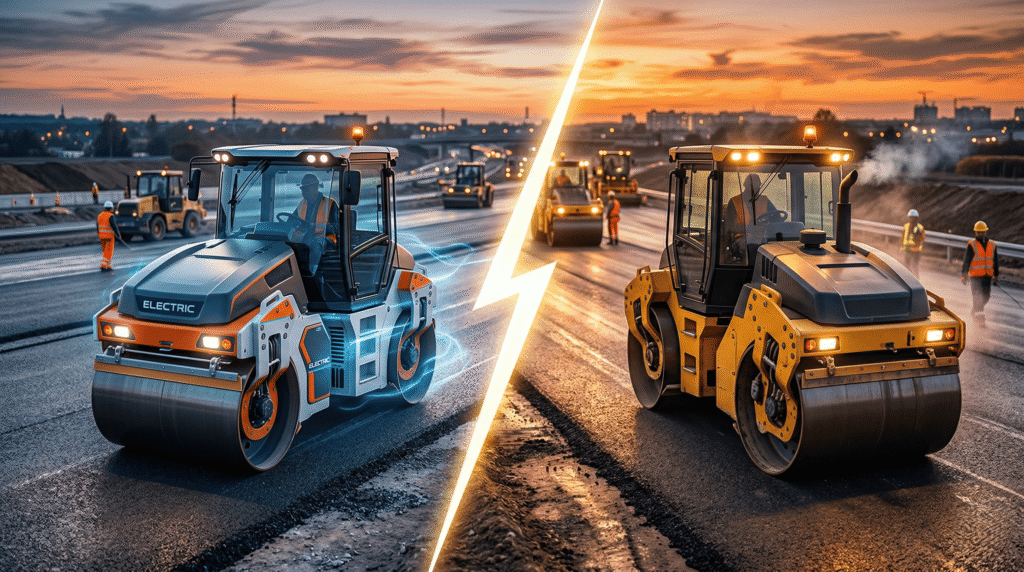
Electric vs Diesel Roller Compactor: What Works Best in 2026?
The year 2026 has seen the construction industry face a drastic transformation shaped by the global emphasis on sustainability and the pursuit of technical efficiency. As environmental regulations for projects tighten and fuel prices become more volatile, the decision between electric and diesel roller compactors has become a crucial choice for fleet managers and site supervisors.
Selecting the right machine today involves a multi-faceted consideration that goes far beyond the initial price figure and looks at total cost of ownership (TCO), operational environment, and performance criteria. In 2026, the debate is no longer about which power source is better but rather which particular technology best meets the specific needs of your jobsite.
The demand for precision and a smaller carbon footprint in new infrastructure projects has pushed the importance of the compactor higher than ever. Diesel machines have been the industry’s mainstay for a long time, providing reliability and the power that cannot be matched.
But with the quick progress in lithium-ion battery technology and wider charging infrastructure, electric compactors have made the jump from being simply niche options to mainstream competitors. This guide goes in-depth on this competition to give you a clear picture of which compactor would be best to lead your fleet through the rest of the decade.
The Rise of Electric Roller Compactors in 2026
Electric roller compactors are no longer a “trial” concept and are at this time the leading choice in the urban construction markets. The core of these machines are sophisticated electric motors which instantly provide high torque that makes the equipment very effective especially when it comes to soil and asphalt compaction where a high level of vibration is necessary.
The absence of an internal combustion engine also means that these rollers are much quieter, which in turn makes it possible to work for longer in situations such as ones in residential areas where noise regulations are very strict. In addition, being emission-free at the tailpipe gives them the absolute advantage if the work is done inside a building or a tunnel where there is little air flow.
One of the main attractive features of electric rollers’ maintenance is that they require very little intervention. For instance, there is no need for oil changes or fuel filters, and exhaust after-treatment systems like DPF (Diesel Particulate Filter) and SCR (Selective Catalytic Reduction) are not necessary, so the intervals between maintenance are quite long.
There are even reports from contractors that point to a 50% saving in maintenance costs when comparing electric rollers with the diesel ones. Though the initial purchase price can still be considered relatively high, lower energy costs combined with fewer breaks leading to more production time demonstrate that electric models usually end up having a lower TCO over a five-year period.
- Emissions-free operation: A vital factor if you want to obtain the various certification such as LEED, BREEAM or DGNB.
- Lower Noise Levels: Works at a noise level of 60-70 dB, whereas, diesel ones produce 85-100 dB.
- Easy Maintenance: Due to fewer running parts, the chances of breakdowns are significantly reduced, thereby less repair-related downtime.
Diesel Roller Compactors: The Undisputed Powerhouses
Even with the growth of the green movement, diesel roller compactors still hold the majority of the market share when it comes to the large-scale construction of highways and the development of remote sites.
In 2026, diesel engines have become extremely efficient Tier 5 and Stage VI compliant models that are capable of generating more power while using less fuel. Projects situated far from urban centers, where the electrical grid is not well-developed, will benefit the most from the diesel compactor’s ability to be refueled quickly, which is an advantage battery technology has yet to match.
Furthermore, diesel engines possess a level of ‘all-day’ endurance power that is very suitable for heavy compaction of earthworks and sub-base.
Diesel systems work in a manner that is very familiar to most people which gives you a hint as to why their lifespan is longer than average. The reason is that there exists a well-established worldwide supply network of diesel engine parts and the mechanics are also familiar with the technology, thus giving the operators the necessary comfort and confidence regarding the running of the machines.
In addition, diesel machines prove their worth in tough environments such as the battery performance will be negatively affected if the temperature is below freezing or the battery could get damaged if the temperature is very high in the desert. Contractors working on the mega expressway projects across the 2026 will still see their diesel machines as their best allies in terms of power and being straightforward to handle and maintain.
- High Power Density: The great power density in this type of machinery can be used to generate high vibrations that enable the compaction of very thick soil layers.
- Quick Refueling: Charging is not needed; instead, a fast refuel can allow the machine to be in operation 24 hours a day, 7 days a week for high-priority infrastructures.
- Weather-proof: Resists extreme weather conditions even better now thanks to the use of heaters and coolers which can keep the engine at optimum temperature.
Operational Cost Comparison: A 2026 Analysis
Looking at the financial implication of the use of one technology against the other, one can now have a more definitive image of the return on investment with the arrival of 2026. Electric compactors achieve greater savings when it comes to the cost of energy as electricity is always cheaper than diesel fuel per hour of work.
On top of that, electric rollers practically do not consume any energy when “idle” because it means that the machine is not moving or vibrating. On the other hand, diesel rollers tend to accumulate engine working hours even when the engine is not practically doing anything, which thus leads to an increase in the consumption of fuel and consequently speeding up the deterioration of the engine and the vehicle as a whole.
The downside, however, when you compare the ‘Charging vs. Refueling’ is the cost as it can really be quite surprising if you do not take it into account properly. The charging of an electric compactor means that you have to either use a mobile fast charger or have a dedicated grid connection, unlike a diesel compactor where one can use a simple fuel truck to fuel it.
There are also a number of contractors who are going solar-powered on 2026 by using solar-powered charging trailers in their sites in order to cut down their costs of operations even more through their electric fleets. The table below shows points of differentiation in operations metrics that eventually have an influence on the end decision.

Table: Electric vs Diesel Roller Compactors
| Feature | Electric Roller Compactor | Diesel Roller Compactor |
| Fuel/Energy Source | Lithium-ion Battery / Grid | Diesel Fuel / Biodiesel |
| Emission Level | Zero Tailpipe Emissions | Low (Tier 4/5/Stage VI) |
| Maintenance Cost | Low (Minimal moving parts) | Moderate to High (Regular servicing) |
| Initial Purchase Price | High (Battery costs) | Moderate (Market Standard) |
| Best Application | Urban, Indoor, Residential | Remote, Heavy Highway, Mining |
| Operational Noise | Ultra-Quiet (65 dB average) | Loud (90 dB average) |
| Torque Delivery | Instant Torque | RPM-dependent Torque |
Technology and Smart Features in 2026
The new roller compactors generation of 2026 is smarter than any of those that came before and this applies to both kinds of machines, electric or diesel, alike. Incorporating Intelligent Compaction (IC) systems has become the norm nowadays.
These systems are capable of using GPS together with sensors to provide a map of the compaction status in real-time so that operators avoid over-compacting or under-compacting.
This is a good match, in fact, with electric rollers because controlling things digitally means that there can be more precise regulation of the vibration frequency and amplitude.
Besides, telematics systems have also greatly improved to the point where fleet managers can keep track of the battery health, fuel levels as well as compaction density without leaving their offices.
In 2026, one can expect to see autonomous roller compactors being used on enclosed job sites for the very first time. This equipment has the capability of following a pre-programmed path with the accuracy of a few centimeters, which results in a significant increase in safety and productivity.
A lot of times, the deciding factor in whether one picks electric or diesel is which machine’s computer system integrates the best with the company’s fleet management software.
- Intelligent Compaction (IC): Instant measurement of moisture and density eliminates guesswork on the number of passes and surface quality is improved.
- Remote Telematics: Comprehensive information on machinery condition, location, and work rate is sent to mobile devices.
- Operator Comfort: Vibration isolation cabin and 360-degree cameras give the operator a more comfortable experience regardless of the power source.
Which One Works Best for Your Project?
Going electric or diesel in 2026 decision fundamentally depends on where you are going to do the job and how long your shifts will be. Electric is the best choice for short and medium shifts in the city where the environment and people will be preserved at the same time that you will be cutting down your daily operating costs. This is real urban maintenance and residential development.
On the other hand, diesel still holds the throne when it comes to long-haul infrastructure. In case your project is 50 kilometers away from the nearest power line and 12 hour of continuous heavy compaction is required, nothing is going to be able to beat diesel engine in terms of reliability.
There are a number of contractors in 2026 who turned to a “hybrid fleet” whereby they use electric rollers for the last sections and urban portions of the project and still rely on diesel for the heavy earthworks.
- You should go Electric if: Most of your tasks are done in cities, include indoor operation or if you are willing to brand yourself as a “Green Contractor”.
- You should go Diesel if: Your work is situated in remote areas, you produce heavy soil of large volumes or you need your machine to be always available with no charging breaks.
- Carbon Neutrality Goals: The two options now offer pathways to achieve a lower carbon footprint, with diesel vehicles being able to run on HVO (Hydrotreated Vegetable Oil).
FAQs: Electric vs Diesel Roller Compactors 2026
Which is cheaper to operate, an electric or diesel roller compactor?
2026 electric rollers will significantly reduce your daily operations cost mainly due to low energy cost and maintenance requirements. However, the higher initial purchase price means it takes roughly 3 to 4 years of consistent use to see a full return on investment compared to a diesel model.
How long does the battery last on an electric roller compactor?
Normally, in 2026, electric rollers will be expected to give 8 hours of work under average conditions. If you use the roller mostly for heavy-duty asphalt, it may last between 4 and 6 hours only, but with fast charging, 80% battery can be achieved over the usual lunch break.
Can diesel rollers still be used in city centers in 2026?
Technically yes, however, many urban areas have imposed local restrictions such as “Low Emission Zones” and noise limits, which make the use of diesel more complicated and expensive due to the need for obtaining permits. To avoid penalties, many contractors are switching to electric machines just on these specific zones.
Is the compaction force the same for electric and diesel models?
Absolutely. The latest electric motor designs are capable of providing the same if not more than the vibration frequency and centrifugal force of diesel engines. The instant torque of electric motors often results in more consistent vibration starts and stops.
What is the lifespan of an electric compactor battery?
Typical lithium-ion heavy machinery batteries have in 2026 been graded for 3,000 to 5,000 complete charging cycles which correspond to 8-10 years of continuous professional usage before down to 80 % in available capacity.
Do electric rollers require special training for operators?
Basic operation remains unchanged, but operators will be required to learn battery management and charging safety, and will also have to understand digital energy consumption displays. Also, many drivers consider electric rollers easier to operate because of the smooth running without vibration and noise from engines.
Are diesel compactors becoming obsolete?
Not a bit. Although they are losing market share in urban environments, diesel is still key to high-output, remote, and large-scale infrastructure projects where power-to-weight ratio and refueling speed are paramount.