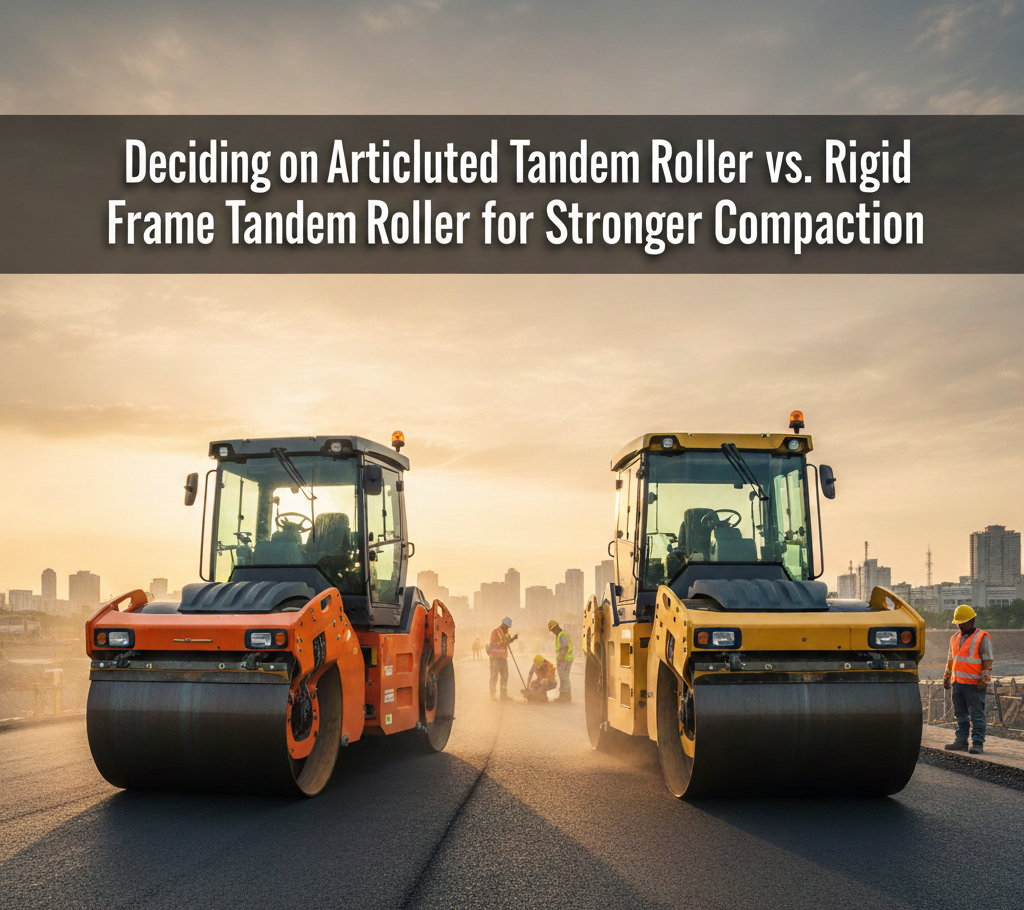
Deciding on Articulated Tandem Roller vs. Rigid Frame Tandem Roller for Stronger Compaction
The base of any solid and sturdy road, runway, or commercial paving project is basically the quality of its compaction. In the case of asphalt and granular soil compaction, a tandem roller, which is a machine characterized by its two drums, is definitely the most important one. However deciding the right choice between articulated tandem roller vs rigid frame tandem roller is the biggest factor.
These powerful machines are used in the most important last stages of construction to guarantee a surface which is not only exceptionally smooth, dense, and lasting, but also safe. However, at the moment of choosing the best machine for your work site, a very important point there is deciding whether you should opt for an articulated tandem roller or a rigid frame tandem roller.
Whilst both of them aim at compaction as a primary function, their frames designs determine their operating characteristics such as the extent to which they can be used on different terrain, their stability as well as their ability to be used in varying project sizes and types. Choosing wrongly could make your work inefficient, result in your pavement wearing faster, and also mean you have to spend money on fixing it again.
What Constitutes a Rigid Frame Tandem Roller
The rigid frame tandem roller is generally the older version of compactor model that has been around for quite some time. In fact, you can take a look at this machine and figure out yourself that the front and rear parts of the roller are attached to a single, solid chassis without any central pivot joint. Consequently, the structural integrity of the roller is very high, and this means that only the front drum is used to execute the steering, or the drum is turned slightly side-to-side by a few degrees.
Hence, the manufacturers make the weight distribution equal and even across the roller’s footprint. This then provides a very predictable and stable compaction force. Due to this design, the tandem roller has the following operation character features which are the ones that make it the most suitable kinds of jobs where a high level of precision and proper straight-line passing is required.
- Constant Pressure Due to Fixed Chassis: The solid and non-pivoting frame is the main factor that ensures that the force of the compaction and weight distribution are consistently applied across the entire drum width during every pass. This stability, which is built-in, is of great value in achieving very high uniform density and surface smoothness, especially on long and straight pavement runs.
- Best Usage Scenario of Large and Open Sites: For example, a project that involves building a major highway or an airport runway as well as large parking areas where one can expect long, uninterrupted compaction runs, thus can benefit enormously from the robust design of the rigid frame which is fine tuned for efficient straight-line at high-speeds.
- Steering and Maneuverability Constraints: Since there is no middle joint allowing the machine to pivot, it has a considerably larger turning radius than the articulated one. Thus, it is less appropriate for the sites which have tight corners, a lot of obstructions, or complex-shaped layouts, because constantly stopping, backing, and repositioning will drastically lower your productivity.
Discovering the Benefits of the Articulated Tandem Roller
Unlike the rigid frame, the articulated tandem roller has a pivot joint, or arm, right at the center between the front and rear drums. Through this hinge, the front (which consists of the cab and operator controls) as well as the rear (the trailing drum) are able to move separately from each other. The operator moves the machine by hydraulically altering this joint, thus “bending” the roller in the center.
This invention changes the limitations of the roller fundamentally, as it now can be described as a very flexible machine with an extraordinary maneuverability and the capability of maintaining the drum in contact with the ground even if it is an uneven or complex surface. The articulated design was thus getting more and more popular because of its versatility and the ability it had to solve issues that were hitherto difficult for job sites.
- Efficiency and Very Narrow Turning Radius: The articulation joint helps to drastically reduce the turning radius of the machine, thus the machine can easily go through sharp bends, dead ends, or confined urban work zones that are of small areas. Therefore, the main effect of this feature becoming visible is the big rise in small job sites (or jobs with intricate layouts) in which the time saved per cycle is higher compared to the time wasted on them.
- Ability to Work on Rough Ground: The pivoting joint gives different parts of the machine such as front and rear drums the freedom to move and adjust to ground contours separately. Though tandem rollers are usually put to use on surfaces which are already prepared, this feature still comes in handy to secure full drum-to-ground contact on slightly uneven bases and as a result, the force of compaction will be steady throughout and the risk of density pockets will be lower.
- Off-Set Drum: There are several articulate versions which allow the operator to carry out the operation of the drums in the “off-set” mode at which the rear drum tracks a bit inside or outside the route of the front drum. Such a scenario is extremely efficient when it comes to the labor of compacting in a closeness to the curb, to utility boxes, or a wall without any change in the quality of the compaction near the obstruction made by the operator.
Key Comparison: Articulated Tandem Rollers vs. Rigid Frame Tandem Rollers
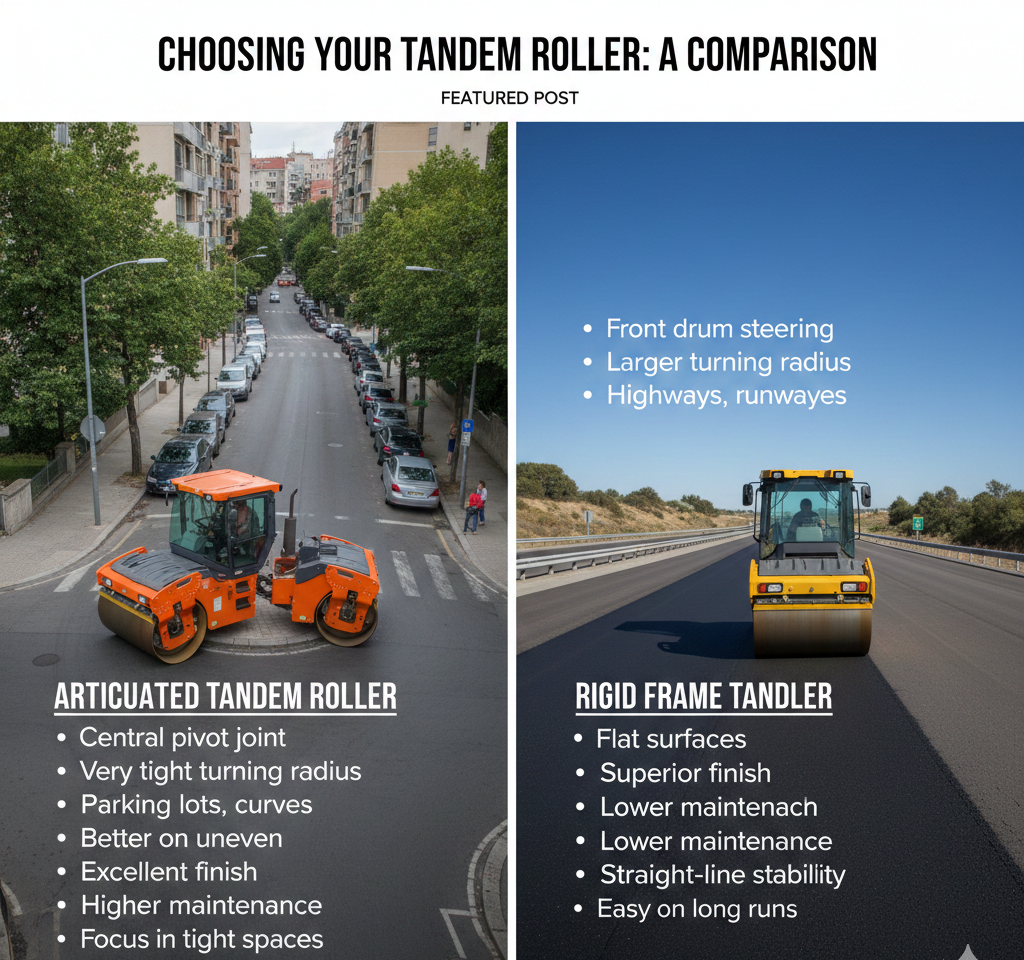
The battle between two very powerful machines of this nature ultimately comes down to the efficient use of the design strengths inherent in each roller type against the project requirements. This detailed comparison table highlights the critical differentiators that inform the final selection, directly impacting project efficiency and pavement quality.
| Feature | Articulated Tandem Roller | Rigid Frame Tandem Roller |
| Steering Mechanism | Central pivot joint (Articulation) | Front drum steering or drum oscillation |
| Turning Radius | Very tight (Superior maneuverability) | Larger (Requires more space) |
| Ideal Application | Parking lots, city streets, residential roads, confined spaces, curves | Highways, airport runways, large open areas, long straight stretches |
| Ground Contact | Better on slightly uneven surfaces due to drum oscillation/flexibility | Optimal on well-graded, flat surfaces |
| Finish Quality | Excellent (Known for versatility and finish quality) | Superior (Best for absolute straight-line tracking and consistent density) |
| Complexity/Maintenance | More complex articulation joint (Higher maintenance potential) | Simpler fixed frame (Lower maintenance potential on the chassis) |
| Special Feature | Off-set drum capability (Compaction up to obstructions) | Exceptional straight-line tracking stability |
| Operator Skill | Requires focus to maintain straight track, but easy in tight spaces | Requires less steering effort on long runs, but difficult in tight spaces |
Factors Driving the Selection Process
Choosing a proper tandem roller is a move requiring careful thought and the decision should mainly come from a thorough and objective evaluation of the work site, the material and the expected result.
As a professional you are, at RollerCompactor.net you are aware that each task contains its own set of variables and consequently a one-size-fits-all method will not give the best results. It is imperative for you to weigh the following aspects:
1. Project Geometry and Site Constraints
Most important factor when deciding on your machine would be the very location of your study area. A job that is mostly made up of curves, cul-de-sacs, or obstacles count will, to a very large extent, be turning to an articulated device, while a simply straight-line project will be the one to take advantage of the inherent stability of a rigid frame.
Articulated rollers are the best ones when it comes to urban and residential paving projects such as complex or historical ones where the possibility of turning sharply and quickly repositioning saves a lot of time. Their design frees you from the great number of three-point turns which is what can result in subtle pavement imperfections.
Rigid frame rollers are the “beasts” of long and open stretches, where their design is instrumental in maintaining perfectly straight-line passes over long distances. Their stability at faster travel speeds (within compaction limits) can be the reason behind the quicker site coverage that’s possible when dealing with large areas.
For tasks that involve a lot of work around vertical obstructions, the off-set option of the articulated roller can be a productivity enhancer, enabling the rear drum to compact right up to the edge without disrupting the stability of the machine itself.
2. Compaction Material and Pavement Design
It depends not only on the roller types which are suitable for asphalt and various granular base layers, but also on the finish quality and material of the pavement which can subtly influence the ideal choice. For instance, an airport runway that requires perfect smoothness along the length might have to choose the rigid frame for the reason that it tracks most consistently.
Rigdest frames can provide slightly better control and more consistent rolling action which is very crucial when it comes to high-quality paving over long distances with minimum deviations in density or surface smoothness. Fixed frame also acts as a barrier to any unwanted “snaking” that sometimes may happen during articulation.
Articulated models are very efficient in dealing with a wider variety of materials, especially for the intermediate and finish rolling of standard road construction. Their main strength is flexibility and the ability which they have to adapt to the site rather than to the material themselves.
The weight as well as the drum diameter (which is very important for mat pushing as explained on RollerCompactor.net) must be in accordance with the material specifications irrespective of the frame type.
3. Maintenance, Operational Costs, and Operator Experience
The long-term ownership expenses and the skill level of the operating crew should not be overlooked as they are the other two factors besides the immediate job performance, which needs to be accounted for in the total investment analysis.
The articulation joint is a complicated mechanical part that requires frequent greasing and nice care. Though it’s very important for the maneuverability, it is also a place that can be worn out and broken the most besides those that aren’t there in the rigid design.
Generally, Rigid frame rollers have less moving parts in their drive and steering train and that means that are easier and cheaper to maintain in the long run as well as their upkeep schedules are simple. A major advantage of their robustness has been and is their longevity.
Despite modern controls make things easier, very smooth and effective operation of an articulated roller still requires more finesse from the operator. Navigating an articulated roller smoothly and effectively will result in the operator getting more practice, hence more skill in ensuring a perfectly straight line on long passes plus he gets more of the inherent stability of a rigid frame which is much forgiving for less experienced operators on straightforward jobs thus skill novices will find it more difficult here.
FAQs – Articulated Tandem Rollers vs. Rigid Frame Tandem Rollers
When should I choose a rigid frame tandem roller over an articulated model?
If your project consists mainly of long and straight runs of pavement, like the case of a major highway, an airport runway, or a lengthy road in an industrial area then you have to go for a rigid frame tandem roller. A rigid design is what provides the most stable platform, thus it is able to deliver the highest level of longitudinal smoothness as well as uniform compaction density throughout the length of the run.
- They are perfect for high-specification projects that require maximum straightness.
- Good for vast, unobstructed job sites.
- The fixed frame offers inherent stability for high-speed passes.
Does the frame type affect the compaction force or density achieved?
The main compaction force is the result of the weight of the roller, the size of the drum, and the settings for vibration. However, the frame type changes the density indirectly. The flexible articulated roller is able to keep contact between the drum and the ground even if the latter is a bit uneven, therefore the density can be more even. On the other hand, a rigid frame is very stable and thus the force is always applied in the same way on a flat surface, which is optimal for uniformity of straight lines.
- The main factors for the compaction force are weight component and vibratory frequency.
- The flexibility of articulated models ensures that the contact is maintained even on varied grounds.
- The stability of a rigid model is what makes it possible to keep the track consistent on flat, long surfaces.
Are articulated tandem rollers more expensive to maintain than rigid frame rollers?
In general, the articulated tandem rollers are likely to experience a little bit higher maintenance costs than rigid frame rollers gradually over time. This is due to the mechanical complexity of the articulation joint which is a component that is subjected to high stress during operation and thus requires frequent lubrication and regular checking of the bearings and the seals. The chassis of a rigid frame roller is designed to be simple and strong and this usually means that less specialized maintenance is required.
- It is a high-wear component that the articulation joint is.
- There are fewer complex moving parts in the chassis of rigid frames.
- Lubrication has to be done regularly if one wants the life of the articulated roller to be long.
Conclusion: Framing Success by Aligning Project
The engineering of articulated tandem rollers and rigid tandem rollers is designed for diverse conditions, not which is “better” amongst them. The rigid frame is a reliable workhorse for large, wide locations that need straight-line regularity and consistency over long distances. However, the articulated frame is a flexible, agile performer that can handle urban geometry, small places, and surfaces where agility implies productivity. The “right” selection for a construction expert is one that best combines its design capacity with the project’s needs, layout, and quality standards. By analyzing your site limitations, the type of pavement finish needed, and the long-term costs versus benefits of each frame, you can choose the tandem roller that will lay the groundwork for a successful, durable, and profitable job.