
The Powerhouse of Paving: Applications of Single Drum Vibratory Rollers in Road Construction
Properly densifying materials is not just a desire in road construction and the whole infrastructure sector; it is a must for the latter to have the desired life span and structural strength. Among the heavy machines on any earthwork site, the single drum vibratory roller is the one that really can be called a powerhouse.
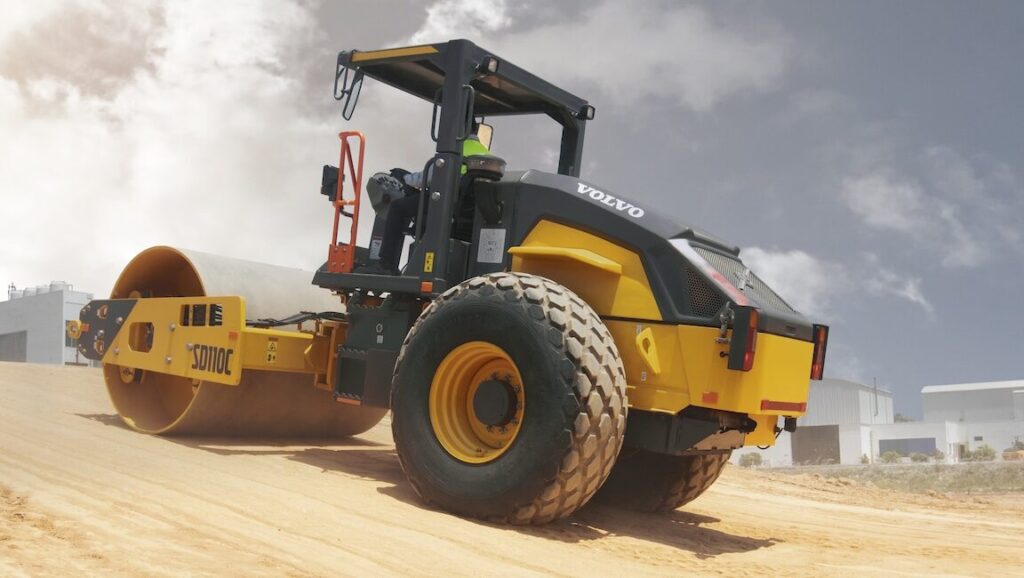
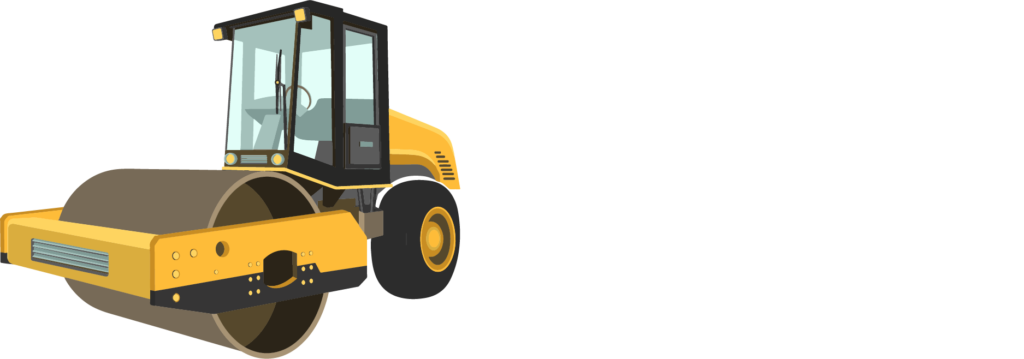
Basically, this strong workhorse, which is marked by a big, smooth or padfoot steel drum at the front and heavy-duty tires at the back, is the one that can be said to be made for immense, high-impact compaction. It is the first-choice machine for execution of the indispensible base layers of any road project thus, the foundation being stable, uniform, and ready to carry decades of traffic load is a sure thing.
Knowing exactly how to use this machine goes a long way in achieving the intended results, saving money on the road, and obviously, constructing a sustainable road.
Understanding the Role in Subgrade and Sub-base Preparation
Before the asphalt is put down, the journey of road construction is only at the very beginning. Preparation of the subgrade as well as the sub-base layers is done with great care and this is the place where the single drum vibratory roller gets the most credit.
At this point, the major task is to densify the natural soil (subgrade) and the first layer of aggregate (sub-base) so as to remove the air voids thus, new settlement is prevented and the load-bearing capacity of the material is enhanced. The one-element design of the single drum roller is just right for the most demanding work, especially if the materials are non-cohesive and semi-cohesive such as sand, gravel, and crushed stone.
- Deep Compaction Achievement: The roller’s static weight and the strong, variable centrifugal force from its vibratory system work arm-in-arm to achieve deep penetration, thus, more compact lacks can be done with fewer passes of a static or lighter roller.
- Optimal Soil Stabilization: The compactor achieves a high degree of soil stabilization by thoroughly rearranging soil and aggregate particles, which is the right condition for earthwork stabilization and the creation of a solid base that will resist future shifting.
- Versatility with Drum Options: A single drum roller can have a smooth drum (which is good for granular soils and an aggregate base) or a padfoot or sheepsfoot drum (which is the most appropriate for cohesive soils like clay and silt because the pads work the material).
- Excellent Rough Terrain Mobility: Whereas tandem rollers have two rear wheels that are narrow and not very powerful, the single drum roller’s heavy-duty rear tires provide excellent traction and stability, therefore, the machine is the most suitable for moving around and tightening the soil on rough, uneven, and sometimes wet terrain that can be met in the new construction sites.
Compacting Granular and Cohesive Materials
Single drum vibratory roller can achieve the specified density of material because they are capable of effectively compacting easily-compacted granular materials and if the site consists of more difficult cohesive soils, then the machine can be reconfigured or supplied with.
This kind of machine is also very useful in the fact that it limits the usage of multiple machine-types that are specialized in compaction, thus, that production process is on-site streamlined.
- Effective on Granular Soils: The roller’s high-frequency, low-amplitude vibration is the most effective one for materials consisting of sand, gravel, and crushed rock, since the dynamic force is the main reason why these non-cohesive particles are rapidly rearranged into a dense, interlocking structure.
- Handling of Cohesive Soils: When the padfoot drum is fitted to the machine, it becomes the best performer in cohesive soil (clays and silts). The ‘feet’ coming right out of the top of the drum continue to work their way through the material, achieving deep compaction while also kneading and mixing the soil to uniformly distribute moisture.
- Trench and Backfill Compaction: The medium-sized single drum rollers are a perfect match for trench backfill material compaction due to their accessibility and focusing power which is a result of the compacting area being very small, hence, trenches can be tightly packed ensuring no imprint is left unbacked.
- Foundation and Embankment Work: One of the primary instruments via which earthwork on a large-scale such as road embankment building, dams construction, and foundations for enormous architectural structures, where deep and necessarily confirmed compaction of vast amounts of material is an absolute condition, are single drum rollers.
Achieving Density and Uniformity with Precision
The norms of today’s road building request more than just the surface to be flat; it also requires that density can be verified and that there is a high level of uniformity throughout the entire compacted layer. Uncompacted areas at the edges of the compacted zone cause, among other things, premature cracking, rutting, and road failure, which can be quite costly and render the investment made at the very beginning useless.
The single drum vibratory roller, especially the models that are fitted with smart compaction technologies, is the one that provides the necessary accurateness for these strict requirements to be fulfilled.
- Intelligent Compaction Systems (IC): The technology of IC, that can be present in an advanced single drum vibrator, comprises the use of an accelerometer for stiffness measurement and material mapping in real-time. This information helps the operator to get the balance of uniform density without over or under-compacting.
- Adjustable Compaction Parameters: The operator has the privilege of adjusting the machine parameters for the vibratory frequency (speed of vibration) and amplitude (vertical movement of the drum) to correlate with the specific material type, lift thickness, and desired compaction depth.
- Minimizing Passes and Time: The deep and high impact of the machine most of the times results in the density that is required being achieved in less than half the passes of the area, thus the project time, fuel consumption, and operational costs are greatly reduced.
- Preparation for Asphalt Layers: When the single drum roller has done its work, asphalt layers can be laid and compacted without any problem, thus a better-quality, longer-lasting final road surface is achieved as a result.
Key Specifications and Operational Efficiency
One of the main points when selecting a single drum vibratory roller of the right size is that you only have to look at technical specs of the machine to figure out whether or not it’s a perfect match for a certain job scale and materials involved. Other than that, cashing in on operational efficiency, maintaining the machine with ease, and safety features are also very important factors that have an indirect effect on a project’s final profitability.
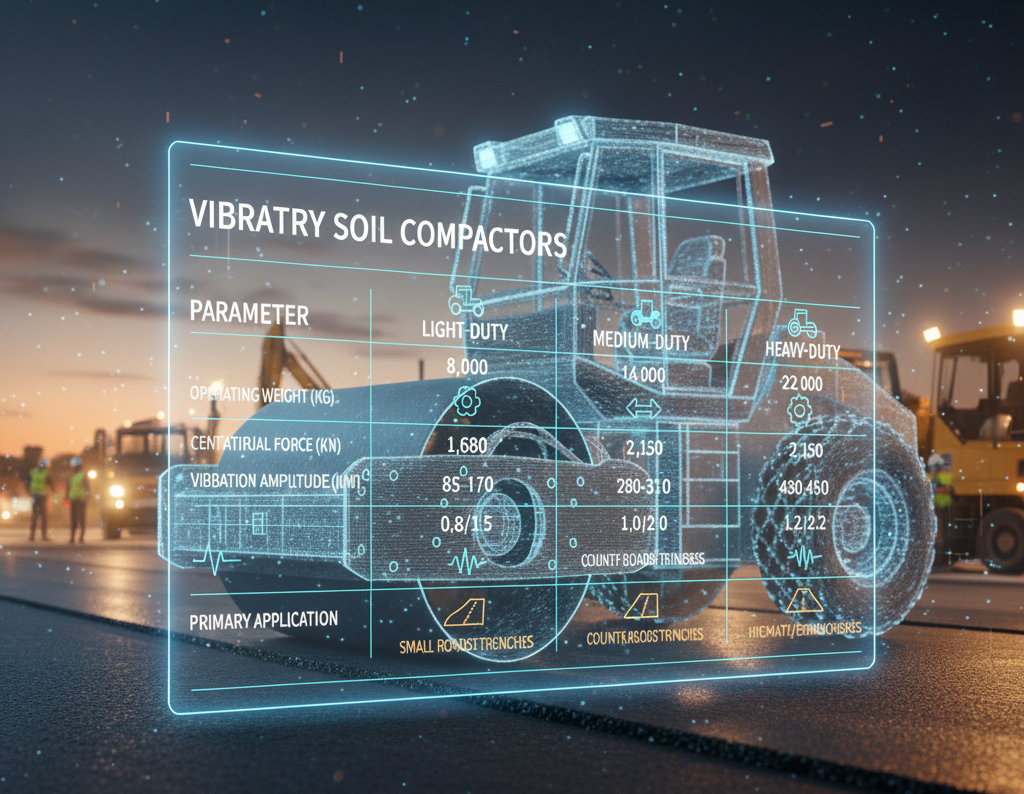
The table below gives examples of some specifications that are representative of various weight categories of single drum vibratory rollers:
| Parameter | Light-Duty (e.g., 8-ton class) | Medium-Duty (e.g., 14-ton class) | Heavy-Duty (e.g., 22-ton class) |
| Operating Weight (kg) | 8,000 | 14,000 | 22,000 |
| Drum Width (mm) | 1,680 | 2,130 | 2,130 |
| Centrifugal Force (kN) | 85 – 170 | 280 – 310 | 420 – 450 |
| Vibration Amplitude (mm) | 0.8 / 1.5 | 1.0 / 2.0 | 1.2 / 2.2 |
| Primary Application | Small-scale roads, utility trenches | County/state roads, sub-base | Highways, large embankments |
- Optimized Engine Power and Efficiency: The power plant alone in modern single drum rollers is very capable of meeting the power demands of the hydraulic and vibratory systems, and at the same time, doing a very good job in reducing fuel consumption, i.e., these engines are often equipped with an Eco-mode for additional fuel savings.
- High Centrifugal Force for Deep Lifts: The very high centrifugal force numbers speak volumes about a machine’s capability to tackle the deep layers of the ground, which in turn, is a great time-utilizing approach in large-scale earthwork projects because it means fewer, thicker loads.
- Enhanced Operator Comfort and Safety: Modern studies greatly focus on eliminating the hardships, discomforts, and also safety hazards of the operator during their work, installing features such as ergonomically designed cabins, superior vibration damping, and 360° visibility, which are, at least, some of the direct results of this, the output is again very important-power and productivity, and also operator less fatigued during their long working hours, thus this is a plus for the whole workforce.
- Simplified Maintenance Access: Among the standards which come with the minimally-intrusive features are large-angle capable-opening rear hoods and easily accessible service points for the engine, hydraulic, and vibratory systems, thus, downtime is short and as a result, the overall cost of ownership is low.
The Compaction Process and Pattern of Single Drum Vibratory Roller
Correct compaction is done in a very well-thought-out pattern which the heavy machine can hardly be seen moving randomly. Specific patterns and techniques are followed by the single drum vibratory roller in order to ensure that the material is uniformly compacted to the specified density in every square inch. The method being employed is particularly relevant at the edges of the compacted area.
- Start and Stop Procedures: When work is interrupted, usually the rolling is brought to a complete halt before the vibratory system is turned on or off so as to avoid a different ‘bump’ or indentation in the material, thus, ensuring a smooth transition between the compacted passes.
- Overlap for Uniformity: Generally, the distance between the adjacent passes or the overlap of the paths covered is from 15 to 30 centimeters (6 to 12 inches). This is a measure that ensures border strips of unpressed material are not left, thus guaranteeing overall uniformity.
- Starting from the Edges: For a road base which is wide, normally, compaction is done first at the sides, and then close to the center, along with it being continuous, systematic, and thereby, a level surface is kept and the displacement of material at the sides is avoided.
- Speed Control: The roller’s speed determines whether the job will be done properly or not; it has to be slow and steady (usually 2.5 km/h to 6 km/h) so as to give the vibrations sufficient time to penetrate the material and to accomplish the desired particle replacement and density increase.
Longevity and Durability of the Constructed Road
One of the main ways the single drum vibratory roller helps in the road building process is through its link to the lifespan and durability of the final product. The road strength is proportional to the strength of its underpinning, and the excellent compaction done by this machine is what makes the bottom layers not only strong but also stable and resistant.
- Preventing Future Settlement: The right compaction that is carried out during the subgrade and sub-base stages significantly lessens the risk of soil settlement over time. Settlement featues uneven surfaces, water pooling, and later, pavement structure failure.
- Improved Load-Bearing Capacity: The denser the material, the more effectively it can distribute heavy loads. Consequently, the road that has been finished will possess a significantly higher bearing capacity, thus being able to endure the stresses of continuous heavy vehicle traffic without getting deformed prematurely.
- Water Infiltration Mitigation: The sub-base that is compacted to the highest degree is less permeable, that is why the infiltration of water will be slowed down. On the other hand, water is the main cause of pavement degradation, and by cutting off its entrance, the roller becomes one of the major contributors to the road’s long-lived service.
- Reduced Lifecycle Costs: Despite the fact that a good quality compaction comes with a hefty price upfront, the long-term advantages of having a solid road foundation such as fewer repairs, less maintenance, and a longer life span lead to great savings over the entire lifespan of the road.
FAQ about Single Drum Vibratory Rollers
What is the main difference between a Single Drum and a Double Drum Vibratory Roller?
Most noticeably, it is the number of compaction drums and their arrangement that are different between a single and a double drum vibratory roller. A Single Drum Vibratory Roller utilizes a steel drum at the front and pneumatic tyres at the rear, thus, it is the best choice for deep soil and aggregate base compaction (earthwork).
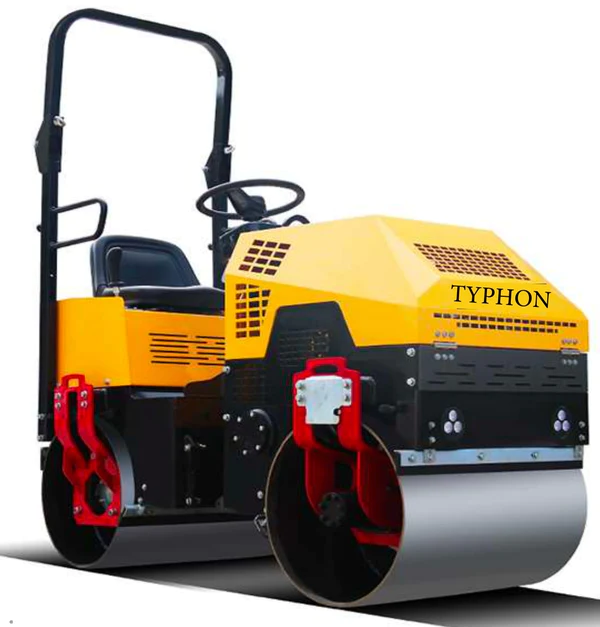
A Double Drum (Tandem) Vibratory Roller contains two steel drums, one at the front and the other at the back, and is a surface finishing tool mainly used for compacting asphalt and thin layers where the smoothness of the surface is of great importance.
When should I use a smooth drum versus a padfoot drum single roller?
A smooth drum will work better for a material that is non-cohesive and granular such as sand, gravel, and crushed stone, where the main goal is to make the surface flat and dense for the next layer.
You should convert a padfoot drum (or ‘sheepsfoot’) for the purpose of penetrating, kneading, and mixing the soil to achieve deep, uniform density as well as moisture distribution in cohesive soils like clay and silt.
What is the meaning of ‘Amplitude’ and ‘Frequency’ on a vibratory roller?
Frequency defines the speed of the vibration (how many times the eccentric weight rotates per second, normally measured in Hertz or VPM) which determines the number of impacts. Amplitude is the vertical distance over which the drum moves during one vibration cycle (the”impact height,” generally measured in millimeters), which determines the depth and force of the impact. Operator adjust both parameters to their best use for different works of materials and layer thickness.
Can a single drum roller be used to compact asphalt?
In a sense, yes, but a normal smooth single drum vibratory roller is definitely not the best or main tool for asphalt compaction. It is meant for the deep compaction of thick soil and base layers. Asphalt Compaction is usually done best by a double drum (tandem) roller or a pneumatic-tired roller, which can deliver high surface smoothness and uniform density on thin asphalt lifts without aggregate crushing or cracking generation.
What is the typical operational speed for a single drum vibratory roller?
The operational speed is quite slow majority of the time so these vibrations can pass through the material properly. The usual working speed is somewhere between 2.5 km/h to 6 km/h (1.5 mph to 3.7 mph). If more speed is used, the number of impacts per unit of length will be lower which, in turn, will affect the quality of compaction negatively.