Vibratory Tampers: Increase Soil Density And Surface Durability
In the constantly shifting field of civil engineering, road building and infrastructure projects, the most important stage of every project is the creation of a solid and rigid base. If the basis is not properly prepared, even the most costly construction materials will give way in a short time under the strain of the environment and traffic loads which can be solved by the best Vibratory Tamper rollers in the industry.
The main reason for compacting the ground is to eliminate tiny air pockets so that the finished surface can support a lot of weight, drain water well and not settle in the future. Big roller compactors are the lords of wide-open expanses and huge highway projects, but sometimes worthless when accuracy and agility in tight locations is needed.
That is precisely when vibratory tampers come to the rescue. Vibratory tampers pack a punch for any road crew. The best of both worlds, hand tool and massive compaction force of a big scale compactor. This complete tutorial from rollercompactor.net will dive into the interesting physics of these machines and see precisely how vibratory tampers enhance soil density and guarantee outstanding surface lifespan for current building projects.
Engineering and Core Mechanics of Vibratory Tamper
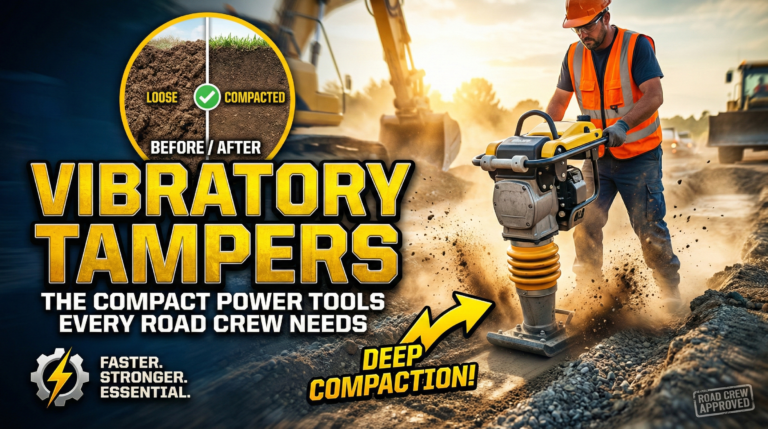
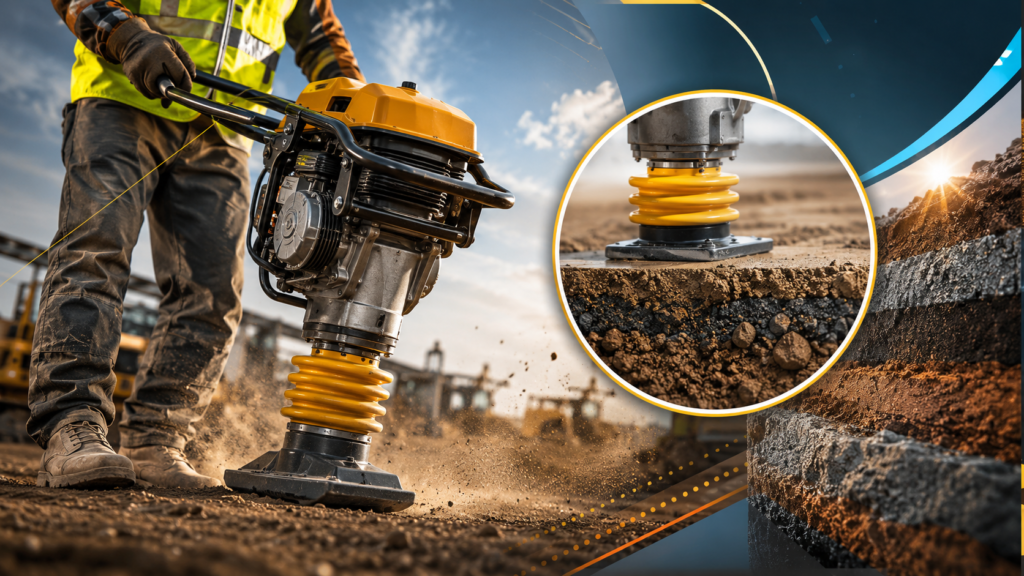
Vibratory tampers function because of an ingenious blend of mechanical engineering and kinetic energy. These are typically driven by a large gasoline or diesel engine and use an internal piston system to convert the rotational energy of the engine into a very quick and powerful up and down action.
This aggressive reciprocating motion is contained behind protected bellows and drives a specialized compaction shoe into the ground with unrelenting regularity. In high-velocity impact, the tamper’s foot rapidly and in succession catches the surface of the ground at an amazing pace, often delivering between 500 and 750 strikes a minute.
This high amplitude focused force is particularly intended to overcome the inherent friction and cohesiveness of resistant soil particles, firmly re-arranging them securely together. Vibratory tampers punch significantly above their weight class because they focus their kinetic energy exclusively downward into a highly concentrated area.
They dig deeply into the substrate, going much beyond the surface depth reached by conventional plate compactors, and make sure every layer of dirt is cemented into place.
- High-Velocity Impact: The machine pounds down 500 to 750 times a minute, hammering the soil to drive the particles into tight alignment.
- Deep Kinetic Penetration: The powerful vertical action sends energy deep into the bottom soil layers, rather than merely vibrating the surface.
- Rotational to Vertical Energy: The new piston technology easily converts engine rotation into strong, earth-shattering vertical strokes.
Importance of Optimal Soil Density to Quality of Construction
The last test of the structural stability of a basis for building is soil density. Backfilling of the excavated soil into a trench or foundation will have a large amount of trapped air and loose spaces.
If these holes are not actively removed, the sheer weight of succeeding development will cause the earth to settle, resulting in catastrophic structural collapses. Heavy duty intervention is required to induce the soil particle size to cling together to the point where there is no more natural compression feasible.
Vibratory tampers are good for this job since their deep-impact power smashes the air gaps out of the material forever. Small gaps and deep holes must be watched over, or otherwise the building site falls prey to the deadly occurrence called “bridging.”
Bridging occurs when the top layer of soil hardens enough, but the below layers remain dangerously loose and uncompacted. As high loads move over the surface the hardened top layer falls into the empty spaces below, creating deadly sinkholes, broken slabs and pavement failure.
- Voids removed: The machine compacts soil particles firmly, eliminating the small air pockets that lead to subsequent settling.
- Bridging Elimination: Heavy vertical strokes provide uniform compaction from bottom up, entirely eliminating the harmful bridging effect.
- Load-Bearing Reinforcement: A high soil density significantly enhances the load-bearing capacity of the earth, making it able to readily sustain heavy structural elements.
Improving Surface Durability Through Deep Compaction Methods
But the real test of any building job is how well the completed surface withstands time and weather. Surface lifetime is closely related to the quality of compaction below. When roads, driveways or building foundations are placed on top of an inadequately compacted sub-base, unavoidable water penetration will cause the earth to expand and contract considerably during freeze-thaw cycles.
Vibratory tampers provide a long lasting surface by fully solidifying the material underneath the surface to a point where moisture cannot readily enter the foundation layers. Vibratory tampers have a powerful impact and provide great results, particularly on cohesive soils such as clays and silts where the particles naturally bind firmly together and need significant amplitude to break down and reform.
The thorough compaction produces a homogeneous density so the base is a solid, impermeable block. This consistency minimizes localized sinking , reduces rutting under vehicle traffic , and eliminates pothole development before it even has an opportunity to begin , lengthening the lifespan of the asphalt or concrete poured above .
- Moisture Resistance: Dense, firmly packed soil prevents water from infiltrating, reducing the destructive effects of frost heaving and underground erosion.
- Pothole and Rut Prevention: A hard, consistently compacted foundation avoids localized sinking and surface deformation under high motor activity.
- Lifecycle Maximization: Deep compaction applied to the max really enhances the structural life of the concrete, asphalt or paving stones that go on top of it.
Essential Trench Applications & Confined Space Mastery
Huge roller compactors are needed for huge highway paving but are totally ineffective when dealing with tight property borders, thin utility ditches or complex home foundations. Vibratory tampers are intended to operate in such physically constrained locations.
The smaller footprint and very narrow shoe shape gives them the unique ability to readily slide into trenches, ditches and foundation dugouts when the working area is restricted to less than 24 inches. The ability to operate in restricted spaces is a major benefit for contemporary civil engineering, enabling contractors to deliver heavy-duty compaction power to the most inaccessible of areas.
Precision compaction is also a trademark of vibratory tampers. These machines are operated by highly qualified operators up to the very margins of foundation walls, fragile utility lines and drainage systems where the huge footprint of a typical plate compactor might cause disastrous unintended damage. Whether compacting backfill along deep cable tunnels or fastening the foundation around a freshly placed fire hydrant, these tampers provide optimum support for subterranean infrastructure.
- Compact Footprint Construction: Built with ultra-low-profile shoes that easily fit in utility ditches smaller than 24 inches wide.
- Surgical Precision: Operators may tamp dirt right up to the borders of delicate pipelines and concrete walls, without damaging their structure.
- Utility Backfill Mastery: Essential for full and total protection of deep backfill around pipelines, drainage systems and underground wires.
Vibratory Tampers Operation – Critical Best Practices
Strict construction guidelines are a necessary for construction workers to fully enjoy the benefits of vibratory tampers without sacrificing operator safety and machine life. The trick is in managing the thickness of the soil layer, or what the industry often refers to as “lifts”. For most vibratory tampers, each lift must be exactly 6 to 12 inches thick.
Operators must avoid the urge to save time by sacrificing layers. Trying to compress a lift that is too deep will result in a weak, under-compacted foundation. Moisture management is also critical. The right moisture in the soil works as an important binding agent. If the dirt is bone dry, the particles won’t knit together. If the soil is too wet, the water acts as a lubricant, physically separating the particles, causing the machine to sink.
Operators should also have a steady posture, with body weight uniformly distributed so the machine does the hard work. The hopping action of the tamper needs a lot of physical effort to direct effectively.
- Lift Management: Must be compacted in thin, controlled lifts of 6 to 12 inches to provide maximal kinetic penetration.
- Proper Moisture Control: Operators need to strike a careful balance of moisture in the soil so it’s wet enough to bind, but dry enough to avoid spreading.
- Ergonomics: A balanced posture, shoulder-width apart, is needed and the machine should be guided gently, absorbing its prominent vertical leaping action.
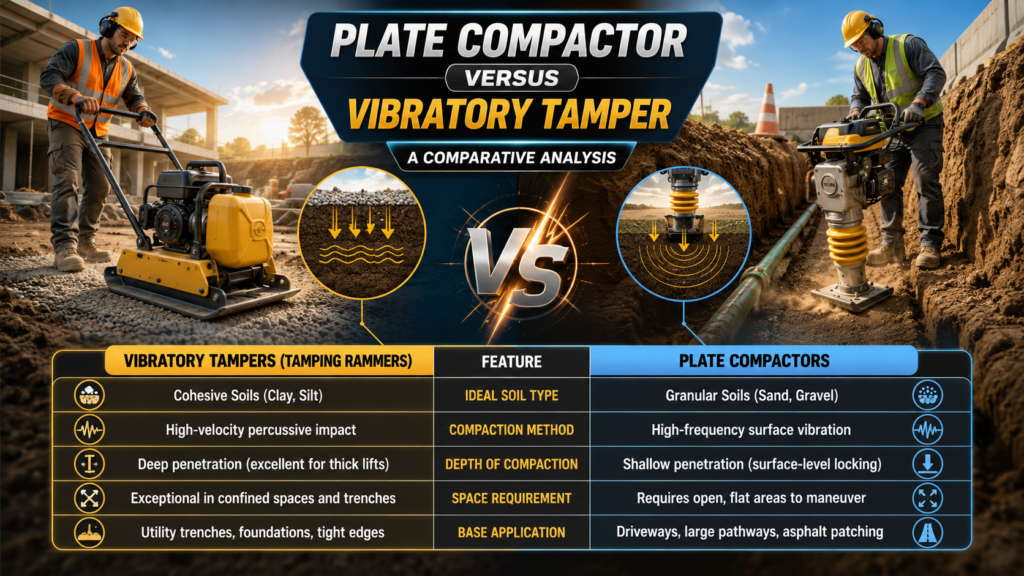
Plate Compactor versus Vibratory Tamper: A Comparative Analysis
To understand where vibratory tampers fit into your equipment fleet, it’s essential to compare them to standard plate compactors across a range of project needs.
| Feature | Vibratory Tampers (Tamping Rammers) | Plate Compactors |
| Ideal Soil Type | Cohesive Soils (Clay, Silt) | Granular Soils (Sand, Gravel) |
| Compaction Method | High-velocity percussive impact | High-frequency surface vibration |
| Depth of Compaction | Deep penetration (excellent for thick lifts) | Shallow penetration (surface-level locking) |
| Space Requirement | Exceptional in confined spaces and trenches | Requires open, flat areas to maneuver |
| Base Application | Utility trenches, foundations, tight edges | Driveways, large pathways, asphalt patching |
FAQs on Vibratory Tampers
What is the difference between a plate compactor and a vibratory tamper?
The only variation is the technique of compaction and the kind of soil best suited. Vibratory tampers punch deep into cohesive soils such as clay and silt with a strong vertical percussive impact. Plate compactors employ quick, shallow vibrations to settle granular materials such as sand and gravel across larger, flat open areas.
Should you use a vibratory tamper on asphalt?
No vibratory tampers are not normally suggested for asphalt. Their concentrated vertical impact may quickly destroy, damage or mar a fragile asphalt surface. The appropriate and safest finishing tool for asphalt is either a vibratory plate compactor or a smooth drum roller compactor.
What is the depth of dirt compacted by vibratory tamper?
Vibratory tampers generate a lot of deep compaction due to their focused kinetic force. Depending on the soil type and moisture content, a tamper may efficiently compress lifts 6 to 12 inches deep in one pass, which is substantially deeper than typical plate compactors.
What sort of soil is appropriate for a vibratory tamper?
For cohesive soils the best instrument is a vibratory tamper. Cohesive soils have a high proportion of clay and silt. The shearing force has to be of a high amplitude to break up the clumps and press the sticky aggregates together. Tampers provide the precise heavy localized impact required for these difficult materials.
Why does the vibratory tamper engine operate yet the machine would not jump?
If the engine is running correctly, but the tamper is not leaping, the problem is generally often in the clutch or in the internal mechanical transmission. The centrifugal clutch may be worn out, the springs may be damaged, or the reciprocating piston mechanism within the protective bellows is not sufficiently lubricated and has seized.
Is a vibratory tamper more difficult to use than a plate compactor?
Yes, a vibratory tamper usually requires greater physical effort by the operator. The machine is being “jumped” up and down forcibly so the operator has to absorb most of the vibration and actively steer the heavy equipment to keep it balanced. A plate compactor glides ahead smoothly on its own virtually.
What are the major uses of the vibratory tamper in road construction?
The vibratory tamper is extensively used in road construction for compacting granular and cohesive backfill in narrow utility trenches, for preparing tight edges of road shoulders, for securing earth around newly installed drainage pipes and for deep foundational stability in confined areas where large roller compactors cannot reach.