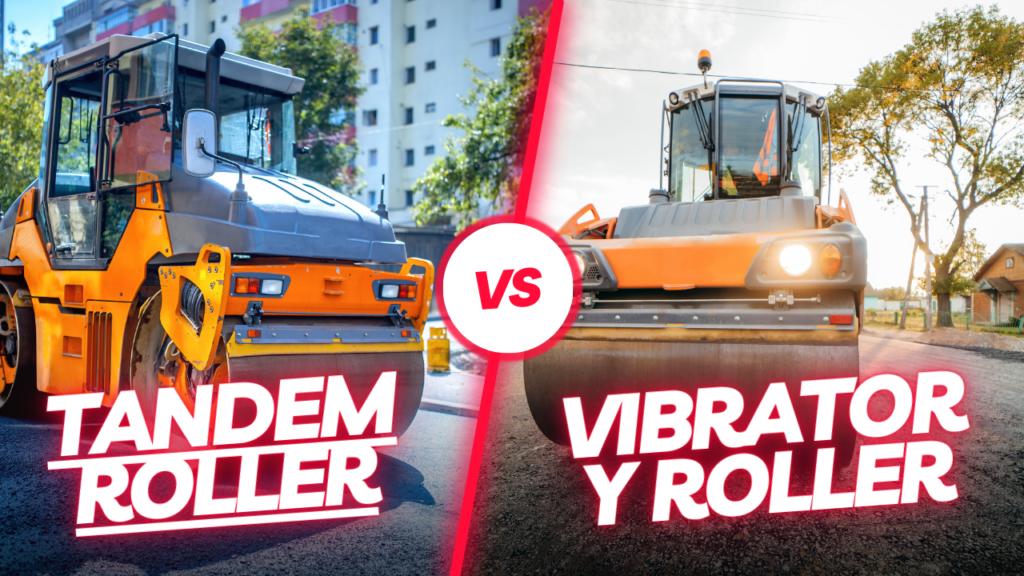
Tandem Vibratory Rollers enhance asphalt density like never before! Discover techniques!
Creating a tough, durable pavement surface demands thorough engineering, top-tier materials, and the proper compaction method. In today’s road construction industry, reaching the desired density of the material is a major element in resisting the infrastructure against the heavy traffic exertions and severe weather changes. Tandem vibratory rollers are considered as the best tool for modern asphalt densification because they use a dual-drum system to ensure that energy is consistently and directly transmitted to the newly laid asphalt.
If a material layer has a high number of air pockets, water infiltration will cause tremendous structural breakdown leading to the early appearance of cracks and ruts that can result in very expensive road damages. Working with high-performance roadwork machines from rollercompactor.net is the best way for workers to get deep knowledge and technical solutions that are necessary for the accomplishment of perfect paving works.
Importance of Tandem Vibratory Rollers
With skilled manipulation of the basic vibration mechanics, the amplitude, and the machine mass, the operator is capable of delivering higher asphalt density through tandem vibratory rollers in a reduced number of machine passes while still obtaining a sleek and robust surface structure.
Knowing the underlying physics of vibratory compaction is essential for the operators and construction site managers to extract maximum performance from their equipment. Merely piling up a fairly heavy static weight will hardly be sufficient to align the particles of aggregates layer properly in thick or stiff asphalt mixtures.
Vibrating dynamic forces act by momentarily lowering the resistance (frictional forces) between the aggregate pieces, thus making it possible for them to move about and form a denser, more compacted matrix when locked.
Proper frequency use guarantees that the material moves well before it becomes cold and thus the strength of the structure gets locked in perpetually. The degree to which one can achieve high asphalt density with tandem vibratory rollers is significantly dependent on the degree to which the forward speed of the roller and the structural vibration settings are harmonized.
The Dual-Drum Operation of Tandem Vibratory Rollers
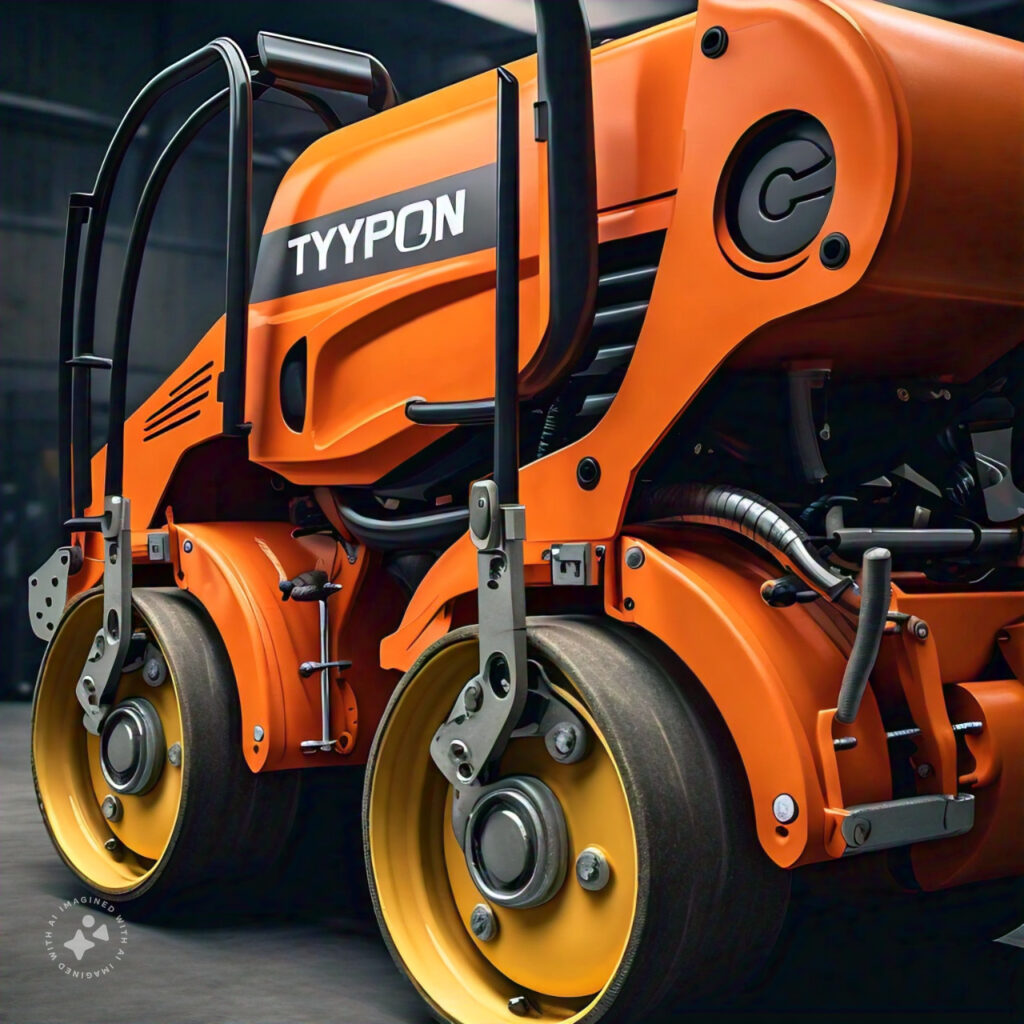
The layout design of a tandem roller offers a great mechanical setup allowing rapid material densification. Having both front and rear steel drums working together means that the machine repeats the compaction force application twice in a single forward movement. Such a layout offsets uneven surfaces and does away with those uneven weight exposures that are typically caused by single-drum soil compactors.
- Dual Drum Surface Contact: Both the front and rear steel drums are in continuous contact with the hot mix, thus ensuring that the energy delivered is uniformly distributed across the lane width.
- Equally Balanced Weight Distribution: The location of the engine and other internal mechanical components are designed so that they are balanced, this way no drum will be digging too much or making any unintended marks on the soft surface.
- Use of Vibration System on Both Drums: Operators have the option of using the vibration systems on both drums at the same time or to switch one of the drums to static mode going by the thickness of the material layer.
Internal vibratory systems have been adjusted by the manufacturers in such a way that they can be tuned to the structural requirement of different asphalt mix design. Thin materials require the use of high frequency combined with low amplitude so as to be able to move quickly without crushing the aggregates.
The other extreme is low frequency combined with high amplitude best suited to thick lifts of stiff material, where very deep penetrating energy is required to force out the deeply embedded air pockets. The right mix of these parameters can help the machine operators achieve their density targets without compromising on the material structural strength.
Major Elements for Getting High Asphalt Density
Getting to the exact desired density percentage requires a comprehensive understanding of the different elements, such as environmental conditions, material characteristics to machinery operation.
The biggest human factor in temperature monitoring control during the initial breakdown rolling phase. Once the asphalt cools down too much, it will be too stiff for the binder to move, and superior compacting of asphalt with the use of tandem vibratory rollers will be next to impossible.
Operators must be always right behind the asphalt paver because without that they are going to wedge the hot material into the hardened surface, thus making the dense material compact very difficult.
- Pavement Temperature Tracking: Using continuous temperature measurements from infrared sensors allows practitioners to keep the compaction process within the ideal temperature range in real time.
- Proper Rolling Patterns: Clearly defining paths with cross-matched overlapping sections prevents the occurrence of transient uncompacted areas along the joints and centerlines.
- Work at Steady Speed of Roller: Always keep a forward speed of the roller simple and regular so as to completely avoid creating small bumps where the hot asphalt might be pushed or shoved forward by the drums.
Maintaining control of the technical operational passes is a good way of avoiding under-compaction as well as over-compaction at the site of the project. Under-compaction generally means leaving interconnected air voids that are the main cause of water infiltration, which will ultimately lead to structural failure and extensive cracking when subjected to heavy traffic.
Over-compaction, on the other hand, is able to fragment the stones resulting in a lowering of the internal stability of the asphalt and causing the surface to flush. Changing to the use of intelligent compaction control systems has brought operators one step further in their ability to keep track pass counts and even look at temperature readouts live, which is through no doubt a way of ensuring quality surface every time.
Final considerations when selecting roller Model and Size
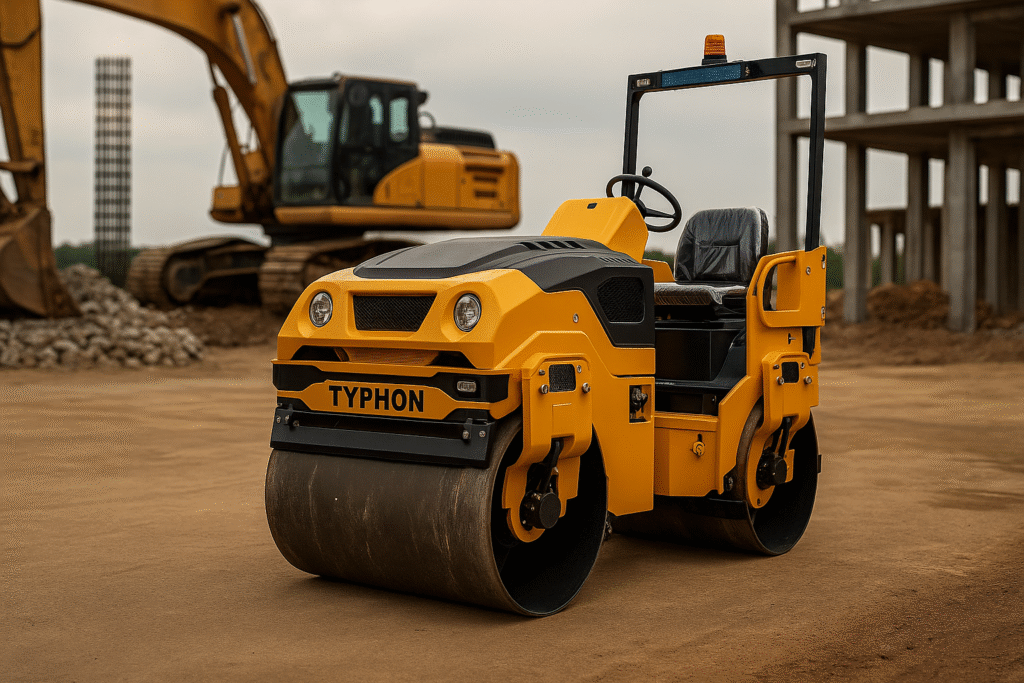
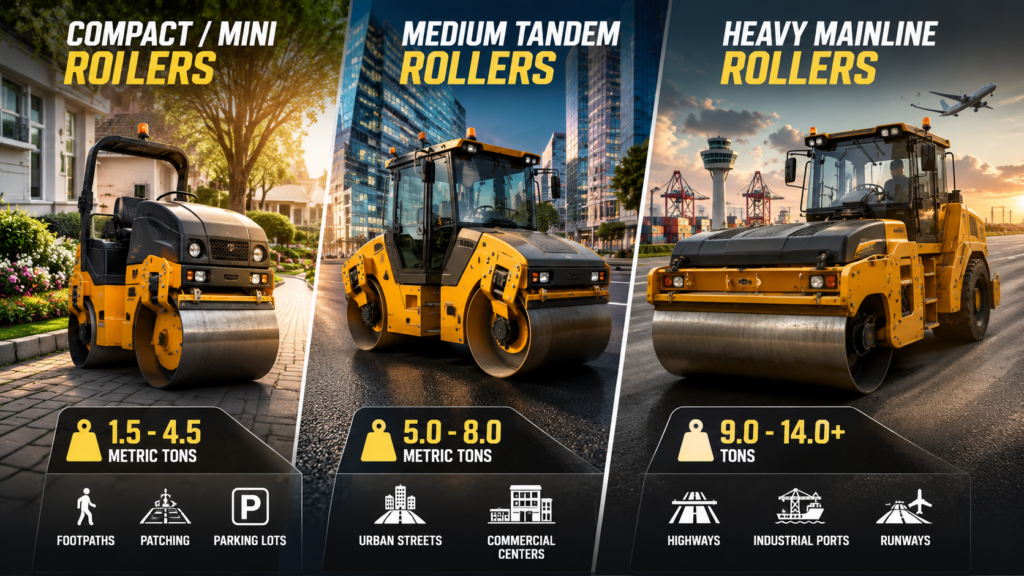
Efficient on-site work can be brought about by taking just that one step of choosing correctly from the varied collection of heavy machines to be found on rollercompactor.net. Mini roller units with narrow drum widths are most suitable for paths, driveways, and patch repairs where space is limited.
Large, high-capacity tandem vibratory rollers constitute the standard selection for monumental highway projects, airport runways, and large industrial commercial parking areas. Keeping the structural width and operating weight of the machine matched with that of the asphalt paver’s hourly output will ensure uninterrupted production without any delays in the workflow.
- Operating Weight Capability: Heavy machines with capabilities from 7 to 14 metric tons deliver sufficient and thorough compaction force required for dense mainline highway construction.
- Proper Width of Drum Matching: The use of wider drum equipment significantly shortens the duration of long passes required for a single traffic lane, which also means fuel and labor saving.
- Water Spray Enhancements: Tanks with increased capacity in water combined with well-functioning spray bars keep steel drums wet, thus stopping hot asphalt from getting sticky and bonding with the metal.
Temperature-dependent phase changes in viscosity play a critical role in break-down rolling compaction stages. Presently, most compaction units use vibratory and static applications in a temperate range of approximately:
Table: Tandem Vibratory Rollers – Roller Type Selection Reference
| Machine Classification | Operating Weight | Primary Target Applications |
| Compact / Mini Rollers | 1.5 – 4.5 Metric Tons | Footpaths, Patching, Parking Lots |
| Medium Tandem Rollers | 5.0 – 8.0 Metric Tons | Urban Streets, Commercial Centers |
| Heavy Mainline Rollers | 9.0 – 14.0+ Tons | Highways, Industrial Ports, Runways |
If over-compaction is pushed too far, it results in aggregate degradation and a subsequent lowering of the asphalt’s stability and this state is associated with surface flushing. Overdoing compaction will not produce more density but creates a weaker wearing course which is contrary to the very purpose for compaction.
Advanced Intelligent Compaction and Paving Equipment
Control and tracking are rapidly evolving in the road paving sector together with the integration of digitally smart on-board assistance programs. The use of Intelligent Compaction (IC) systems combines GPS tracking with accelerometers mounted inside the drum to measure material stiffness continuously in real time.
Providing operators instant feedback by displaying visually the exact points where pavement has reached the level of density and those areas that would require another round is the aim of this technical setup. Implementing these new technological systems again can help teams to:
- Inventory the Stiffness: On-board devices are capable of sensing the elasticity of the material to evaluate compaction levels, hence eliminating unnecessary extra passes over solid locations.
- GPS Pass Map Display: In-cab screen that shows a color-coded map which achieves precise pass counts, thus preventing the occurrence of under-compacted spots and guaranteeing uniform coverage throughout the whole project layout.
- Cloud Data Syncing: Managers are able to monitor quality remotely ensuring that all parts meet the specified building codes without physically being present.
Such smart automated tools significantly reduce operator fatigue and at the same time promote job consistency, even across different shifts. Unlike manual calculations, the operator can utilize the clear digital visual guide provided on the interactive screen. This high technical precision level results in reducing surface faults and helps construction companies earn quality bonuses.
Taking Action and Preventing Failures
One has to diligently implement preventative maintenance practices if they want to have their equipment performing uninterruptedly and achieving superior asphalt density with tandem vibratory rollers at all times.
The continuous vibrations essential to the densification of materials are indeed very demanding on the structural parts, bolts, and hydraulic lines in the long run. Along with frequent checking of vibratory pod assemblies and then the replacing of dampening scrapers, leads to the prevention of sudden occurrences of machine failures.
- Daily Spray Bar Cleaning: Ensuring that nozzle holes remain open prevents the mix from sticking to the drum and maintains the excellent finish.
- Vibratory Isolation Testing: Checking the condition of the vibration rubber mounts guarantees that the energy produced mechanically is efficiently focused on the ground and not transmitted to the frame of the machine.
- Hydraulic Oil Level and Condition Checks: Monitoring and maintenance keep the oil in good condition and at the proper level which ensures the drums operate at the required frequency continuously throughout long working hours.
A thorough maintenance program as exemplified on rollercompactor.net has the double-benefit effect of not only improving the performance and profitability of your field operations but also maintaining the high resale value of your machinery. The good condition of the machine ensures that all compactions carried out are uniform and there is an increase in efficiency and profitability in your operations.
FAQs – Achieving Superior Asphalt Density with Tandem Vibratory Rollers
What does a tandem vibratory roller do?
They are compaction machines that compact hot mix asphalt, granular bases, and sub-base layer materials using static load and vibratory forces. The two drums of a tandem roller work together to effectively reduce the number and size of air voids and hence helping teams achieve high asphalt density with tandem vibratory rollers for highways, runways, and parking areas.
How does vibration frequency change the density of asphalt compaction?
Higher vibration frequencies comprise production of impacts that are close spaced in time and space which enables rapid particle rearrangement to no-break dense packing of aggregates. In order to reach target densities while simultaneously keeping aggregates intact choosing the correct frequency depending on layer thickness is a must.
What makes achieving appropriate asphalt density highly critical in roadwork?
Once the pavement is well compacted it will have the structural capacity to support heavy traffic loads and the presence of air voids through which water can infiltrate would be minimized. Having the highest density possible right from the start of construction will be the main reason behind the extended life of the road and lesser episodes of deterioration such as cracking, rutting, and potholes.
What is the ideal temperature range for compacting hot mix asphalt?
Compaction should be done during the breakdown phase before the temperature falls below 260°F ideally when the aggregate binder bitumen is sufficiently fluid to entail movement of aggregates. The bitumen starts to harden below this threshold and hence no significant densification will be achieved using tandem vibratory rollers.
What benefits do Intelligent Compaction (IC) systems bring to paving?
IC systems are GPS-enabled and use drum-mounted sensors to gauge the stiffness of the material and count the number of roller passes in real time. The system provides the operator with an on-screen map showing exactly where the pavement is not sufficiently compacted and also where it has been compacted excessively, ensuring uniform density across the entire surface.
Are tandem vibratory rollers meant only for asphalt?
Not really, tandem vibratory rollers with smooth steel drums work best with hot mix asphalt but they can be effectively used on granular soils, gravel bases, and layers of crushed stones. They offer a great combination of surface leveling and deep compaction of the material prior to the application of the final wearing course.
What steps can you take to prevent hot asphalt from sticking to roller drums?
This is usually done by the rollers through the use of advanced onboard water distribution systems by which a very thin and uniform layer of water is continuously sprayed over the drums. Proper lubrication and keeping the steel drums WET will always prevent bitumen from sticking to the metal, thus providing a smooth, flaw-free surface all the time.