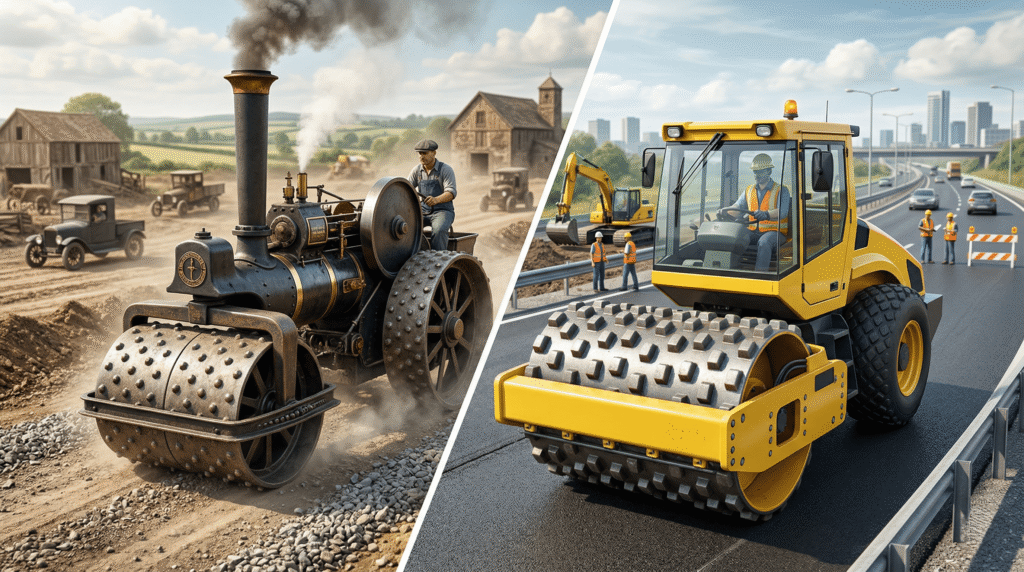
From Vintage to Modern: The Journey of Steam Rollers with Bumpy Drums
Steam Rollers with Bumpy Drums are one of the many engineering marvels that have built the foundation of construction. The construction of many of the world’s greatest engineering wonders and the manual hard work that preceded them.
Steam Rollers with Bumpy Drums are the original construction machinery to innovate the preparation of ground surfaces. Ground surface preparation has evolved from horse-drawn machines to the complex vibratory padfoot compactors that are commonplace in modern highway construction projects.
The Beginning of Compaction: Steam Rollers with Bumpy Drums
The Steam Rollers with Bumpy Drums origin story starts in the late 1800s where the first self-propelled models of the Steam Rollers with Bumpy Drums were introduced. The first models replaced horse-drawn machines that dragged road construction machinery.
Aveling & Porter was one of the first road construction machinery manufacturers. These machines were about more than just the weight of the machine. These machines were engineered to work the soil with more precision.
- Ingenious Engineering: The 19th century engineers knew that the static weight of the machine alone would not be enough to achieve desirable results with deep soil compaction.
- Influence of Aveling & Porter: Aveling & Porter was the first to pivot from traction engines to steam rollers which succeeded commercially in the UK, and were eventually exported to many countries.
- Steam’s Dominance: These contraptions would use steam’s massive pressure to rotate large iron wheels, which at the time still had early forms of ”lumps” to aid breaking ground with rocks.
The Shepsfoot Invention: Nature Inspired
The time-frame of approximately 1900 marks a key point in the development of Steam Rollers with Bumpy Drums. John Fitzgerald, while in California, came to a realization when he watched a flock of sheep.
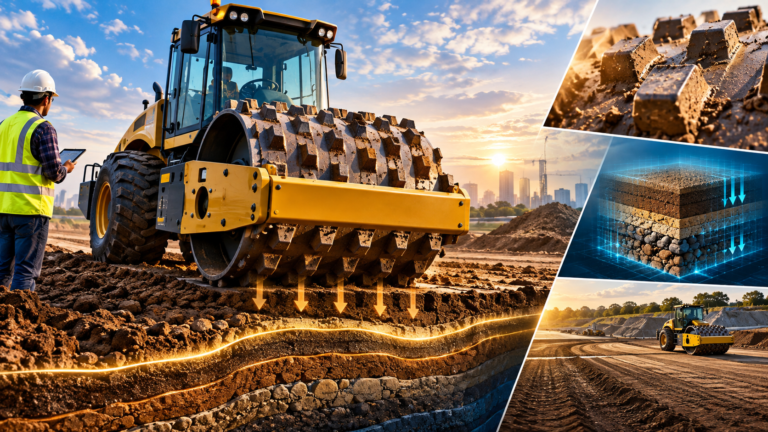
After the sheep had crossed a dirt road, the clay by the road had become much more compact than when a smooth roller had previously crossed. Hence, a new type of roller was designed: the Sheepsfoot Roller, which consists of large, steel drum wheels with a series of bumps and rectangular lugs.
- Kneading Action: In contrast to the smooth drums which apply even pressure from the top, the roller’s ”feet” compact the soil by pushing upwards.
- Benefit of Aeration: The bump formation of the roller’s surface allows the top layer to fluff, which in turn aids the aeration and drying of the top layers of clay or silt that was too wet.
- Compacting the Deep Layers: The design of the bumps also guarantees that when the soil ‘lift’ is broken, the lower layers are compacted to a density that will resist any future shifting.
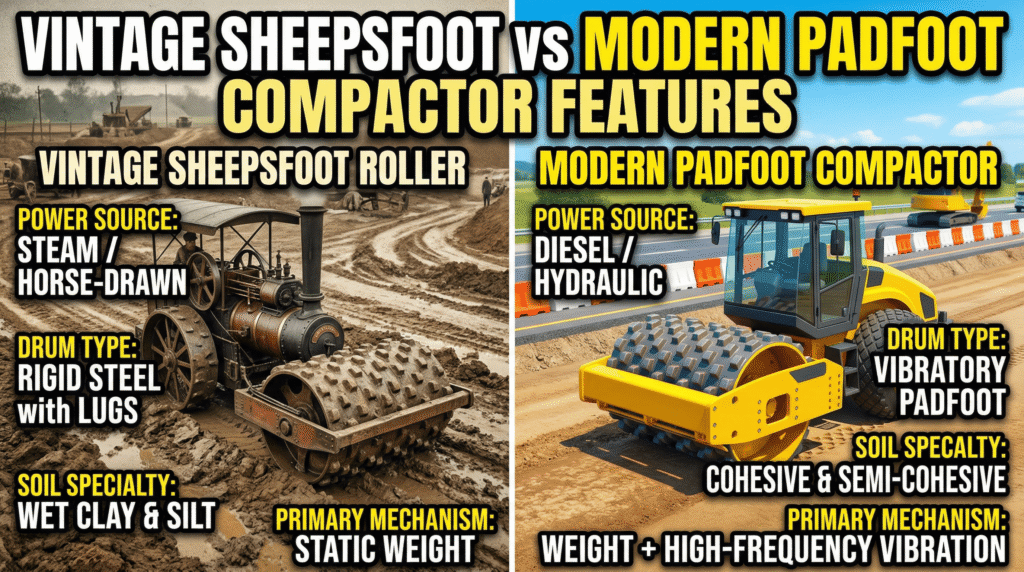
Table: Vintage Sheepsfoot Roller Vs Modern Padfoot Compactor Features
| Feature | Vintage Sheepsfoot Roller | Modern Padfoot Compactor |
| Power Source | Steam / Horse-drawn | Diesel / Hydraulic |
| Drum Type | Rigid Steel with Lugs | Vibratory Padfoot |
| Soil Specialty | Wet Clay & Silt | Cohesive & Semi-cohesive |
| Primary Mechanism | Static Weight | Weight + High-Frequency Vibration |
The Transition to Padfoot: Engineering Modern Efficiency
With the decline of steam power, the Sheepsfoot Roller design underwent transformation. Sheepsfoot Roller is the direct descendant of the vintage Sheepsfoot roller, incorporating the latest in hydraulic technology and vibration systems which enhance the compaction effect. The “bumps” are now designed to be a specified size and shape to maximize surface area coverage and penetration.
- Vibration: Modern machines are designed with a high frequency vibration that allow the bumps to penetrate deeper in the soil.
- Self-Propelled: Modern Padfoot Rollers are self-propelled and designed for maneuverability eliminating the need to tow one behind a tractor.
- Versatility: Modern Rollers are designed with interchangeable shells. A padfoot roller can be quickly changed out for a smooth roller to a different job.
Why the “Bumps” Matter: The Science of Soil Density
The “bumps” on the steam roller with bumpy drums are not just for aesthetics. In the construction industry, these features are of great importance when working with “cohesive” soil types, especially clay.
A roller with a smooth surface may slide over the top of slippery clay, resulting in the construction of insufficient support for buildings and roads. A roller with bumpy drums digs into the clay and compacts the soil to form a stable base for roads and buildings.
- Surface Area Concentration: The bumps focus the total weight of the machine over very small areas, resulting in extreme pressure.
- Moisture Management: The ‘kneading’ action expels air and water, which is vital to avoid the premature breakdown of the road.
- Increased Stability: The use of bumpy drums ensures a uniform foundation and lessens the possibility of water ingress and cracking of the structure.
Comparing Vintage Giants and Modern Marvels
The difference between a 1920s Buffalo Springfield and a 2025 vibratory compactor is extreme. When considering Steam Rollers with Bumpy Drums, the fundamentals may still apply.
The vintage units relied primarily on mass and ‘lumps’ strategically positioned. Modern units still utilize electronics and vibration, but the ‘bumpy drum’ is still the preferred option for serious earthworks.
- Durability: Vintage steam rollers are still in operation decades after being constructed, with many vintage rollers being used for heritage demonstrations.
- Efficiency: A vintage roller may take ten passes to complete a particular density, while a modern compactor can achieve the same density in two passes.
- Operator Comfort: Vintage operators had to endure the steam engine’s heat and soot, while modern cabs are climate-controlled with GPS and precision controls.
A Look at the Cultural Importance of Bumpy Drum Steam Rollers
Beyond their basic function, Bumpy Drum Steam Rollers have also become symbolic of an industrial revolution. They are a classic feature in museums and movies, representing the era of steam-powered technology that gave us the modern day infrastructure.
From Fred Dibnah’s restored “Betsy” to the roller machines that built the first transcontinental highways, steam rollers are a testament to human brilliance.
- Heritage Preservation: World-wide hobbyists restore and operate these rollers to showcase the origins of civil engineering in practice.
- Learning Opportunity: Steam rollers are an excellent, hands-on example of how the most basic scientific concepts of weight and pressure are used in construction to manipulate the earth.
- Innovative Design: The original “bulldog” or “lumpy” drum design has been and will continue to be the design inspiration for heavy construction equipment in many different industries.
A Look at the Possible Future of Steam Rollers
The Steam Rollers with Bumpy Drum have a long and promising evolution. The construction industry is looking at forward-thinking technology like fully autonomous operations and electric-powered compactors.
Regardless of the technology used—be it steam, diesel, or electric—there is a drum design requirement of a kneading and penetrating function. The bumpy drum design will be a construction site classic for many, many years.
- Autonomous Rollers: “Smart” rollers with the ability to map and measure soil density in real-time are currently being tested to revolutionize construction.
- Patented EcoPower: Construction is going “green” without sacrificing powerful construction tools thanks to electric rollers. Major infrastructure projects are experiencing a significant reduction in carbon footprint.
- Innovative Materials: New styles of bumps are made of latest alloys which are more resistant to wear. This results in longer machine life in abrasive soils.
Final Update – From Vintage to Modern: The Journey of Steam Rollers with Bumpy Drums
In conclusion, the evolution of steam rollers from their vintage origins to their modern designs shows how technology has changed over time and how engineering innovation has lasted.
The switch from bumpy drums to smoother, more efficient models shows that the industry is dedicated to improving infrastructure while keeping the charm of old machines. As we move forward with modernization, we need to remember the long history that has shaped the way we do things now.
The steam roller is a symbol of this journey that connects the past and the present. Let’s keep appreciating and learning from this amazing change in how buildings are made.
FAQs for Bumpy Drum Steam Rollers
Why do some steam rollers have bumps on their wheels?
They are purpose-built to compact clay and other cohesive soils. They help release the trapped moisture and knead the soil upwards.
What is the difference between a sheepsfoot roller and a padfoot roller?
A sheepsfoot roller is unidirectional. A padfoot roller has larger pads that are usually laid out in a more powerful, vibratory configuration.
Are vintage steam rollers still used in construction?
Yes and no. They have been replaced by diesel vibratory rollers., but vintage steam rollers are still used for educational purposes, heritage restoration, and occasionally on small scale projects.
What is the weight of a modern padfoot roller?
Modern compactors have a wide range of weight. Padfoot rollers, however, typically range between 7 to 20 tons and have the ability to add ballast to increase weight as well as pressure.
What soil type is most suitable for rollers that have bumpy drums?
These rollers are best suited for cohesive soils like clay, as well as silty soil, where a smooth roller would be ineffective.
Who is the sheepsfoot roller inventor?
The sheepsfoot roller inventor is John Fitzgerald, who patented it in 1906, after observing the compacting effect a herd of sheep.
What are the “lumps” on a steam roller drum called?
They are called, amongst others, “feet,” “lugs,” “pads,” or, historically, “bulldogs.”